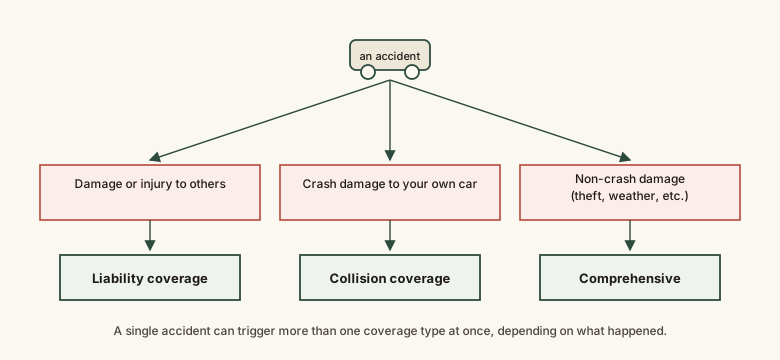
A typical auto insurance policy bundles several distinct coverage types: liability coverage (which pays for damage or injury the policyholder causes to others), collision coverage (which pays for damage to the policyholder's own vehicle from a crash), and comprehensive coverage (which pays for non-crash damage like theft or weather) — each with its own limits, and collision/comprehensive typically carrying their own separate deductible.
Reading time
— 4 min
Updated
— Aug 22, 2026
Fact-reviewed
— Aug 22, 2026
This entry explains the general mechanics behind auto insurance coverage types — it is financial literacy, not personalized insurance advice. Choosing specific coverage types, limits, and amounts belongs with a licensed insurance agent or broker who can assess your state's requirements and your situation.
Key Takeaways
Key Takeaways
1A typical auto policy bundles several distinct coverage types, each responding to a different kind of loss rather than one blanket "car insurance" payout.
2Liability coverage pays for damage or injury the policyholder causes to others; collision and comprehensive coverage pay for damage to the policyholder's own vehicle.
3Collision and comprehensive coverage typically carry their own separate deductible, chosen by the policyholder, that applies before the insurer pays a claim on the policyholder's own vehicle.
The concept
An auto policy is really several coverages bundled together. Liability coverage pays for the other person's car and medical bills if the policyholder causes an accident. Collision coverage pays to fix the policyholder's own car after a crash, no matter who caused it. Comprehensive coverage pays for things that happen to the car outside of a crash, like theft, a cracked windshield from a rock, or storm damage.
Walking through a few different accident scenarios shows exactly which coverage responds in each case.
Quick check
A policyholder is at fault in an accident that damages another driver's car and their own car. Which coverage(s) would typically respond?
Worked examples
Example 1: A single-car crash into a guardrail (baseline)
A policyholder loses control and hits a guardrail, causing $6,000 in damage to their own car and no damage to anyone else's property. With a $500 collision deductible, the policyholder pays the first $500 and collision coverage (if carried) pays the remaining $5,500. Liability coverage doesn't apply here since no other party's property or person was involved.
Example 2: A tree branch falls on a parked car (edge case / variation)
The same policyholder's car is later damaged by a falling tree branch during a storm while parked — no collision or crash occurred. This is a comprehensive claim, not a collision claim, since it resulted from a non-crash event. With a separate $250 comprehensive deductible, the policyholder pays $250 and comprehensive coverage (if carried) pays the rest, up to the vehicle's insured value.
Quick check
Why might a policyholder's collision deductible and comprehensive deductible be two different dollar amounts on the same policy?
Example 3: Choosing coverage limits and deductibles for an older car (real-world / applied)
Consider a policyholder driving a 15-year-old car worth roughly $3,000. Since collision and comprehensive payouts are generally capped at the vehicle's actual cash value, paying substantial premiums for collision and comprehensive on a $3,000 car may mean the annual premium cost approaches or exceeds what the coverage could ever pay out. This is a common point where drivers reconsider carrying full coverage on an older, lower-value vehicle versus carrying liability-only coverage — a decision that depends on the specific vehicle's value, the driver's savings cushion, and state requirements, which is exactly the kind of trade-off a licensed insurance agent can help evaluate.
How it works (visual)
Which auto coverage responds to which kind of loss
Each branch shows a different trigger event leading to a different coverage type — the same accident can activate more than one branch at once, depending on exactly what happened.
Common mistakes
Common Mistakes
✕
Assuming liability coverage pays to repair the policyholder's own car.
→ Remember liability only covers damage or injury caused to others — repairing your own car after a crash requires collision coverage.
✕
Filing a weather or theft claim under collision coverage.
→ Recognize that non-crash events like theft, vandalism, or storm damage fall under comprehensive coverage, which may carry a different deductible than collision.
✕
Choosing a very low deductible without considering the higher premium it usually carries.
→ Compare the premium difference between deductible options against how much cash you could comfortably pay out of pocket if a claim happened.
Common misconception
“If you're not at fault in an accident, your own insurance won't be involved at all.”
Even when another driver is at fault, the not-at-fault driver's own collision coverage can still pay for their vehicle's damage up front (subject to their own deductible), with their insurer then potentially seeking reimbursement from the at-fault driver's insurer. This can get the not-at-fault driver's car repaired faster than waiting on the other driver's insurer to investigate and pay out.
What to do next
What to do next
Review your policy's declarations page to see exactly which coverage types you carry and their individual limits and deductibles.
Check your state's minimum liability requirements, since these vary and carrying only the state minimum may leave a significant gap for larger accidents.
Consider your vehicle's actual value when deciding whether collision and comprehensive coverage still make financial sense on an older car.
Bring specific coverage-type, limit, and deductible decisions to a licensed insurance agent or broker.
FAQ
FAQ
Related terms
Related terms
Liability coverage
Auto insurance coverage that pays for injury or property damage the policyholder causes to other people when at fault in an accident, not for damage to the policyholder's own vehicle.
Collision coverage
Auto insurance coverage that pays for damage to the policyholder's own vehicle resulting from a crash, regardless of who was at fault.
Comprehensive coverage
Auto insurance coverage that pays for damage to the policyholder's own vehicle from non-crash events, such as theft, vandalism, fire, or weather.
Deductible
The amount a policyholder pays out of pocket toward a covered claim before insurance pays the remainder, applied separately to collision and comprehensive coverage on most auto policies.
This entry was researched from public sources and drafted with AI-assisted tools, then edited — errors are still possible. Spot one, or want a topic covered? Read our disclaimer.
 KnowThis