Insurance exists because pooling risk across a large group turns an unpredictable individual event into a predictable group statistic — insurers collect small, regular premiums from many policyholders and use that pool to pay the full cost of the few claims that actually occur, a mechanism formalized through actuarial science and the law of large numbers.
Reading time
— 5 min
Updated
— Aug 22, 2026
Fact-reviewed
— Aug 22, 2026
This entry explains the general mechanics behind how insurance works — it is financial literacy, not personalized insurance advice. Choosing coverage and coverage amounts belongs with a licensed insurance agent or broker who can assess your specific situation.
Key Takeaways
Key Takeaways
1Insurance exists because a large group's total losses in a given period are far more predictable than any single person's individual loss — that predictability is what makes selling coverage a viable business.
2Pooled risk works by collecting small, regular premiums from many policyholders and using that shared pool to pay the full cost of the relatively few claims that actually happen.
3The law of large numbers is the statistical principle underneath this — as the pool of policyholders grows, the group's average loss converges toward a predictable number, even though no individual's own loss is predictable.
The concept
No single person can predict whether their house will burn down next year. But an insurer covering a million houses can predict, with real accuracy, roughly how many of those million houses will have a fire claim — because across a large enough group, rare individual events settle into a predictable group average. Pooled risk is the practice of collecting a small, affordable premium from everyone in that pool and using the combined total to pay the full cost for the few who actually have a loss.
Seeing exactly how the math behind pooling works — not just the general idea — is what makes clear why insurance can offer real financial protection at a price far below the potential loss it covers.
Quick check
Why can an insurance company predict a large pool's total claims fairly accurately, even though it can't predict which specific policyholder will file a claim?
Worked examples
Example 1: A simplified pool of 10,000 homes (baseline case)
Suppose historical data shows that, on average, 1 in 500 homes has a fire serious enough to cause a $200,000 claim in a given year. Across a pool of 10,000 homes, that implies roughly 20 claims per year, totaling about $4,000,000 in expected losses. Divided evenly across all 10,000 policyholders, that's $400 per household per year in pure expected-claim cost — the actual premium would be somewhat higher to also cover the insurer's operating expenses and profit margin, but the core pooling math is exactly this simple: total expected losses divided across the pool.
Example 2: Why a bigger pool produces more predictable results (edge case / variation)
A pool of only 10 homes with that same 1-in-500 fire rate might easily see zero fires in a given year — or, by unlucky chance, two or three. That small pool's actual results could swing wildly from the statistical average, making the "expected" premium a poor predictor of any single year's real cost. A pool of 10 million homes with the same underlying rate, by contrast, will land very close to its statistically expected claim count almost every year, since the law of large numbers smooths out the individual-level randomness far more effectively at scale. This is exactly why insurers actively want to grow their policyholder pools — a larger, more diversified pool makes their own pricing more accurate and more stable.
Quick check
Why would an insurance company prefer to insure 10 million similar homes rather than just 10?
Example 3: Why pooling beats self-insuring for most people (real-world / applied case)
A homeowner could, in theory, skip insurance entirely and set aside money each month to self-insure against a total loss. But to be prepared for even a modest chance of losing a $300,000 home, they'd need to accumulate close to that full amount themselves, since they're a pool of one — there's no group to average their risk against. An insurer covering thousands of similar homes needs to collect only a small fraction of that amount from each policyholder, since it's extremely unlikely that anywhere near all of them will have a claim in the same year. Pooling is what makes real protection affordable at all — the individual premium is small precisely because the pool, not the individual, is what actually absorbs the rare large loss.
How it works (visual)
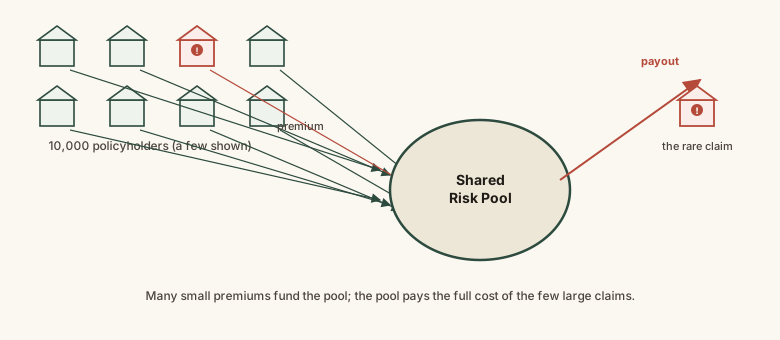
How pooled premiums cover the pool's rare claims
The visual makes the core mechanism concrete: every policyholder pays in a small amount, but only a small fraction of them ever draw a large payout back out — the pool is what makes that asymmetry work financially for everyone involved.
Common mistakes
Common Mistakes
✕
Thinking of insurance as a personal savings or investment account that should 'pay out' proportional to what was paid in.
→ Remember insurance is a risk-pooling mechanism, not a savings vehicle — most policyholders in any given year pay premiums and file no claim at all, and that's the pool working as intended, not a loss.
✕
Assuming a small pool of people can get the same low, stable pricing as a large one.
→ Recognize that pricing stability comes from pool size — a small, undiversified pool will see much more volatile, less predictable claims experience than a large one.
✕
Believing self-insuring (setting aside your own savings) is always equivalent to buying insurance.
→ Self-insuring means bearing the full risk alone with no pool to average against — it can work for small, predictable costs, but rarely matches the affordability of pooled coverage for rare, high-cost events.
Common misconception
“If you pay premiums for years without ever filing a claim, the insurance company 'won' and you got nothing for your money.”
The premiums paid during claim-free years are exactly what fund the pool that would have covered you had a loss occurred — and what covers the other policyholders in the same pool who do have losses in a given year. The value purchased is the protection against a potential catastrophic loss during that period, whether or not that loss ends up happening, the same way a smoke detector has value whether or not a fire ever occurs.
What to do next
What to do next
When evaluating any insurance policy, remember its price reflects the pooled, actuarially-estimated risk of the group you're joining, not a personal prediction about your own future.
Understand that a claim-free year isn't 'wasted' premium — it's the cost of the protection the pool provided during that period.
Recognize that larger, more established insurers pooling bigger, more diversified groups can generally offer more stable long-term pricing than very small or narrow risk pools.
Bring specific coverage-type and coverage-amount decisions to a licensed insurance agent or broker, who can assess your actual situation.
FAQ
FAQ
Related terms
Related terms
Pooled risk
The practice of spreading the financial cost of rare, expensive losses across a large group of people who each contribute a smaller, predictable amount, so no single person bears the full cost alone.
Premium
The amount a policyholder pays, usually on a regular schedule, to keep an insurance policy active and receive its coverage.
Law of large numbers
A statistical principle stating that as the number of independent, similar events observed grows, the average outcome converges toward the true expected value — the mathematical basis that lets insurers predict group-level losses even though individual losses are unpredictable.
Actuary
A professional who uses statistics, probability, and financial theory to calculate the likelihood and cost of future events, setting the premiums an insurer needs to collect to cover expected claims plus operating costs and profit.
This entry was researched from public sources and drafted with AI-assisted tools, then edited — errors are still possible. Spot one, or want a topic covered? Read our disclaimer.
 KnowThis