Term life insurance provides a death benefit only for a fixed period at a lower premium, with no cash value, and simply expires if the insured outlives the term. Whole life insurance provides a death benefit for the insured's entire life at a much higher premium, and builds a cash value component the policyholder can potentially borrow against — the price difference reflects the fact that whole life bundles investment-like savings with insurance, while term life is pure, temporary risk pooling.
Reading time
— 5 min
Updated
— Aug 22, 2026
Fact-reviewed
— Aug 22, 2026
This entry explains the general mechanics behind term and whole life insurance — it is financial literacy, not personalized insurance advice. Choosing a specific policy type, coverage amount, or insurer belongs with a licensed insurance agent or broker who can assess your specific situation.
Key Takeaways
Key Takeaways
1Term life insurance covers a fixed period only and pays out solely if the insured dies within that term, with no value if the term expires without a claim.
2Whole life insurance covers the insured's entire life and builds a cash value component, which is why its premiums run far higher than term life for the same death benefit.
3The price difference between term and whole life mostly reflects whether the policy is pure, temporary risk pooling or risk pooling bundled with a permanent savings component.
The concept
Term life insurance is like renting protection for a set number of years, say 20 — if the insured dies during those 20 years, the beneficiary gets the payout, and if not, the policy just ends with nothing paid out. Whole life insurance instead covers the insured for their entire life and slowly builds a savings-like pot of money called cash value inside the policy, which is part of why it costs so much more per month.
Comparing the same person's options side by side shows exactly why these two structures produce such different price tags.
Quick check
A 35-year-old buys a 20-year term policy and outlives the term without ever making a claim. What happens to the policy?
Worked examples
Example 1: Comparing premiums for the same death benefit (baseline)
A healthy 35-year-old shopping for a $500,000 death benefit might find a 20-year term policy priced at roughly $25-$35 per month, while a whole life policy for the same $500,000 death benefit might be priced at $400-$500 or more per month. The gap reflects the fact that the whole life premium is funding both the eventual guaranteed payout and the ongoing cash value build-up, while the term premium is funding only the temporary, conditional risk pool for those 20 years.
Example 2: What happens to cash value over time (edge case / variation)
A whole life policyholder pays premiums for 15 years, during which a cash value of, say, $18,000 has accumulated inside the policy according to its schedule. If this policyholder needs funds, they may be able to borrow against that $18,000 cash value (a loan that reduces the eventual death benefit if unpaid) or, in some cases, surrender the policy for its cash value instead of keeping the death benefit active. A term life policyholder in the same situation has no equivalent option — there is no cash value to borrow against or surrender, since the policy was never designed to build one.
Quick check
Why does a whole life policy's cash value grow while a term life policy has none at all?
Example 3: Matching the policy type to a life situation (real-world / applied)
Consider a parent who wants a death benefit large enough to replace their income until their children finish college, roughly 18 years away. A 20-year term policy directly matches that time-limited need at a lower premium, freeing up money that could otherwise go toward retirement savings or other goals. A different person seeking permanent estate-planning coverage that must exist no matter when they die, regardless of age, might instead find whole life's lifelong coverage structurally necessary for that specific goal, even at a higher premium. Neither policy type is universally "better" — each is structurally suited to a different kind of need, which is exactly the kind of judgment call a licensed insurance agent can help evaluate for an individual's actual circumstances.
How it works (visual)
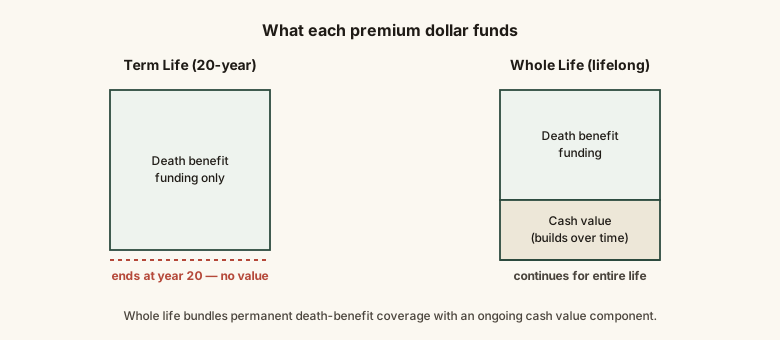
Term life vs. whole life: what each premium dollar funds
The term life bar simply stops at the end of the term with nothing behind it, while the whole life bar keeps building a cash value layer underneath the death benefit for as long as the policy stays active.
Common mistakes
Common Mistakes
✕
Assuming term life is a "worse" or incomplete version of whole life.
→ Recognize they solve different problems — term matches temporary needs at lower cost, whole life provides permanent coverage plus a savings component at higher cost.
✕
Expecting a refund of term life premiums if no claim is ever made.
→ Understand this is how term life is structurally designed to work — it's temporary risk pooling, not a savings account, so an unused term produces no payout.
✕
Treating a whole life policy's cash value growth as equivalent to a typical investment account's returns.
→ Review the specific policy's cash value schedule and guarantees with a licensed agent, since growth mechanics vary by policy and are usually slower than typical market-based investment growth, especially in early years.
Common misconception
“Whole life insurance is always a better choice than term life because it never expires and builds cash value.”
Whole life's permanence and cash value come at a substantially higher premium than term life for the same death benefit. For many people with a time-limited need, like income replacement until children are grown, a lower-cost term policy plus separately investing the premium difference can accomplish a similar or better financial outcome — but this depends heavily on individual circumstances and is exactly the kind of comparison a licensed insurance agent or financial professional can help evaluate.
What to do next
What to do next
Identify whether the need is time-limited (like income replacement until kids are grown) or permanent (like estate planning), since this often points toward term versus whole life structurally.
Compare quotes for the same death benefit amount across policy types to see the actual premium gap for your age and health profile.
Ask about the specific cash value schedule and guarantees for any whole life policy under consideration, since these vary by insurer and policy.
Bring your specific coverage-type, coverage-amount, and insurer decisions to a licensed insurance agent or broker.
FAQ
FAQ
Related terms
Related terms
Term life insurance
A life insurance policy that provides a death benefit only if the insured dies within a fixed period (the term), with no cash value and no payout if the insured outlives the term.
Whole life insurance
A permanent life insurance policy that provides a death benefit for the insured's entire life, as long as premiums are paid, and builds a cash value component over time.
Cash value
A savings-like component within a permanent life insurance policy that accumulates over time and can potentially be borrowed against or withdrawn by the policyholder while still living.
Beneficiary
The person or entity designated to receive a life insurance policy's death benefit when the insured dies.
A policyholder's claim is denied after an adjuster determines the cause of loss is listed as an exclusion in the policy. Does this mean the loss itself wasn't real?
This entry was researched from public sources and drafted with AI-assisted tools, then edited — errors are still possible. Spot one, or want a topic covered? Read our disclaimer.
 KnowThis