 KnowThis
Key Takeaways
Key Takeaways
- 1An insurance policy document functionally breaks into three parts: the declarations page (coverage amounts and period), the insuring agreement and exclusions (what's covered and what's specifically carved out), and the conditions (the policyholder's own obligations).
- 2Most claim disputes trace back to one of these three sections — either a coverage amount from the declarations page, a specific exclusion, or a missed condition — rather than the policy as a whole being unclear.
- 3A deductible reduces what the insurer pays, not what the loss actually costs — the policyholder still bears that amount regardless of how large the total loss is.
The concept
Because these three sections do fundamentally different jobs, reading only the declarations page — the part most people actually look at — leaves out exactly the information that determines whether a specific loss will actually be paid.
A homeowner's policy declarations page lists $300,000 in dwelling coverage. Their home suffers water damage from a slow, long-term pipe leak the homeowner didn't notice for months. The claim is denied. What's the most likely reason, given how these documents are typically structured?
Worked examples
Example 1: Reading the declarations page (baseline case)
Example 2: An exclusion that limits an otherwise-covered claim (edge case / variation)
Example 3: A missed condition affecting a claim (real-world / applied case)
Why might a policyholder's claim be denied even though the type of damage they experienced is generally covered under their policy's insuring agreement?
How it works (visual)
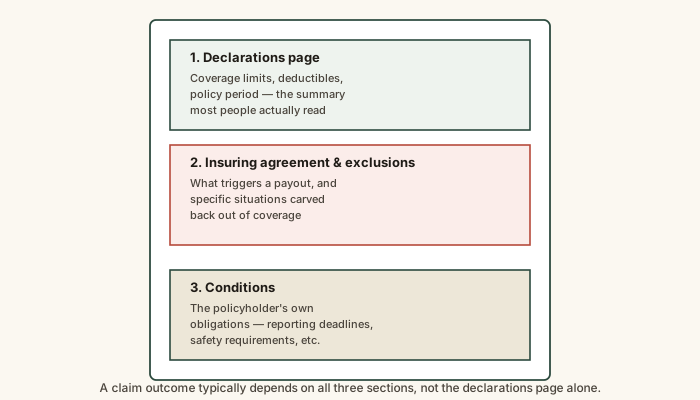
A claim outcome usually depends on all three sections working together, not on the declarations page alone.
Common mistakes
Common Mistakes
Reading only the declarations page and assuming it fully describes what's covered.
→ Review the exclusions and conditions sections too, since the declarations page shows coverage amounts but not what specifically triggers a payout.
Assuming a deductible is a percentage of the loss rather than a fixed amount stated on the declarations page.
→ Check the specific deductible amount listed for each coverage type, since it's typically a flat dollar figure the policyholder pays before the insurer's payment begins.
Missing a policy condition, like a claim-reporting deadline, because it seems like a minor administrative detail.
→ Treat reporting deadlines and other conditions as seriously as coverage terms — missing one can affect an otherwise valid claim.
Common misconception
“If a policy's declarations page lists a coverage type, any loss of that general type will automatically be paid up to the listed limit.”
The declarations page states the maximum possible coverage amount, not a guarantee that every loss of that general type is covered — the specific exclusions and conditions elsewhere in the document determine whether an individual loss actually qualifies, and sub-limits can cap specific categories well below the overall stated amount.
What to do next
What to do next
- Read the exclusions section, not just the declarations page, to understand what's specifically carved out of your coverage.
- Note any conditions — like reporting deadlines or required maintenance — and calendar them so they aren't accidentally missed.
- Check for sub-limits on specific categories (like jewelry, electronics, or business property) that may be lower than your policy's overall coverage amount.
- If a claim is denied, ask the insurer to point to the specific exclusion or condition cited, and consider consulting a licensed insurance professional or attorney if the denial seems inconsistent with the policy language.