 KnowThis
Key Takeaways
Key Takeaways
- 1There is generally no broad legal right to a refund just for changing your mind — most everyday return and refund rights come from the seller's own posted policy, not a universal law.
- 2A narrower set of situations — defective products, certain legally mandated cancellation windows, and unused portions of a prepaid service — are instead governed by actual consumer protection rules rather than store discretion.
- 3When a service is canceled partway through a paid period, a prorated refund is generally calculated based on the unused portion, not simply given as a full or zero refund.
The concept
Because most refund rights are either a store's discretionary policy or a narrow, specific legal rule, the practical first step in any refund question is figuring out which of those two categories actually applies.
A customer buys a shirt in-store, wears it once, and later decides they simply don't like the color. There's no defect and no cancellation-window situation involved. What generally determines whether they can get a refund?
Worked examples
Example 1: A store's own return policy (baseline case)
Example 2: A defective product (edge case / variation)
Example 3: Canceling a prepaid annual service (real-world / applied case)
Why might a customer who cancels a prepaid annual service partway through the year be entitled to a prorated refund rather than either a full refund or no refund at all?
Try it yourself
Estimate a prorated refund for a prepaid service canceled partway through its term, based on how much of the paid period is unused.
This is a simplified proration illustration, not a legal or contractual determination — actual refund entitlements depend on the specific contract terms, any applicable cancellation fees, and state law, and can differ from a simple day-based proration.
How it works (visual)
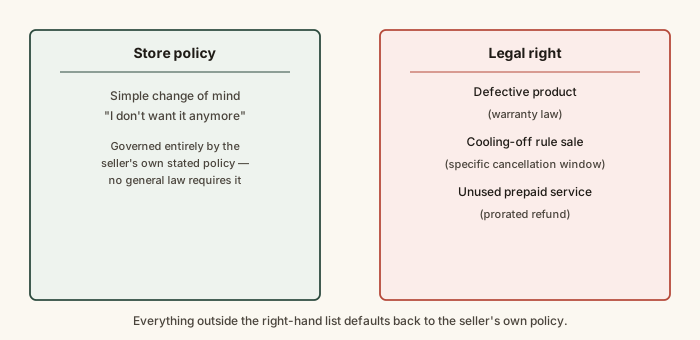
Knowing which side of this split a situation falls on determines whether the relevant document to check is the store's return policy or a specific consumer protection rule.
Common mistakes
Common Mistakes
Assuming there's a general legal right to a refund for any unwanted purchase.
→ Check whether the situation involves a defect, a specific legal cancellation right, or an unused prepaid service — absent one of those, the store's own policy generally governs.
Not reading the specific return policy (timeframe, condition requirements, restocking fees) before assuming a return will be accepted.
→ Review the store's stated policy at the time of purchase, since these terms — not a general assumption — determine what's actually allowed.
Forgetting that a prorated refund is based on the unused time or usage, not simply half of whatever amount feels fair.
→ Use the actual days or usage remaining against the total paid period to estimate a reasonable prorated amount, and compare it against the actual contract terms.
Common misconception
“You always have three days to cancel any purchase and get your money back, no matter what you bought or where.”
The FTC's cooling-off rule granting a mandatory cancellation window applies to a specific, narrower category of sales — generally certain transactions made away from a seller's regular place of business above a minimum dollar amount — not to ordinary in-store or standard online purchases. Outside that specific rule, refund and return rights are either the store's own policy or tied to other specific legal triggers like a genuine product defect.
What to do next
What to do next
- Read the specific return policy at the time of purchase — timeframe, condition requirements, and any restocking fees — rather than assuming a general rule applies.
- For a defective product, check whether a warranty (express or implied) applies before assuming the store's ordinary return window is your only option.
- For a prepaid service you're canceling early, ask specifically about proration and compare it against the contract's actual cancellation terms.
- If a seller won't resolve a legitimate dispute directly, consider a card chargeback or a complaint to your state consumer protection office as next steps.