 KnowThis
Key Takeaways
Key Takeaways
- 1Clicking 'I agree' (or sometimes just continuing to use a service) forms a real, legally binding contract, even though the vast majority of users never read the full document.
- 2A small number of recurring clause types — arbitration requirements, data-use licenses, and the company's right to change terms unilaterally — carry most of the practical weight in an otherwise long, repetitive document.
- 3How the agreement was formed matters: a 'clickwrap' agreement tied to an explicit action is generally more enforceable than a 'browsewrap' agreement where terms are just linked somewhere on the page.
The concept
Because most terms of service documents are written once and reused across millions of users, the specific wording of a handful of clauses ends up mattering far more than the document's overall length.
Why might a 'browsewrap' terms of service agreement (terms merely linked in a website's footer) be harder to enforce than a 'clickwrap' agreement (an explicit 'I agree' button)?
Worked examples
Example 1: Signing up for a new app (baseline case)
Example 2: A website with only a footer link (edge case / variation)
Example 3: Terms changing after the fact (real-world / applied case)
A company updates its terms of service and only posts a notice banner on its website, without emailing users. A user keeps using the app without reading the update. What's the most likely legal effect?
How it works (visual)
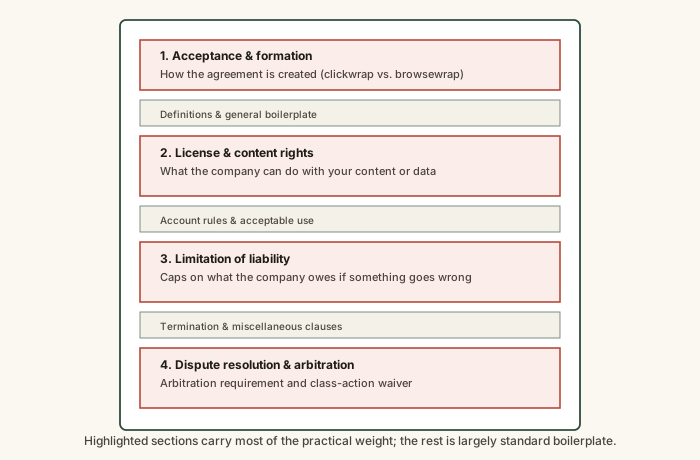
Most of a terms of service document is standard boilerplate that varies little between services — the sections worth actually reading are a small, predictable set.
Common mistakes
Common Mistakes
Assuming a terms of service agreement isn't really binding because 'nobody reads those things.'
→ Treat the click or the continued use as a real signature — courts generally do, especially in a clear clickwrap setup, regardless of whether the terms were actually read.
Ignoring notice banners about updated terms rather than at least skimming what changed.
→ Check update notices for changes to the sections that matter most — arbitration, data use, and liability limits — since continued use can count as accepting the new version.
Assuming every terms of service agreement is equally enforceable regardless of how it was presented.
→ Notice the difference between an explicit 'I agree' action (clickwrap, generally stronger) and a passive footer link (browsewrap, generally weaker) when evaluating how binding a given agreement really is.
Common misconception
“Terms of service agreements are basically unenforceable filler text that companies post to look official.”
Terms of service agreements are real contracts, and courts routinely enforce them — including arbitration clauses and liability limitations — when they were properly formed through a clear, affirmative process like a clickwrap agreement. The length and the fact that few people read them doesn't reduce their legal weight; if anything, it makes understanding a handful of high-impact clauses more valuable, not less.
What to do next
What to do next
- Before agreeing, search the document (Ctrl+F / Cmd+F) for 'arbitration,' 'class action,' and 'liability' to jump straight to the highest-impact clauses.
- Read update notices for services you actively use, since continued use can count as accepting changed terms under many agreements.
- Note whether an agreement required an explicit action (clickwrap) or was just linked passively (browsewrap) — it affects how strong the agreement actually is if a dispute arises.
- For any agreement involving significant money or ongoing obligations, consider having a licensed attorney review it rather than relying on a quick self-read.