 KnowThis
Key Takeaways
Key Takeaways
- 1Consumer protection law generally targets specific seller conduct — deception, unfairness, and unsafe products — rather than guaranteeing any particular buying experience.
- 2Being unhappy with a purchase is not the same, legally, as being deceived or treated unfairly — the practical question is usually whether the seller crossed a defined line.
- 3Enforcement happens at multiple levels: federal agencies like the FTC, state attorneys general and consumer protection offices, and — for smaller individual disputes — small claims court.
The concept
Because these standards focus on seller conduct rather than buyer satisfaction, the same purchase experience can be a straightforward disappointment in one case and a genuine legal violation in another, depending entirely on what the seller actually did or said.
A customer buys a blender that works fine but turns out to be much less powerful than they personally expected. Separately, another customer buys a blender explicitly advertised as having a specific horsepower rating that the product doesn't actually have. Which situation is more likely to raise a consumer protection issue?
Worked examples
Example 1: A straightforward disappointment (baseline case)
Example 2: A hidden-fee subscription (edge case / variation)
Example 3: A false product claim (real-world / applied case)
Why might a confusing, hard-to-navigate subscription cancellation process raise a consumer protection concern even if the company never made a single false statement?
How it works (visual)
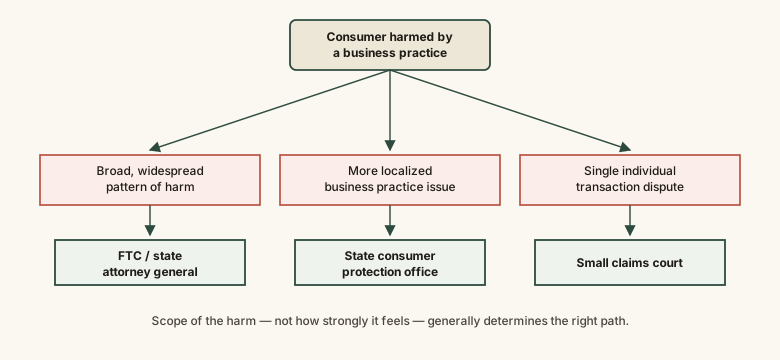
Which path fits best generally depends on scope — how widespread the conduct is — rather than how serious any one individual's harm feels.
Common mistakes
Common Mistakes
Assuming any disappointing purchase is automatically a consumer protection violation.
→ Distinguish between subjective dissatisfaction and an objectively false, misleading, or unavoidably harmful business practice — only the latter generally raises a consumer protection issue.
Not documenting the specific claims a seller made before assuming a purchase was simply a bad decision.
→ Save advertisements, listings, and any specific representations at the time of purchase — this documentation is what turns a vague complaint into a concrete deception claim.
Contacting only the seller and never a consumer protection agency when a pattern of harm seems widespread.
→ Report broader, repeated issues to the FTC or your state attorney general's consumer protection office — individual complaints often feed into larger pattern-based enforcement actions.
Common misconception
“If a product just isn't very good, that's automatically a consumer protection violation the seller has to answer for.”
Consumer protection law is generally aimed at specific seller conduct — deception, unfairness, and unsafe products — not at guaranteeing that every purchase meets a buyer's expectations. A product that's simply mediocre but accurately described usually isn't a legal violation; a product that's falsely described, or sold through a practice designed to trap consumers, more plausibly is.
What to do next
What to do next
- Save advertisements, listings, receipts, and any specific claims made by the seller at the time of purchase — documentation is the foundation of any consumer protection complaint.
- Try resolving the issue directly with the seller first, since many disputes are resolved faster this way than through a formal complaint.
- File a complaint with the FTC (reportfraud.ftc.gov) or your state attorney general's consumer protection office for broader or unresolved issues.
- For a single, specific transaction dispute involving a modest dollar amount, consider small claims court as a direct path to resolution.