Small claims court is a simplified, lower-cost civil court track built specifically for people to represent themselves, generally handling disputes up to a set dollar limit that varies by state or jurisdiction, and the mechanics — filing a claim, serving the other party, presenting evidence at a short hearing, and collecting a judgment if you win — are deliberately more streamlined than a standard civil lawsuit.
Reading time
— 4 min
Updated
— Aug 26, 2026
Fact-reviewed
— Aug 26, 2026
Key Takeaways
Key Takeaways
1Small claims court is deliberately designed for people without a lawyer, using simplified procedures and generally capping cases at a set dollar limit that varies by jurisdiction.
2The basic process — filing, serving the defendant, a short hearing, and (if you win) a judgment — is far more streamlined than a standard civil lawsuit, but each step still has specific requirements.
3Winning a judgment and actually collecting the money are two separate steps — a court ruling in your favor doesn't automatically transfer funds from the other party.
The concept
Small claims court is a simpler, cheaper version of a regular civil lawsuit, built specifically so ordinary people can use it without hiring a lawyer. It generally handles disputes up to a specific dollar limit that varies from place to place, and the process is streamlined: you file a claim, the other party is formally notified, both sides show up to a relatively short hearing, and a judge (not a jury) decides the outcome. It's a practical option for a clear, provable dispute over a modest amount of money — a security deposit, an unpaid invoice, property damage — rather than for complex or high-dollar disputes.
Because winning a judgment and actually collecting the money are two separate legal steps, it's worth thinking about how collectible a judgment against a specific defendant would realistically be before filing.
Quick check
A plaintiff wins a small claims judgment for $2,000 against a defendant who simply refuses to pay. What happens next, generally speaking?
Worked examples
Example 1: A withheld security deposit (baseline case)
A former tenant believes their landlord wrongfully withheld $1,200 of their security deposit without a valid reason. This is a textbook small claims case — a specific, provable dollar amount, a clear dispute, and an amount well within most jurisdictions' small claims dollar limits.
Example 2: A claim exceeding the dollar limit (edge case / variation)
A contractor is owed $8,000 for completed work, but their state's small claims limit is $5,000. In this situation, the contractor generally has to choose between capping the claim at $5,000 to stay in small claims court, or filing in a standard civil court, which handles larger amounts but comes with more complex procedures and often the practical need for an attorney.
Example 3: Winning but struggling to collect (real-world / applied case)
A plaintiff wins a $1,500 judgment against a defendant who has no steady job and no funds on hand. Even with a valid judgment in hand, collecting the money can require additional legal steps, and in some cases a judgment against a defendant with genuinely no assets may be difficult to collect regardless of how clearly the plaintiff won the case.
Quick check
A prospective plaintiff has a valid, provable claim for $6,000 in a state with a $5,000 small claims limit. What's a realistic option they generally have?
How it works (visual)
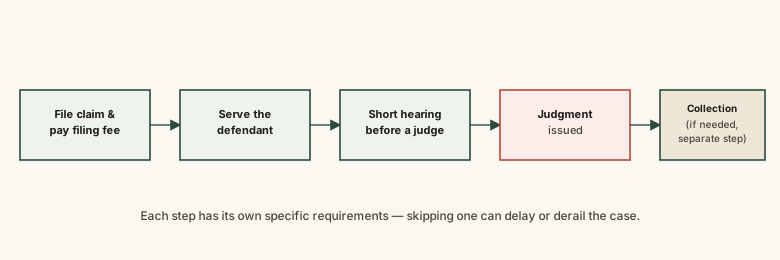
The general small claims court process
Each step has its own specific requirements, and skipping one — like failing to properly serve the defendant — can delay or derail an otherwise strong case.
Common mistakes
Common Mistakes
✕
Assuming winning a judgment means the money is automatically transferred.
→ Plan for the possibility of a separate collection step, and consider how realistically collectible a judgment would be before filing.
✕
Filing a claim above the jurisdiction's small claims dollar limit without checking first.
→ Confirm your state or jurisdiction's specific small claims limit before filing, and decide whether to cap the claim or pursue standard civil court instead.
✕
Not properly completing service of process on the defendant.
→ Follow your court's specific rules for formally notifying the defendant — a case generally can't proceed until this step is done correctly.
Common misconception
“Small claims court always requires a lawyer, just like any other type of lawsuit.”
Small claims court is specifically designed for self-representation, with simplified procedures, lower filing fees, and — in many jurisdictions — rules that limit or even prohibit attorneys from appearing for either side. This is one of its core practical advantages over standard civil litigation for a clear, modest-dollar dispute.
What to do next
What to do next
Check your specific state or local court's small claims dollar limit and filing fee before deciding where to file.
Gather documentation — receipts, contracts, photos, communications — that clearly supports the specific amount you're claiming.
Follow your court's exact rules for serving the defendant, since a case generally can't proceed without proper service.
Before filing, consider how realistically collectible a judgment against this particular defendant would actually be.
FAQ
FAQ
Related terms
Related terms
Small claims court
A simplified civil court track designed for people to represent themselves, generally handling disputes up to a specific dollar limit that varies by state or jurisdiction.
Plaintiff
The person or party who files a claim and initiates a small claims (or other civil) case.
Defendant
The person or party a small claims (or other civil) case is filed against.
Service of process
The formal delivery of court documents (like a claim and hearing notice) to the defendant, required before a case can proceed — the specific method allowed varies by jurisdiction.
Judgment
The court's official decision in a case; in small claims court, winning a judgment doesn't automatically transfer money — collecting on it is often a separate step.
A customer buys a shirt in-store, wears it once, and later decides they simply don't like the color. There's no defect and no cancellation-window situation involved. What generally determines whether they can get a refund?
This entry was researched from public sources and drafted with AI-assisted tools, then edited — errors are still possible. Spot one, or want a topic covered? Read our disclaimer.
 KnowThis