The public sector is government-owned and government-run, funded through taxes and generally accountable to elected officials and the public; the private sector is owned and operated by individuals or companies pursuing profit; a third category, the nonprofit or voluntary sector, is privately run but organized around a mission rather than profit distribution.
Reading time
— 4 min
Updated
— Aug 21, 2026
Fact-reviewed
— Aug 21, 2026
Key Takeaways
Key Takeaways
1The public sector is government-owned and tax-funded; the private sector is privately owned and generally profit-driven; a distinct nonprofit sector is privately run but mission-driven rather than profit-driven.
2A service being publicly funded doesn't mean it's operated by government employees — public-private partnerships let private companies deliver publicly funded services under government contract.
3Because of these blended arrangements, checking who owns and operates something (versus who funds it) is the more reliable way to classify it as public, private, or nonprofit.
The concept
The public sector is everything owned and run by government — public schools, national parks, the postal service in many countries. The private sector is everything owned and run by individuals or companies for profit — most retail businesses, private employers, most restaurants. A third group, the nonprofit sector, is privately organized but built around a specific mission rather than generating profit for owners.
The most common source of confusion is assuming "funded by tax dollars" and "run by government" are the same thing — public-private partnerships exist specifically because they often aren't.
Quick check
If a service is funded by taxpayer money, does that automatically mean it's operated directly by government employees?
Worked examples
Example 1: A clear public-sector service (baseline case)
A public school is owned by a local school district (a government body), staffed by government-employed teachers and administrators, and funded primarily through local property taxes and intergovernmental transfers. Every part of this arrangement — ownership, staffing, and funding — sits squarely in the public sector, making it a straightforward case with no blending involved.
Example 2: A nonprofit delivering a public-adjacent service (edge case / variation)
A nonprofit organization runs a local food bank, funded through a mix of private donations, grants, and some government funding. It's not government-owned (so not strictly public sector), and it's not profit-driven for owners (so not strictly private sector either) — it sits in the distinct nonprofit sector, illustrating why the two-category public/private model misses a real, common third category.
Example 3: A public-private partnership toll road (real-world / applied case)
A government agency contracts a private company to design, build, and operate a new toll road for a set number of years, during which the company collects toll revenue to recoup its investment and earn a return, after which the road may revert to full government ownership. The road is publicly authorized and regulated, privately built and initially operated, and funded by a mix of user tolls and possibly some public financing — a genuine blend that doesn't fit neatly into a single public-or-private label.
Quick check
Is a nonprofit organization considered part of the private sector because it's not government-owned?
How it works (visual)
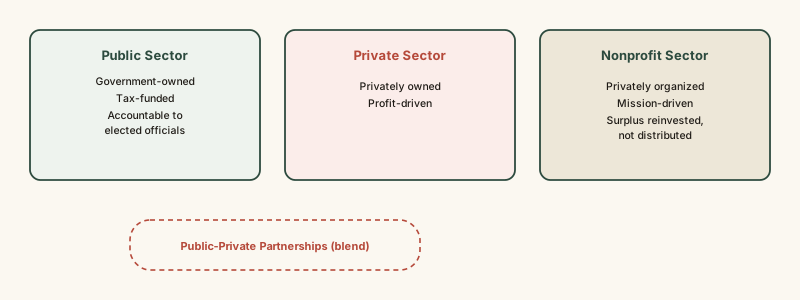
Three sectors, sorted by ownership and profit structure
The bridge at the bottom matters because public-private partnerships are exactly where the clean three-column split breaks down in practice — funding, ownership, and operation can each sit in a different column for the same service.
Common mistakes
Common Mistakes
✕
Assuming a service must be either fully public or fully private, with no middle ground.
→ Check specifically for a public-private partnership arrangement, which blends public funding/oversight with private ownership or operation.
✕
Treating nonprofit organizations as either public or private sector.
→ Recognize nonprofits as a genuinely distinct third sector — privately organized but mission-driven, not profit-driven.
✕
Classifying an organization by its funding source alone rather than its ownership structure.
→ Check who actually owns and operates the organization, not just who pays for it — funding source alone can be misleading.
Common misconception
“Any organization that receives government funding is automatically part of the public sector.”
Government funding alone doesn't determine sector classification — a private company delivering a service under government contract remains privately owned and operated, and a nonprofit receiving grant funding remains part of the distinct nonprofit sector. Ownership and profit structure, not funding source, are the more reliable classifiers.
Quick check
What's the key structural difference between a for-profit private company and a nonprofit organization?
What to do next
What to do next
Next time you use a public-adjacent service, check whether it's directly government-run or delivered through a public-private partnership.
Look up a local example of a public-private partnership (a toll road, stadium, or utility) to see how the funding and operation actually split.
If you're researching an organization, check its legal structure (government agency, for-profit company, or registered nonprofit) rather than assuming from its funding source alone.
Notice how national employment statistics report public-sector, private-sector, and nonprofit employment separately — a useful real-world confirmation of the three-way split.
FAQ
FAQ
Related terms
Related terms
Public sector
The part of the economy owned and operated by government, funded primarily through taxation, and generally accountable to elected officials rather than private shareholders.
Private sector
The part of the economy owned and operated by individuals or companies, generally organized around generating profit for owners or shareholders.
Nonprofit sector
Also called the voluntary or third sector — privately organized entities pursuing a specific mission rather than profit distribution, often funded by donations, grants, or fees rather than taxes.
Public-private partnership
An arrangement where government contracts with a private company to deliver a public service or build public infrastructure, blending public funding or oversight with private-sector operation.
This entry was researched from public sources and drafted with AI-assisted tools, then edited — errors are still possible. Spot one, or want a topic covered? Read our disclaimer.
 KnowThis