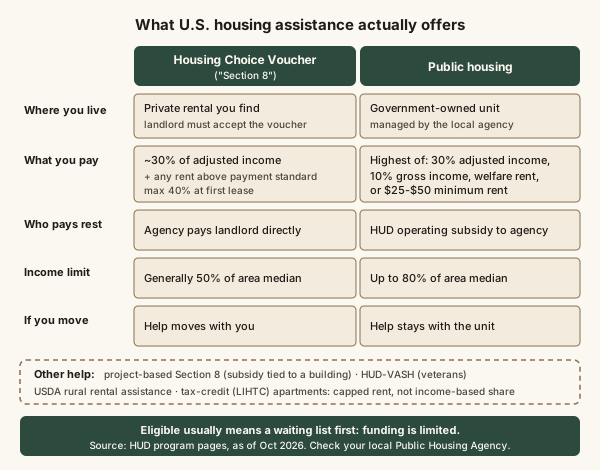
Federal housing assistance in the U.S., run mainly by the Department of Housing and Urban Development (HUD) through local Public Housing Agencies, does not usually hand out cash; it limits how much of a household's income goes to rent. In the Housing Choice Voucher program (often called Section 8), the family generally pays about 30% of its adjusted monthly income toward rent and utilities and the agency pays the rest, up to a local 'payment standard', directly to a private landlord; at first lease-up the family's share can't exceed 40% of adjusted monthly income. In public housing, the household rents a government-owned unit and pays the highest of 30% of adjusted monthly income, 10% of gross monthly income, welfare rent, or a minimum rent of $25 to $50 set by the agency. Eligibility is based on income limits set as a percentage of area median income (generally 50% for vouchers and 80% for public housing), and because funding is limited, eligible households are typically placed on waiting lists. Other programs include project-based rental assistance, HUD-VASH vouchers for veterans experiencing homelessness, USDA rural rental assistance, and tax-credit apartments with capped rents. This is general information as of October 2026; rules, funding and income limits change, and the local housing agency gives the authoritative answer.
Reading time
— 6 min
Updated
— Oct 1, 2026
Fact-reviewed
— Oct 1, 2026
This entry explains how U.S. federal housing assistance generally works, as of October 2026. It is not a determination of eligibility or legal advice. Income limits, payment standards, local preferences and funding change and vary by area. For your situation, contact your local Public Housing Agency or check HUD's official pages. If you're facing eviction or homelessness, a local legal aid office or 211 can point you to emergency help.
Key Takeaways
Key Takeaways
1Most U.S. housing assistance doesn't pay cash. It caps the household's share of rent at about 30% of adjusted monthly income, and the program covers the rest.
2A Housing Choice Voucher (Section 8) follows the household to a private rental; public housing is a specific government-owned unit.
3Eligibility is set by local income limits tied to area median income: generally 50% of AMI for vouchers and 80% for public housing.
4Qualifying isn't the same as receiving help. Funding is limited, so eligible households usually go on waiting lists, sometimes for years.
The concept
People often imagine housing assistance as a check that pays your rent. Mostly it's something different: a ceiling on how much of your income rent can take. Think of it as a co-pay for housing. You pay a share based on what you earn, usually around 30% of your income after certain deductions, and the program pays the rest. With a voucher (the program people call Section 8), you find a private apartment and the local housing agency pays its part straight to the landlord. With public housing, you rent an apartment the government owns. In both cases your local income has to be low enough to qualify, and because there's far less funding than need, you usually join a waiting list first.
Beyond those two programs, the landscape includes project-based rental assistance (the subsidy is attached to specific privately owned buildings, so it stays when you move out), housing for elderly people and people with disabilities, HUD-VASH (vouchers plus VA support services for veterans experiencing homelessness), USDA rental assistance in rural areas, and tax-credit (LIHTC) apartments, where rents are capped for income-qualified tenants but don't flex with each tenant's income. The general application process is covered in our guide to applying for government assistance programs. Veterans have extra routes as well, starting with the VA home loan guaranty; see what veterans benefits actually include.
Quick check
A household with a housing voucher has an adjusted monthly income of $2,000. Roughly how much would its usual share toward rent and utilities be?
Worked examples
The numbers below are illustrative, chosen to show the arithmetic. Real payment standards, utility allowances and deductions depend on your area and household.
Example 1: A voucher in a typical unit (baseline case)
A family of three has an adjusted annual income of $28,800, so adjusted monthly income is $2,400. Its share is 30%: $720. The family finds an apartment with a gross rent (rent plus utilities) of $1,400, and the local payment standard for that unit size is $1,500. Because the rent is under the payment standard, the PHA pays the difference: $1,400 − $720 = $680 a month, sent directly to the landlord. Without assistance, the same rent would take 58% of the family's adjusted income.
Example 2: Choosing a unit above the payment standard (edge case)
The same family prefers a unit near a better school with a gross rent of $1,700, which is $200 above the $1,500 payment standard. The PHA still only subsidises up to the standard: $1,500 − $720 = $780. The family pays the rest: $720 + $200 = $920, which is 38% of its $2,400 adjusted monthly income. That's within the 40% limit for a first lease, so it's allowed. A unit at $1,800 would push the family's share to $1,020, or 42.5%, which exceeds the 40% cap at lease-up, so the PHA would not approve it.
Example 3: Public housing rent for a very low income (applied case)
A retired man living alone has gross income of $1,200 a month, and after his allowed deductions his adjusted monthly income is $1,000. His public housing Total Tenant Payment is the highest of: 30% of adjusted income ($300), 10% of gross income ($120), or the agency's minimum rent (say $50). He pays $300. If his income dropped to zero, the minimum rent would apply instead, though HUD rules let agencies grant hardship exemptions from it. Our guide to what Social Security pays out covers how a retirement benefit like his is calculated.
Quick check
A household is told it qualifies for a voucher but is placed on a waiting list. What does that usually mean?
How it works (visual)
Voucher vs public housing vs other help: what each actually offers
Common mistakes
Common Mistakes
✕
Assuming a voucher covers the whole rent.
→ Budget for your share, usually about 30% of adjusted monthly income, plus any amount above the payment standard and possibly a security deposit.
✕
Applying to only one waiting list.
→ HUD suggests applying to multiple PHA waiting lists where possible. Lists open and close at different times, so check each agency's site.
✕
Paying a website or 'agent' to apply or to jump a waiting list.
→ Applications go through the local PHA, and legitimate PHAs don't sell places on waiting lists. Fees for a guaranteed voucher are a scam warning sign.
✕
Not reporting income changes after you're approved.
→ Your share is recalculated from income, so PHAs require you to report changes. Unreported increases can lead to repayment demands or losing assistance.
Common misconception
“If you qualify for Section 8, you'll get a voucher.”
Eligibility and assistance are two different things. Federal rental assistance is funded at a fixed level each year, not as an entitlement for every household that qualifies. HUD itself warns of high demand and long waiting lists. Many lists are closed for long periods, and some PHAs open them briefly and select applicants by lottery. That's why the practical advice is to apply to more than one list, keep your contact details current with each agency, and look at other options such as tax-credit apartments while you wait.
What to do next
What to do next
Look up your area's income limits on HUD User's Income Limits page to see roughly which programs your household size and income may fit.
Find your local Public Housing Agency through HUD's website and check which waiting lists are open.
Gather documents in advance: identification, Social Security numbers for household members, and proof of income.
Veterans experiencing homelessness can ask a VA medical center about HUD-VASH; rural renters can check USDA Rural Development properties.
This is general information, not an eligibility decision. Confirm the current rules with your local PHA before relying on any figure here.
FAQ
FAQ
Related terms
Related terms
Public Housing Agency (PHA)
The local or regional agency that runs HUD's voucher and public housing programs in an area: it takes applications, keeps the waiting list, checks eligibility and pays landlords.
Housing Choice Voucher
HUD's main rental subsidy, often called Section 8. It lets a household rent from a private landlord while the PHA pays part of the rent directly to the landlord.
Adjusted income
Annual household income minus deductions allowed by HUD rules (for example for dependents, or for elderly or disabled household members). Rent shares are calculated from it.
Payment standard
The maximum amount a PHA will use when calculating its voucher subsidy for rent plus utilities in an area. It is not a rent cap; a family may rent above it and pay the difference, within limits.
Area median income (AMI)
The middle household income for a county or metro area, adjusted for household size. HUD sets program income limits as percentages of it, such as 30%, 50% and 80%.
Total Tenant Payment (TTP)
In HUD programs, the amount the household is expected to contribute toward rent and utilities, usually based on 30% of adjusted monthly income.
This entry was researched from public sources and drafted with AI-assisted tools, then edited — errors are still possible. Spot one, or want a topic covered? Read our disclaimer.
 KnowThis