How Small Business Government Grants Actually Get Awarded
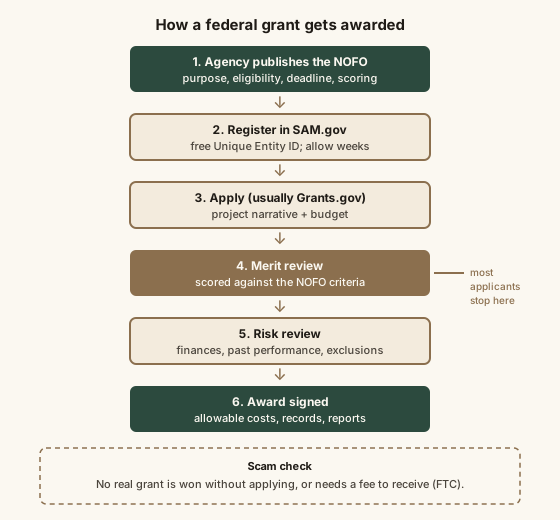
Small business government grants are awarded competitively, against published criteria, for a specific public purpose, not as general startup money. The U.S. Small Business Administration states plainly that it does not provide grants for starting or expanding a business; its grants mostly go to nonprofits, educational institutions and resource partners that support entrepreneurs, plus limited programs for research, exporting and community entrepreneurship. The largest federal grant route open to for-profit small businesses is the SBIR/STTR research program, which funds research and development tied to an agency's mission. Its authority lapsed on 30 September 2025 and was restored in April 2026 through 30 September 2031. The federal process follows a pattern set out in the Uniform Guidance (2 CFR 200): an agency publishes a Notice of Funding Opportunity (NOFO) with eligibility rules and scoring criteria; applicants register in SAM.gov for a Unique Entity ID and apply, usually through Grants.gov; reviewers score applications against the criteria; the agency checks the applicant's risk and financial capacity; and winners sign an award with reporting and spending rules. State and local programs exist but vary widely. The FTC warns that 'free government grant' offers asking for a fee are scams.
Reading time
— 6 min
Updated
— Oct 3, 2026
Fact-reviewed
— Oct 3, 2026
This entry explains how government grants are generally awarded in the United States, as of October 2026. It is not legal, tax or financial advice. Programs, eligibility and deadlines change and vary by agency and state. Check the official Notice of Funding Opportunity, and for help with your situation, contact your local Small Business Development Center (SBDC) or SCORE chapter, which offer free counseling.
Key Takeaways
Key Takeaways
1There is no general federal grant for starting or growing a business. The SBA says so directly; most of its grants go to organizations that help entrepreneurs.
2Grants pay for a specific public purpose. For for-profit small businesses, the biggest federal route is SBIR/STTR research and development funding.
3Awards are competitive: an agency publishes the rules (the NOFO), reviewers score applications against them, and the agency checks the applicant's risk before awarding.
4Winning comes with strings: spending rules, records and reports. And any offer of a 'free grant' for a fee is a scam.
The concept
A lot of people picture government grants as free money for anyone with a business idea. It's closer to a job posting. The government has a specific task it wants done, such as developing a new medical device, helping rural towns or training new entrepreneurs. It writes a public description of that task, who's allowed to apply and how applications will be judged. Applicants send in a detailed proposal. A panel scores each one against the published checklist, the agency makes sure the winner can actually manage public money, and then it signs an agreement. Like a job, the money is for doing that specific work, and you have to report on how you used it. That's why the most common small business grants are for research and development, exporting or specific local goals, and why the SBA itself says it doesn't give grants just to start or expand a business. Most small businesses fund themselves through savings, revenue or loans.
Quick check
Which statement about federal small business grants is accurate?
Worked examples
Example 1: A research startup's SBIR Phase I (baseline case)
A three-person company has a new sensor that could detect crop disease early. It finds an agency SBIR topic asking for exactly that kind of technology. Step by step: the founders register in SAM.gov and get a UEI, read the solicitation's eligibility rules (U.S.-owned, for-profit, under 500 employees) and its scoring criteria, and write a proposal covering the technical approach, the team and the commercial potential. Reviewers score it against those criteria alongside many other proposals for the same topic; most proposals are not funded. If it ranks high enough and passes the agency's risk check, the company signs a Phase I award to test feasibility, with reports due. A strong Phase I result is what qualifies it to compete for Phase II. Award sizes are set in each solicitation, so the solicitation, not a website summary, is the number to trust.
Example 2: The "you've been approved" phone call (edge case)
A café owner gets a call: she's been selected for a $9,000 federal grant and just needs to pay a $249 processing fee or share her bank details. Every part of this contradicts how real grants work. She never applied, and federal grants are only awarded to people who submit an application against a published NOFO. Agencies don't cold-call winners, and there's no fee to receive one. The FTC lists exactly this pattern as a government grant scam. The right move is to hang up, never pay or share account details, and report it at ReportFraud.ftc.gov.
Example 3: A bakery that needs an oven (applied case)
A bakery owner wants $15,000 for a new oven. Federal grants are a poor fit: SBIR funds research, and the SBA doesn't offer general expansion grants. Her realistic grant options, if any, are local: some states, cities or economic development agencies run small business grants tied to goals such as reviving a downtown, energy-efficient equipment or recovering from a declared disaster. Those vary by place and year, and they still have eligibility rules, deadlines and scoring. In practice, she should check her state economic development agency and local SBDC, and compare a grant's paperwork and odds with a loan or equipment financing, which are more common routes for equipment.
Quick check
After the merit review scores an application highly, what else does the agency check before making a federal award?
How it works (visual)
How a federal grant gets awarded, step by step
Most of the outcome is decided at steps 1 and 4. If your business doesn't fit the purpose and eligibility in the NOFO, nothing else matters; if it does, the score against the written criteria is what separates funded from unfunded.
Common mistakes
Common Mistakes
✕
Searching for a federal grant to start a business.
→ The SBA says it doesn't offer these. Look at SBIR/STTR if you do R&D, and at state and local programs otherwise.
✕
Starting SAM.gov registration a few days before the deadline.
→ Registration can take weeks. Register early and keep it active; it must be renewed every year.
✕
Writing a general pitch instead of answering the scoring criteria.
→ Mirror the NOFO's criteria in your headings so reviewers can find and score each one.
✕
Paying a service that 'guarantees' a grant.
→ No one can guarantee a competitive award. Free help is available from SBDCs and SCORE.
✕
Treating the money as unrestricted once it arrives.
→ Spend only on approved costs, keep records and file reports on time; misused funds can have to be repaid.
Common misconception
“There are billions in unclaimed government grants waiting for small businesses that know where to look.”
This line usually comes from ads selling grant lists or "guaranteed" applications. Federal grant money is not sitting unclaimed: it is tied to specific programs, most of which fund states, universities, nonprofits and research, and the competitive ones receive far more applications than they fund. The SBA's own grants page says it does not provide grants for starting and expanding a business.
What to do next
What to do next
Decide what you need money for. Research and development points to SBIR/STTR; equipment or working capital usually points to loans or local programs.
Search federal opportunities on Grants.gov and SBIR.gov, and check your state economic development agency for local programs.
Register your business in SAM.gov well before any deadline (it's free).
Read the full NOFO or solicitation, especially eligibility, matching requirements and scoring criteria, before writing anything.
Book a free session with your local Small Business Development Center or SCORE mentor to review your plan.
Never pay a fee to 'receive' a grant; report grant scams at ReportFraud.ftc.gov.
FAQ
FAQ
Related terms
Related terms
Grant
Money given for a defined public purpose that, unlike a loan, does not have to be repaid if the recipient follows the award's terms.
Notice of Funding Opportunity (NOFO)
The public announcement for a grant program, setting out its purpose, who is eligible, the deadline, the amount and how applications will be scored.
Merit review
The scoring of applications against the published criteria, often by a panel of subject experts.
Unique Entity ID (UEI)
A 12-character identifier issued through SAM.gov that organizations need to apply for and receive federal awards. It replaced the DUNS number in April 2022.
SBIR / STTR
Small Business Innovation Research and Small Business Technology Transfer: federal programs that fund research and development by small for-profit businesses in phases.
Uniform Guidance (2 CFR 200)
The federal rules for how agencies award and manage grants and how recipients must spend, track and report the money.
Matching funds
A share of a project's cost the recipient must cover from its own or other non-federal money, when a program requires it.
This entry was researched from public sources and drafted with AI-assisted tools, then edited — errors are still possible. Spot one, or want a topic covered? Read our disclaimer.
 KnowThis