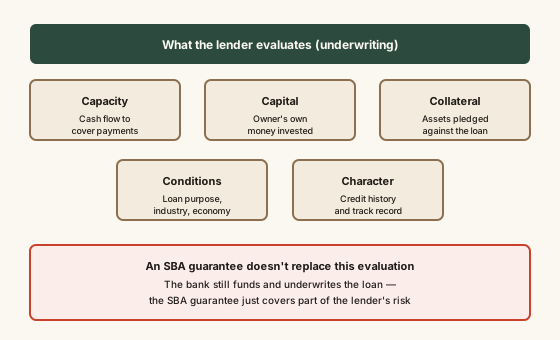
A small business loan is fundamentally a bank deciding whether to lend its own money to a business, evaluated against a real underwriting framework — capacity, capital, collateral, conditions, and character — and where a program is described as an 'SBA loan,' the Small Business Administration is not the lender; per SBA.gov, the agency instead guarantees a portion of the loan so the bank carries less risk, which is why SBA-backed loans often reach businesses a bank wouldn't otherwise approve.
Reading time
— 5 min
Updated
— Sep 23, 2026
Fact-reviewed
— Sep 23, 2026
Key Takeaways
Key Takeaways
1A bank or other private lender makes a small business loan with its own money and carries the risk — the SBA almost never lends directly.
2Lenders evaluate applicants against a real underwriting framework: capacity, capital, collateral, conditions, and character.
3An 'SBA loan' means the SBA has agreed to guarantee a portion of the loan, which lowers the lender's risk and can unlock financing a bank wouldn't otherwise approve.
The concept
When people talk about a "small business loan," they usually mean money borrowed from a bank or online lender to start or grow a business, paid back over time with interest. Some of these loans come with an SBA guarantee attached, which people sometimes mistake for the government directly lending the money. It doesn't — the bank is still the one deciding whether to approve you, still the one funding the loan, and still the one collecting your payments. The SBA guarantee just means that if you default, the government covers part of the bank's loss, which makes the bank more willing to say yes to a business that looks riskier on paper.
This structure — private lender funds and services the loan, SBA guarantees a portion — is also why applying for an SBA-backed loan still means applying through a bank or an SBA-approved lender, not through a government office, and why approval still depends on the lender's own underwriting decision.
Quick check
A business owner is approved for an SBA 7(a) loan through a local bank. Who actually funds and services the loan month to month?
Worked examples
Example 1: A straightforward equipment term loan (baseline case)
A bakery owner needs $30,000 for a commercial oven. She applies for a term loan at her bank, which evaluates her cash flow (capacity), the down payment she's putting in (capital), the oven itself as collateral, the purpose and loan amount (conditions), and her personal credit history (character). Approved, she repays the loan in fixed monthly installments over five years at a fixed rate — a standard term loan, no SBA guarantee involved.
Example 2: A newer business that only qualifies with an SBA guarantee (edge case / variation)
A two-year-old landscaping business wants a $75,000 loan to buy a second truck crew's worth of equipment. On its own, the business's short track record and thin cash reserves would likely get it declined by a bank's standard underwriting. Applying through the SBA 7(a) program, the same bank runs the same underwriting evaluation, but because the SBA guarantees a percentage of the loan against default, the bank is willing to accept the risk it wouldn't take on an unguaranteed loan. The business still deals only with the bank for approval, funding, and repayment — the SBA guarantee operates in the background.
Example 3: Using a line of credit instead of a term loan for uneven cash flow (real-world / applied case)
A retail shop with seasonal sales spikes doesn't need one lump sum — it needs flexible access to cash during slow months and the ability to pay it back quickly once sales pick up. A line of credit fits that pattern better than a term loan: the shop draws what it needs, pays interest only on the drawn amount, repays it, and can draw again later, up to its approved limit, without reapplying each time.
Quick check
Why might a business with uneven, seasonal cash flow prefer a line of credit over a term loan?
Try it yourself
Estimate a monthly payment on a fixed-rate business term loan
Enter a principal amount, annual interest rate, and repayment term to see the estimated fixed monthly payment. This is a general amortization estimate, not a loan offer — actual lender terms vary.
Estimated monthly payment$1,038
This is a general estimate using a standard amortization formula, not a loan quote — actual business loan rates, fees, and terms vary by lender, industry, and creditworthiness.
How it works (visual)
What a lender actually evaluates before approving a small business loan
Common mistakes
Common Mistakes
✕
Assuming the SBA hands out loans directly to small businesses.
→ Understand that per SBA.gov, a private lender funds and services the loan — the SBA guarantees a portion of it, reducing the lender's risk.
✕
Applying for financing without understanding what a lender is actually evaluating.
→ Prepare to speak to all five underwriting factors — capacity, capital, collateral, conditions, and character — before you apply, not after a decline.
✕
Defaulting to a term loan for financing needs that are actually recurring and uneven.
→ Match the loan structure to the need: a term loan for a one-time purchase, a line of credit for ongoing or seasonal cash-flow gaps.
Common misconception
“An 'SBA loan' is free or low-cost government money, separate from the regular banking system.”
Per SBA.gov, an SBA-backed loan is still a private loan from a bank or other approved lender, funded with that lender's own money and underwritten by that lender's own process. The SBA's role is to guarantee a percentage of the loan against default, which lowers the lender's risk and can make approval possible for businesses a bank might otherwise decline — but the business still pays interest to the lender, still applies through the lender, and still deals with the lender for servicing, not a government office.
What to do next
What to do next
Identify which financing structure actually fits your need: a term loan for a one-time purchase, a line of credit for recurring or uneven cash flow.
Prepare documentation that speaks to all five underwriting factors — cash flow projections, your own capital contribution, available collateral, loan purpose, and your credit history.
If a bank declines you on standard terms, ask whether an SBA-guaranteed option changes the outcome, or use the SBA's Lender Match tool to find participating lenders.
This is general educational information, not financial or lending advice — consult SBA.gov directly or a qualified lender for guidance specific to your business.
FAQ
FAQ
Related terms
Related terms
SBA guarantee
A commitment from the U.S. Small Business Administration to repay a lender a set percentage of a loan if the borrower defaults — it reduces the lender's risk, but the lender still makes and services the loan with its own money.
Term loan
A loan for a fixed amount, repaid in scheduled installments (usually monthly) over a set period, at a fixed or variable rate.
Line of credit
A revolving pool of approved credit a business can draw from, repay, and draw from again, up to a set limit — interest is charged only on the amount actually drawn.
Underwriting
The lender's process of evaluating a loan applicant's risk before approving or denying the loan and setting its terms.
This entry was researched from public sources and drafted with AI-assisted tools, then edited — errors are still possible. Spot one, or want a topic covered? Read our disclaimer.
 KnowThis