 KnowThis
Key Takeaways
Key Takeaways
- 1Working capital = current assets minus current liabilities — it measures whether a business has enough short-term resources to cover its short-term bills.
- 2A business can be profitable on paper and still run into a real cash crunch if too much value is tied up in unsold inventory or unpaid customer invoices.
- 3Negative working capital is a real warning sign, but it isn't automatically fatal — some business models (like subscription businesses collecting cash upfront) run that way by design.
The concept
This is why lenders and investors look at working capital specifically, separately from profit — it's a more direct signal of near-term survival than the profit figure alone.
A business reports a $50,000 annual profit, but most of its revenue is sitting in unpaid customer invoices it hasn't collected yet. What does working capital specifically help reveal about this business?
Worked examples
Example 1: A healthy small retailer (baseline case)
Example 2: A subscription business with negative working capital (edge case / variation)
Example 3: A seasonal business managing a working capital gap (real-world / applied case)
Is negative working capital always a sign a business is in financial trouble?
How it works (visual)
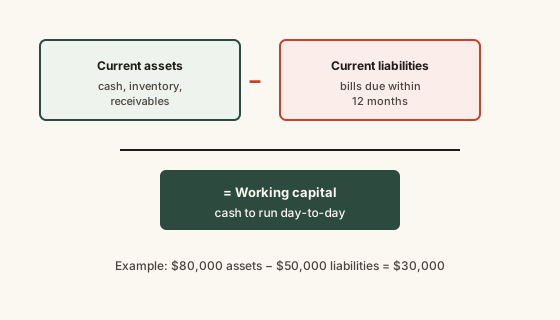
Estimate working capital from current assets and current liabilities.
A simplified illustration, not a substitute for a full balance sheet or professional financial analysis.
Common mistakes
Common Mistakes
Assuming a profitable business is automatically financially safe.
→ Check working capital and cash flow specifically — profit and available cash are genuinely different numbers, and the gap between them is where businesses get into real trouble.
Treating all inventory as equally 'liquid' current assets.
→ Slow-moving or obsolete inventory may take far longer than a year to convert to cash, even though it's technically classified as a current asset.
Panicking over negative working capital without checking whether it fits the business model.
→ Compare against businesses with a similar revenue structure before concluding negative working capital signals distress.
Common misconception
“A business with strong profit margins doesn't need to worry about working capital.”
Profit margin measures how much of each sales dollar becomes profit — it says nothing about when that value actually becomes spendable cash. A business can have excellent margins and still run out of usable cash if too much of its value is tied up in inventory sitting on shelves or invoices customers haven't paid yet, which is exactly the gap working capital is built to expose.
What to do next
What to do next
- Calculate your own business's working capital (current assets minus current liabilities) and revisit it monthly, not just at tax time.
- If working capital is thin or negative, check whether it fits your specific business model before assuming a crisis.
- Watch how quickly receivables actually get collected — a receivable that never converts to real cash isn't truly liquid, whatever the balance sheet says.
- For a real cash flow shortfall, talk to an accountant or SBA resource partner about working capital financing options before it becomes urgent.