 KnowThis
Key Takeaways
Key Takeaways
- 1Real validation means strangers spending money or real effort (a pre-order, a signup, a deposit) — polite encouragement from friends and family doesn't count as evidence.
- 2The goal is to test the riskiest assumption first — usually "will people actually pay for this" — before investing time in building the full product.
- 3A validated idea can still fail at execution, but an unvalidated idea fails at demand, which is a far more expensive and avoidable mistake.
The concept
The point of all of this is to fail cheaply and quickly if the idea doesn't hold up — validation exists specifically to catch a bad idea before it costs months of unpaid work.
An aspiring founder asks 20 friends whether they'd use their new app idea, and all 20 say yes enthusiastically. Why isn't this strong validation?
Worked examples
Example 1: A landing page pre-sale (baseline case)
Example 2: An idea that fails validation (edge case / variation)
Example 3: A service business validated through direct sales (real-world / applied case)
Why might directly contacting and pitching potential customers be a particularly strong validation method for a service business specifically?
How it works (visual)
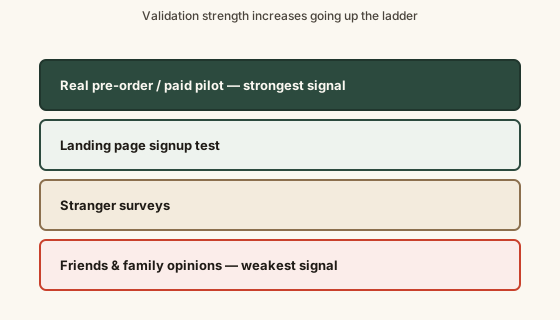
Moving up this ladder costs more effort at each step, which is exactly why it's worth testing cheaply near the bottom first and only investing in the stronger, costlier tests once the idea has already survived the cheap ones.
Common mistakes
Common Mistakes
Treating encouragement from friends and family as real market validation.
→ Test with strangers who have no social reason to be supportive, using a real ask tied to money or time.
Building the full product before testing whether anyone wants it.
→ Test the riskiest assumption first with the smallest possible version, before committing significant time to building everything.
Treating a lack of signups as a reason to keep building instead of a signal to reconsider.
→ Treat weak validation results as real data about the idea, not as something to push through by building more features.
Common misconception
“If you build a genuinely good product, customers will naturally find it and want it.”
Per SBA and SCORE guidance for new founders, a large share of small business failures trace back to building something the market didn't actually want, not to the product being low quality — genuine demand has to be tested and confirmed with real evidence before building, because "good" by the founder's own judgment and "wanted enough to pay for" by real customers are two different, separately-testable things.
What to do next
What to do next
- Identify the single riskiest assumption behind your business idea — usually whether people will pay for it — and design a test for that specifically.
- Talk to or survey real strangers in your target market, not just friends and family, and ask about their current behavior, not hypothetical future intent.
- Create a low-cost test (landing page, pre-order, direct pitch) that asks for a real commitment of money or time, not just an opinion.
- Use SBA.gov's free market research tools and SCORE's free mentoring to get outside, unbiased feedback on your validation plan.