 KnowThis
Key Takeaways
Key Takeaways
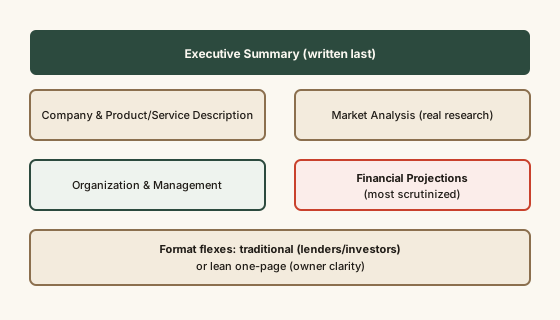
- 1Per SBA guidance, a business plan's core sections cover the business concept, target market, operating structure, and financial projections.
- 2The specific format can flex (traditional or lean), but skipping a section usually means skipping the thinking that section is meant to force.
- 3Financial projections are the section most often underdeveloped, even though they're what most lenders and investors scrutinize first.
Business plan sections at a glance
| Traditional plan section (SBA) | What it answers |
|---|---|
| Executive summary | What the company is and why it will work (write it last) |
| Company description | The problem you solve, who you serve and your edge |
| Market analysis | Industry outlook, target market and competitors |
| Organization and management | Legal structure and who runs what |
| Service or product line | What you sell and how it helps customers |
| Marketing and sales | How you'll attract and keep customers and close a sale |
| Funding request | How much money you need, debt or equity, and what it's for |
| Financial projections | A five-year outlook, with quarterly or monthly detail in year one |
The concept
This is also why a plan that's all executive summary and mission language, with thin financial projections, tends to get flagged immediately by an experienced lender or mentor — the sections that are hardest to fake are exactly the ones that matter most.
A prospective business owner writes a business plan with a strong, detailed executive summary and product description, but a market analysis based purely on personal opinion rather than research. What is the most likely issue a lender or mentor would flag?
Worked examples
Example 1: A traditional plan for a bank loan application (baseline case)
Example 2: A lean one-page plan for internal clarity only (edge case / variation)
Example 3: Revising a plan after real customer research (real-world / applied case)
Per SBA guidance, what's the main practical difference between a traditional business plan and a lean one-page plan?
How it works (visual)
Common mistakes
Common Mistakes
Writing the executive summary first and letting it set unexamined assumptions for the rest of the plan.
→ Draft the other sections first, then write the executive summary last as a genuine summary of what you found, per SCORE guidance.
Basing the market analysis on personal opinion instead of real research.
→ Research actual target customers, market size, and competitors before writing this section — it's one of the most scrutinized parts of the plan.
Treating financial projections as a formality to fill in quickly at the end.
→ Build realistic revenue and expense estimates grounded in actual costs and researched demand, since this is typically what lenders and mentors examine most closely.
Common misconception
“A business plan is mainly a formality you write once to satisfy a bank or investor, not something with real ongoing value.”
Per SBA and SCORE guidance, a business plan's core value is forcing genuine analysis of the target market, operating structure, and financial reality of a business idea — work that's useful regardless of whether outside funding is ever sought. The lean one-page format exists specifically for owners who want that clarity without producing lender-grade documentation, which underscores that the thinking behind each section, not the paperwork itself, is the actual point.
What to do next
What to do next
- Choose a traditional or lean plan format based on whether you'll be seeking a loan or outside investment, per SBA guidance.
- Research your actual target market and competitors before writing the market analysis section — don't rely on assumption.
- Build financial projections from real, itemized cost and demand estimates, not rough guesses.
- Write the executive summary last, once the rest of the plan reflects genuine research and analysis.