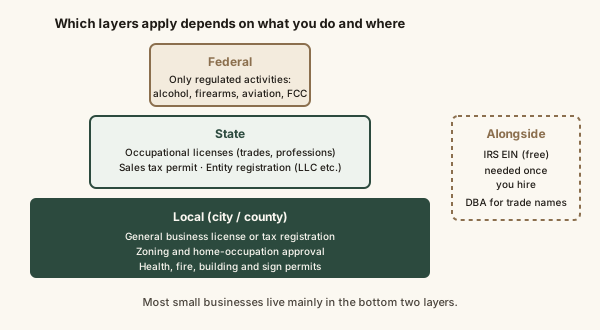
In the United States there is no single, universal business license. According to the U.S. Small Business Administration, the licenses and permits a business needs depend on its activity, its location and the government agencies that regulate that activity. Most businesses need little or nothing at the federal level unless they work in a regulated field such as alcohol, firearms, aviation, broadcasting or agriculture. At the state level, common requirements include occupational or professional licenses for regulated trades and a sales tax (seller's) permit for selling taxable goods. Locally, a city or county may require a general business license or business tax registration, a zoning or home-occupation approval, and health, fire or sign permits. Separate from licensing, registering a business entity with the state and getting an Employer Identification Number from the IRS are often required, especially once you hire employees. Fees, renewal periods and penalties vary widely by state and city, so the authoritative answer always comes from the specific state and local offices, often through a small business portal or a local SBA or SCORE adviser.
Reading time
— 6 min
Updated
— Oct 1, 2026
Fact-reviewed
— Oct 1, 2026
Licensing rules vary by state, county and city, and they change. This entry explains how the system is generally structured in the United States, based on SBA and IRS guidance. It isn't legal advice. Confirm your specific requirements with your state and local licensing offices, or a free SBA resource partner such as SCORE.
Key Takeaways
Key Takeaways
1There's no single US business license. What you need is a stack of approvals set by what you do, where you do it, and whether you hire, per the SBA.
2Most small businesses deal mainly with local and state requirements: a city or county business license, zoning approval, a sales tax permit, and any occupational license their trade requires.
3Federal licenses apply only to regulated activities such as alcohol, firearms, aviation or broadcasting. Entity registration and an EIN are separate steps from licensing.
The concept
People talk about "getting a business license" as if it were one form, like a driver's license. It's more like a stack of keys, each opening a different door. One key comes from your city, letting you operate there at all. Another comes from the state, letting you collect sales tax. If your trade is regulated (hair, electrical work, real estate, food), there's a key that proves you're qualified. And if you work from home, the zoning office may need to say a business is allowed on your street. Which keys you need depends on three questions: what are you doing, where are you doing it, and are you hiring anyone? A freelance writer working from a laptop might need almost nothing. A restaurant needs a whole keyring.
Quick check
Which question has the biggest influence on which licenses a business needs?
The four-question checklist
Before searching for forms, answer these. Each "yes" adds a layer.
Is my activity regulated? Food, alcohol, childcare, health services, construction trades, personal care, transport, finance and real estate usually are, at state level and sometimes federal.
Do I sell taxable goods or services? If your state has a sales tax, you'll likely need a seller's permit before the first sale.
Where physically will I operate? Your city and county set business registration, zoning and building rules. Home-based businesses often need a home-occupation approval.
Will I hire? Employees bring an EIN, state payroll tax registration and workers' compensation insurance (rules vary by state).
Worked examples
Fees and exact rules differ by place, so these examples describe the typical structure, not a specific city's costs.
Example 1: A freelance graphic designer working from home (baseline case)
No regulated activity, no physical customers, no employees, and design services aren't taxable in many states. The likely stack is short: a city or county business registration if the locality requires one, possibly a home-occupation approval (often simple when no clients visit), and a DBA if she trades under a studio name rather than her own. She doesn't need an EIN as a sole proprietor without employees, though many freelancers get one anyway (it's free) to avoid handing out their Social Security number on client tax forms. Total paperwork: often an afternoon. Even a setup this light counts as a business to the IRS once it's run for profit; side hustle vs real business covers where the practical line sits.
Example 2: A mobile food truck (edge case, many layers)
This is where the stack gets tall. The state or county health department inspects and permits the truck and usually requires a food-handler or food-manager certificate. A sales tax permit is needed for food sales. Each city the truck operates in may require its own business license and a mobile vending permit, sometimes with rules on where and when it can park. The fire department may inspect cooking equipment, and the truck needs commercial vehicle registration and insurance. Move to a new city and several of these start again. A food truck is the clearest case of why "the" business license is a myth.
Example 3: A two-person hair salon opening a storefront (applied)
The owners each need a state cosmetology license (training hours plus an exam), and many states also license the salon premises itself. The city requires a business license and, before opening, a zoning check and certificate of occupancy for the space. A sign permit covers the storefront sign. Selling hair products means a sales tax permit. Hiring a receptionist adds an EIN, state payroll registration and workers' compensation coverage. Doing these in the right order matters: signing a lease before confirming zoning is a classic expensive mistake, which is why the SBA and SCORE advisers suggest checking local zoning first.
Quick check
An entrepreneur forms an LLC with the state. Can they open their bakery the next day?
How it works (visual)
The business license stack: federal, state, local
Common mistakes
Common Mistakes
✕
Assuming forming an LLC or corporation means you're licensed.
→ Entity registration sets up the legal structure. Check activity licenses, local registration and tax permits separately.
✕
Signing a lease before checking zoning.
→ Confirm with the local planning or zoning office that your activity is allowed at that address before you commit.
✕
Paying a website to get a "free" EIN.
→ Apply directly on IRS.gov. The EIN itself costs nothing.
✕
Forgetting renewals.
→ Many local and occupational licenses expire on a cycle. Put every renewal date in a calendar the day you receive the license.
Common misconception
“Small or online businesses don't need any licenses.”
Size and being online don't create an exemption. An online seller may still need a sales tax permit, and a home-based business may still need local registration or zoning approval. Many very small service businesses do need little, but that's because of what they do and where, not how small they are.
What to do next
What to do next
Answer the four questions: regulated activity, taxable sales, physical location, employees.
Read the SBA's "Apply for licenses and permits" page and follow its links to your state's business portal.
Call or visit your city or county clerk's or licensing office and ask what a business like yours needs at your address.
Check zoning before signing any lease or investing in a home setup.
Get your EIN directly from IRS.gov if you'll hire or your entity type needs one.
Book a free session with a SCORE mentor or Small Business Development Center if the stack looks complicated.
FAQ
FAQ
Related terms
Related terms
General business license
A city or county registration (sometimes called a business tax certificate) that lets a business operate in that jurisdiction. Not every locality requires one.
Occupational license
A state-issued license for a regulated profession or trade, such as cosmetology, contracting or real estate, usually requiring training or an exam.
Seller's permit
A state registration to collect and remit sales tax on taxable goods or services. Also called a sales tax permit or license.
Home occupation permit
A local zoning approval for running a business from a residence, often with limits on signs, customer visits and employees.
DBA (doing business as)
A registration of a trade name different from the owner's legal name or the entity's registered name.
EIN
Employer Identification Number, a federal tax ID issued free by the IRS. Required for most businesses with employees and for many entity types.
This entry was researched from public sources and drafted with AI-assisted tools, then edited — errors are still possible. Spot one, or want a topic covered? Read our disclaimer.
 KnowThis