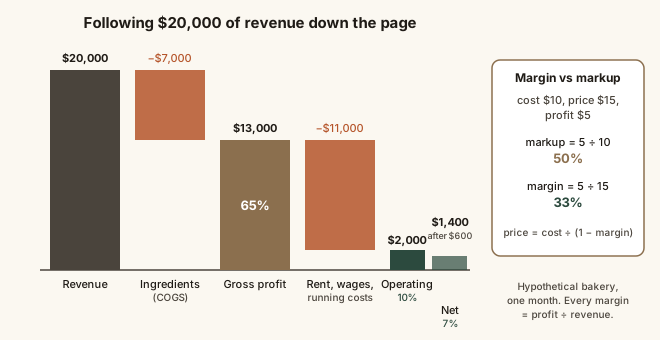
Profit margin is profit expressed as a percentage of revenue, and there are three standard versions depending on which costs are subtracted. Gross margin subtracts only the direct cost of the goods or services sold (COGS): a bakery with $20,000 of monthly sales and $7,000 of ingredients and packaging has a 65% gross margin. Operating margin also subtracts running costs such as rent, wages and software, and net margin subtracts everything, including interest and taxes, so the same bakery might keep 7 cents of every dollar. Margin is not the same as markup: markup divides profit by cost, margin divides it by price, so a 50% markup is only a 33% margin. Small price cuts hit margins hard: at a 40% gross margin, a 10% discount needs about a third more sales just to earn the same gross profit. Margins vary widely by industry, as NYU Stern's Aswath Damodaran's annual dataset shows, so comparisons are only meaningful within an industry. The IRS's Schedule C and the SBA's financial-management guidance use the same building blocks: revenue, cost of goods sold, expenses and net profit.
Reading time
— 5 min
Updated
— Oct 3, 2026
Fact-reviewed
— Oct 3, 2026
Key Takeaways
Key Takeaways
1Every profit margin is profit divided by revenue. The three standard ones differ in which costs come off first: gross (direct costs only), operating (plus running costs), net (everything, including interest and taxes).
2Margin is not markup. Markup divides profit by cost, margin divides it by price, so a 50% markup is only a 33% margin. Mixing them up is a classic way to underprice.
3Margins compare well only within an industry, and a 10% discount at a 40% margin needs about a third more sales just to stand still.
The concept
Take one dollar a customer hands you and follow where it goes. First, part of it pays for the thing you sold: the flour in the bread, the shirt you bought wholesale. What's left is your gross margin. Then part of what's left pays the rent, the staff, the card reader and the website. What survives that is your operating margin. Finally, interest on any loan and taxes take their share, and the few cents still in your hand are your net margin. A bakery might keep 65 cents after ingredients, 10 cents after running the shop, and 7 cents at the very end. All three numbers are "profit margin." When someone quotes one, the first question is always: which one?
Margins feed straight into pricing, and a profitable margin can still sit alongside an empty bank account, which is why cash flow is tracked separately.
Quick check
A freelancer quotes a 30% profit margin. Which number did they most likely mean?
Worked examples
The bakery and its numbers are hypothetical, chosen to make the arithmetic easy to follow.
Example 1: One month at a bakery, three margins (baseline case)
Revenue: $20,000. Ingredients and packaging (COGS): $7,000. Gross profit: $13,000, so gross margin = 13,000 ÷ 20,000 = 65%. Operating expenses: rent $4,000, wages $6,000, utilities, card fees and software $1,000, total $11,000. Operating income: $2,000, so operating margin = 10%. Loan interest: $200. Estimated income tax: $400. Net income: $1,400, so net margin = 7%. The owner who says "bread is a 65% margin business" is right about the ingredients and wrong about what reaches the bank: 7 cents per dollar.
Example 2: The markup trap (edge case)
A reseller buys a lamp for $30 and wants a "40% margin." They add 40% to cost: $30 × 1.4 = $42. Profit is $12, and $12 ÷ $42 is about 28.6%, not 40%. To hit a true 40% margin, divide instead: $30 ÷ (1 − 0.40) = $50, giving $20 profit on a $50 price. Across 1,000 lamps a year, the gap between the two prices is $8,000 of gross profit. The confusion is common because markup and margin are both "percent profit"; they just measure against different bases.
Example 3: What a 10% sale really costs (applied)
A product sells for $100 and costs $60: gross profit $40, margin 40%. Run a 10% discount and the price is $90, but the cost is still $60, so gross profit falls to $30 and margin to 33.3%. The discount took 10% off the price but 25% off the profit per sale. To earn the same $4,000 of gross profit that 100 full-price sales produced, you now need about 134 sales, roughly a third more. At a 20% gross margin the same 10% discount halves profit per sale and requires twice the volume. This is the arithmetic to run before any promotion, and it's why working capital gets tight when discounts don't bring the extra customers.
Quick check
A product costs $40. Which price gives exactly a 50% gross margin?
How it works (visual)
Where each dollar of revenue goes: gross, operating and net margin
Common mistakes
Common Mistakes
✕
Adding a percentage to cost and calling it margin.
→ That's markup. For a target margin, price = cost ÷ (1 − margin). A 40% margin on a $30 item is $50, not $42.
✕
Quoting gross margin as if it were take-home profit.
→ Always say which margin. Net margin is what's left after rent, wages, interest and taxes.
✕
Comparing your margin to a business in a different industry.
→ Use industry benchmarks, such as Damodaran's annual dataset, and compare against peers with similar costs.
✕
Running discounts without checking the volume needed.
→ Compute gross profit per sale after the discount and how many more sales you need to match the old total.
Common misconception
“A high profit margin means the business is doing well.”
Margin is a ratio, not a total, and not cash. A 40% margin on very few sales may not cover the owner's living costs, while a 3% margin on large volume can be a strong business. A high margin can also coexist with running out of money if customers pay slowly or cash is tied up in stock. Read margin alongside total profit and cash flow. Knowing your margins at all is one of the habits that separates a side hustle from a real business.
What to do next
What to do next
Pull last month's revenue, cost of goods sold and operating expenses from your books or bank records.
Calculate all three margins, and label each one clearly.
For your top three products, compute margin per item using price = cost ÷ (1 − target margin).
Before your next promotion, work out how many extra sales the discount needs to break even.
Look up your industry's typical margins and note where you sit; an accountant can help adjust for how costs are classified.
FAQ
FAQ
Related terms
Related terms
Revenue
The total money a business brings in from sales before any costs are subtracted. Also called sales or the top line.
Cost of goods sold (COGS)
The direct cost of producing what was sold, such as materials, inventory purchased for resale, and directly involved labor.
Gross margin
(Revenue minus COGS) divided by revenue. Shows how much of each sale is left to cover running costs and profit.
Operating margin
Operating income (gross profit minus operating expenses such as rent, wages and marketing) divided by revenue.
Net profit margin
Net income after every cost, including interest and taxes, divided by revenue. The bottom line as a percentage.
Markup
Profit divided by cost. A product costing $10 and selling for $15 has a 50% markup but a 33% margin.
Contribution margin
Price minus the variable cost of one unit; what each extra sale contributes toward fixed costs and profit.
This entry was researched from public sources and drafted with AI-assisted tools, then edited — errors are still possible. Spot one, or want a topic covered? Read our disclaimer.
 KnowThis