 KnowThis
Key Takeaways
Key Takeaways
- 1Freelance and self-employment income has no employer withholding it automatically, so the worker is responsible for setting aside and paying both income tax and self-employment tax themselves.
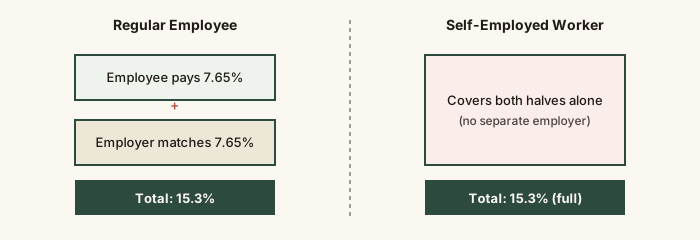
- 2Self-employment tax, currently 15.3% of net earnings, covers Social Security and Medicare contributions that an employer and employee would otherwise split between them.
- 3Most self-employed workers owing more than a small threshold must pay estimated taxes quarterly, not just once a year at filing time, to avoid an underpayment penalty.
The concept
Seeing the two tax layers — self-employment tax and income tax — calculated side by side makes clear why freelance income can carry a noticeably higher effective rate than the same amount of W-2 wages.
Why do self-employed workers pay a 15.3% self-employment tax while regular employees only see 7.65% deducted from their paycheck for the same type of contribution?
Worked examples
Example 1: Calculating self-employment tax on net earnings (baseline case)
Example 2: A part-time side freelancer with a regular job too (edge case / variation)
Example 3: Missing quarterly estimated payments (real-world / applied case)
A freelancer wants to avoid an underpayment penalty. What generally matters most?
How it works (visual)
Common mistakes
Common Mistakes
Not setting aside money for taxes throughout the year, then facing a large unexpected bill at filing time.
→ Set aside a portion of every freelance payment received — many freelancers target roughly 25-30% as a starting estimate, then adjust based on actual bracket and self-employment tax — into a separate account for taxes.
Assuming self-employment tax is the only tax owed on freelance income.
→ Remember regular income tax still applies to net earnings on top of the separate 15.3% self-employment tax — both are owed.
Paying the full year's tax bill in April instead of in quarterly estimated installments.
→ Check the current quarterly estimated tax due dates on irs.gov and pay through the year as income is earned, to avoid a potential underpayment penalty.
Common misconception
“Freelance and self-employment income is taxed at a special, separate lower or higher overall rate than regular wages.”
There isn't a separate special rate — self-employment income is subject to the same income tax brackets as any other income, plus a 15.3% self-employment tax that covers the Social Security/Medicare contribution an employer would otherwise partly cover for a W-2 employee. The total can feel higher simply because there's no employer quietly absorbing half of that contribution.
Try it yourself
What to do next
What to do next
- Set aside a percentage of every freelance payment for taxes in a separate account as soon as it's received, rather than waiting until filing time.
- Check the current quarterly estimated tax due dates and thresholds on irs.gov to see if you're required to pay quarterly.
- Track business expenses carefully throughout the year, since they reduce the net earnings that both income tax and self-employment tax are calculated on.
- For a real quarterly payment schedule or entity-structure decision (like forming an LLC or S-corp), consult a licensed tax professional rather than general literacy content like this.