 KnowThis
Key Takeaways
Key Takeaways
- 1A pay stub has three layers: gross pay (everything earned), a list of individual deductions, and net pay (what's left after every deduction is subtracted).
- 2Deductions fall into distinct categories — taxes (federal, state, FICA), pre-tax benefits (retirement, health insurance), and post-tax deductions — and each category affects your taxable income differently.
- 3This is general paycheck literacy, not personalized tax advice — for a specific paycheck discrepancy or filing question, your employer's payroll department or a licensed tax professional is the right resource, not a general reference article.
The concept
Once gross pay and the deduction categories are separated out, the actual arithmetic connecting them is simple — it's identifying which category a given line belongs to that trips people up.
An employee increases their traditional 401(k) contribution by $100 per paycheck. Does their take-home pay drop by exactly $100?
Worked examples
Example 1: A straightforward biweekly pay stub (baseline case)
Example 2: Adding a pre-tax 401(k) contribution changes the tax base (edge case / variation)
Example 3: Why year-to-date totals matter for catching a payroll error (real-world / applied case)
Near the end of the year, a high earner notices their Social Security withholding suddenly drops to $0 on their pay stub. What does this most likely indicate?
How it works (visual)
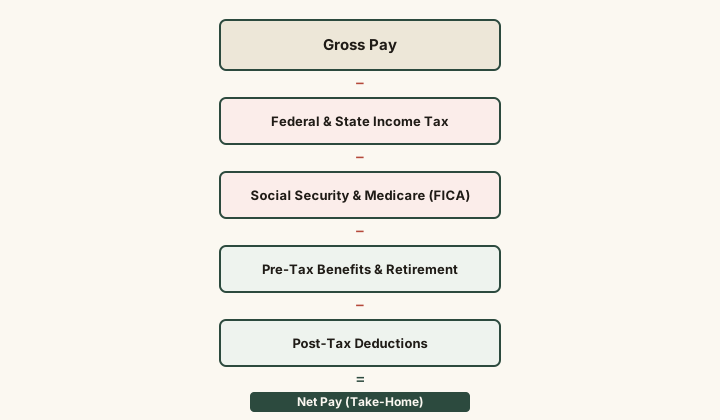
Each slice represents a genuinely separate calculation — some (pre-tax deductions) change what the tax-calculation slices above them are based on, while FICA is calculated on the original gross figure regardless of what else has already been deducted.
Common mistakes
Common Mistakes
Assuming a raise or a benefit change will move net pay by the exact same dollar amount as the change itself.
→ Check which deduction category is affected — pre-tax changes shift the tax-calculation base too, so the net-pay effect is rarely a 1:1 match with the raw dollar change.
Treating a single pay period's numbers as the full picture when investigating a possible payroll error.
→ Compare against the year-to-date (YTD) totals printed on the same stub — some apparent anomalies (like Social Security withholding stopping) are normal once annual thresholds are considered.
Confusing FICA (Social Security and Medicare) with federal income tax withholding.
→ Remember FICA is a flat-rate payroll tax set by federal law and isn't adjusted by a W-4, while income tax withholding is estimated based on W-4 elections and can vary paycheck to paycheck.
Common misconception
“Every dollar deducted from a paycheck for taxes and benefits reduces take-home pay by exactly that same dollar amount.”
Only true for post-tax deductions. Pre-tax deductions (like a traditional 401(k) contribution or many health insurance premiums) also reduce the income that federal and state income tax withholding is calculated on that period — so take-home pay typically drops by somewhat less than the raw pre-tax deduction amount, since the income tax lines shrink too.
Try it yourself
What to do next
What to do next
- Pull up your most recent pay stub and identify which category each deduction line actually belongs to: tax, pre-tax benefit, or post-tax deduction.
- Check the year-to-date totals against the current period's numbers at least once a year — it's the fastest way to catch a genuine payroll discrepancy.
- If a number looks wrong, raise it with your employer's payroll department first — they have access to your actual withholding elections and history, which a general reference article can't account for.
- For any real tax filing question tied to your specific situation, consult a licensed tax professional or the IRS directly rather than relying on general literacy content like this.