 KnowThis
Key Takeaways
Key Takeaways
- 1Withholding is an estimate of your tax bill, deducted from each paycheck throughout the year and sent to the IRS on your behalf before you ever file a return.
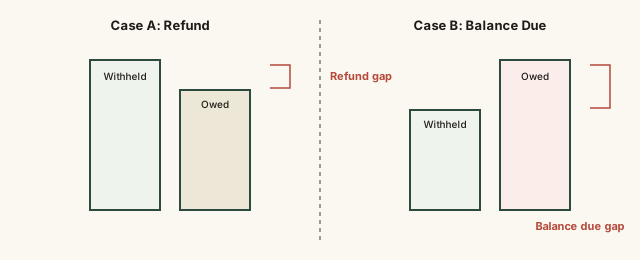
- 2A tax refund is not free money — it's the amount your withholding exceeded your actual tax owed, meaning you overpaid all year and are only now getting your own money back.
- 3Owing money at filing time means your withholding came in under your actual tax bill — it doesn't automatically mean something went wrong, just that less was set aside than was owed.
The concept
Neither a refund nor a balance due is inherently "good" or "bad" — they both just describe how closely withholding happened to match the actual tax bill.
A taxpayer gets a $2,000 refund every year. What does this actually mean?
Worked examples
Example 1: Over-withholding leads to a refund (baseline case)
Example 2: Under-withholding leads to a balance due (edge case / variation)
Example 3: Adjusting withholding after a life change (real-world / applied case)
Is it always best to aim for the biggest possible tax refund?
How it works (visual)
Common mistakes
Common Mistakes
Treating a tax refund as a windfall or bonus rather than as returned overpayment.
→ Remember a refund is your own money coming back without interest — if you'd rather have it throughout the year, adjust your W-4 to reduce over-withholding.
Not updating a W-4 after a major life change like marriage, a new job, or a new dependent.
→ Run the IRS Tax Withholding Estimator whenever your household income or filing status changes, and submit an updated W-4 to your employer.
Assuming a balance due at filing time always means a mistake was made.
→ A balance due just means withholding came in under the actual tax owed — check whether it's a one-time issue (like side income) or a recurring gap worth adjusting the W-4 for.
Common misconception
“Getting a big tax refund means you got extra money from the government.”
A refund is a return of your own money — specifically, the amount your paycheck withholding exceeded your actual tax bill for the year. It was never the government's money to give; it was yours all along, held without interest until filing time.
What to do next
What to do next
- Use the IRS Tax Withholding Estimator at least once a year, and after any major life change, to check whether your current W-4 still matches your situation.
- If you consistently get a very large refund and would rather have that money throughout the year, consider adjusting your W-4 to reduce withholding.
- If you owe a balance every year, especially with a penalty, consider adjusting your W-4 to withhold slightly more.
- For complex situations — multiple jobs, freelance income alongside a job, major household changes — consult a licensed tax professional rather than guessing at W-4 adjustments.