 KnowThis
Key Takeaways
Key Takeaways
- 1A progressive tax bracket applies only to the slice of income that falls inside it — not to a person's entire income once they cross into that bracket.
- 2This is why marginal tax rate (the rate on your last dollar earned) and effective tax rate (your actual average rate across all income) are different numbers, and effective rate is always the lower of the two.
- 3This entry uses an illustrative simplified two-bracket example to explain the mechanism — for actual current bracket thresholds and rates, see irs.gov, not this article.
The concept
Once the slicing mechanism is clear, the arithmetic behind "why a raise never leaves you worse off" (a common, related worry) follows directly from it.
Someone earning $95,000 is offered a raise to $105,000, and the $100,000 mark is the threshold into a higher tax bracket. Could taking the raise ever leave them with less take-home pay than before?
Worked examples
Example 1: A simplified two-bracket calculation (baseline case)
Example 2: Marginal vs effective rate on the same income (edge case / variation)
Example 3: Why a raise can't reduce take-home pay through bracket-crossing alone (real-world / applied case)
If effective tax rate is always less than or equal to marginal tax rate in a progressive system, when would the two be closest to equal?
How it works (visual)
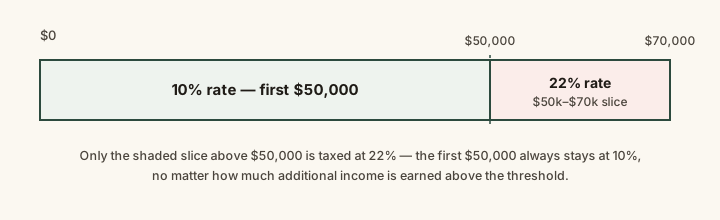
The lower slice never changes rate no matter how much additional income stacks on top of it — each bracket's rate is locked to that specific slice of income, which is the entire mechanism behind why crossing a bracket boundary can't retroactively raise the tax on income already earned below it.
Common mistakes
Common Mistakes
Believing that crossing into a higher tax bracket means your entire income gets taxed at the new, higher rate.
→ Remember only the slice of income above the bracket threshold is taxed at the higher rate — every dollar below the threshold keeps its original, lower rate.
Using 'tax bracket' and 'effective tax rate' interchangeably.
→ Marginal rate (the bracket you're 'in') describes only your last dollar earned; effective rate is your actual average rate across all income, and it's always lower in a genuinely progressive system.
Turning down a raise or bonus out of fear it will result in less take-home pay overall.
→ In a progressive system, a raise can only ever increase total take-home pay — the higher rate applies only to the new, incremental income, never retroactively to income already earned.
Common misconception
“If you're 'in the 22% bracket,' you're paying 22% of your total income in tax.”
The 22% (or whatever bracket rate) applies only to the slice of income within that specific bracket — not to your total income. Your actual overall tax burden, the effective rate, blends in the lower rates paid on every slice of income below that bracket, and is always a lower number than the marginal rate itself.
Try it yourself
What to do next
What to do next
- Check irs.gov for the actual current-year federal tax brackets rather than relying on any specific number from a general reference article.
- When comparing your own tax situation, distinguish between your marginal rate (the bracket you're in) and your effective rate (your real average burden) — they answer different questions.
- Don't decline a raise or bonus out of a mistaken fear of bracket-crossing — in a progressive system, more gross income always means more net income, even after tax.
- For a real filing question specific to your income and deductions, consult a licensed tax professional rather than general literacy content like this.