 KnowThis
Key Takeaways
Key Takeaways
- 1A tax deduction reduces taxable income, so its actual dollar-value savings equals the deduction amount multiplied by your marginal tax rate — never the full deduction amount itself.
- 2A tax credit reduces the tax bill directly, dollar for dollar, so a $1,000 credit always saves exactly $1,000 regardless of tax rate.
- 3This means a $1,000 credit is always worth at least as much as a $1,000 deduction, and usually worth considerably more, since most people's marginal rate is well under 100%.
The concept
Seeing the actual dollar difference side by side makes clear why a smaller-sounding credit can outperform a larger-sounding deduction.
A taxpayer in a 12% marginal bracket is choosing between a $2,000 deduction and a $1,000 credit. Which saves them more money?
Worked examples
Example 1: A deduction's real value at a given marginal rate (baseline case)
Example 2: The same $1,000 as a credit instead (edge case / variation)
Example 3: Why the same deduction is worth different amounts to different earners (real-world / applied case)
Why might a policymaker prefer a tax credit over a tax deduction when designing a benefit meant to help lower-income taxpayers specifically?
How it works (visual)
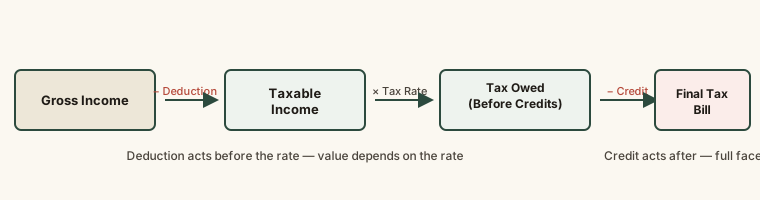
The deduction intervenes before the tax rate is ever applied, which is why its value depends on that rate — the credit intervenes after the rate has already done its work, which is why its value doesn't depend on the rate at all.
Common mistakes
Common Mistakes
Assuming a deduction and a credit of the same headline dollar amount produce the same tax savings.
→ Multiply the deduction by your marginal tax rate to find its real value, then compare that to the credit's full face value — they're rarely equal.
Assuming a bigger deduction is always better than a smaller credit.
→ Do the actual multiplication — a modest credit frequently outperforms a much larger deduction once the marginal-rate math is applied.
Treating all tax credits as equally valuable without checking whether they're refundable or nonrefundable.
→ Check each credit's refundability on irs.gov — a nonrefundable credit can only reduce tax owed to zero, while a refundable one can result in money paid back even below that.
Common misconception
“A $1,000 tax deduction and a $1,000 tax credit save you the same amount of money.”
They almost never do. A deduction's real savings equal the deduction amount multiplied by your marginal tax rate — for most taxpayers, well under $1,000. A credit's savings equal its full face value, subtracted directly from the tax bill. The only case where they'd be equal is a taxpayer facing a hypothetical 100% marginal rate, which doesn't happen in practice.
Try it yourself
What to do next
What to do next
- Before comparing a deduction and a credit, multiply the deduction by your marginal tax rate to see its real dollar value — never compare headline numbers directly.
- Check whether a credit you're considering is refundable or nonrefundable on irs.gov, since that changes its real value if your tax bill is already low.
- Remember a deduction's real value scales with your marginal rate, while a credit's value doesn't — this matters when estimating the benefit of any specific deduction or credit for your situation.
- For a real filing decision involving specific deductions or credits, consult a licensed tax professional rather than general literacy content like this.