What Tax Credits Actually Differ From Tax Deductions
A tax deduction reduces taxable income, so its value equals the deduction multiplied by the taxpayer's marginal tax rate (a $1,000 deduction saves $220 for someone in the 22% bracket), and itemized deductions only help if they exceed the standard deduction. A tax credit reduces the tax owed directly, dollar for dollar. Credits come in two kinds, per the IRS: nonrefundable credits can reduce tax only to zero, while refundable credits, such as the Earned Income Tax Credit and the refundable part of the Child Tax Credit, are paid out as a refund even when the credit exceeds the tax owed. That refundability is why the IRS and researchers treat credits like the EITC as one of the largest U.S. income-support programs for working families, and why eligible people with low incomes may need to file a return to receive money even if they aren't otherwise required to file. This is general information, not tax advice; rules and amounts change yearly.
Reading time
— 5 min
Updated
— Sep 25, 2026
Fact-reviewed
— Sep 25, 2026
Key Takeaways
Key Takeaways
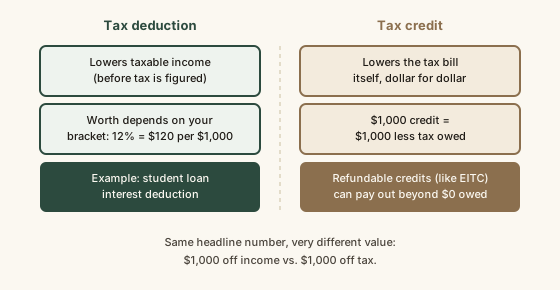
1A deduction lowers the income you're taxed on, so it saves only your tax rate times the amount: $1,000 is worth $120 in the 12% bracket.
2A credit lowers the tax bill itself, dollar for dollar: $1,000 is worth $1,000.
3Refundable credits, like the Earned Income Tax Credit, can pay you money even when you owe no tax, which makes them some of the largest support programs for working families.
The concept
Picture your taxes in two steps. First, figure out how much of your income gets taxed. Second, figure out the tax on it. A deduction works on step one: it shrinks the income that gets taxed, so you save only a slice of it, the slice your tax rate would have taken. A credit works on step two: it comes straight off the final bill. That's why a $1,000 credit is worth far more than a $1,000 deduction. Then there's one more twist. Some credits are "refundable," meaning if the credit is bigger than your tax, the government pays you the difference. For many working families with modest incomes, those refundable credits are the biggest money event of the year.
A companion piece in Personal Finance, understanding tax deductions vs. tax credits, covers everyday filing terms. This one focuses on why the credit side matters as a benefit, and how it connects to applying for government assistance programs, since tax credits are claimed on a return rather than through an application office. Businesses meet a similar split: a business tax credit lowers the tax owed, while a small business grant is money awarded through a competitive, scored review for a specific purpose.
Quick check
Two people each get a $2,000 deduction. One is in the 12% bracket, the other in the 32% bracket. How much does each save?
Worked examples
Example 1: Same $1,000, very different value (baseline case)
A single filer in the 22% bracket owes $5,000 in tax. A $1,000 deduction lowers taxable income by $1,000, cutting tax by $1,000 × 22% = $220, to $4,780. A $1,000 credit cuts the bill itself to $4,000. The credit is worth about 4.5 times as much to this person.
Example 2: Refundable vs. nonrefundable (edge case)
A part-time worker owes $300 in tax and qualifies for two credits: a $500 nonrefundable credit and a $1,200 refundable credit. The nonrefundable credit is applied first and can only take the bill from $300 to $0; the leftover $200 of it is generally lost. The refundable credit then has nothing left to offset, so the full $1,200 is paid as a refund. The order of application is set by the tax forms; the point is that only the refundable one can become a check.
Example 3: The worker who didn't think they needed to file (applied case)
A parent earned $18,000 last year, had little tax withheld, and assumed there was no reason to file. But at that income with children they may qualify for a substantial EITC plus the refundable part of the Child Tax Credit, which together can run into thousands of dollars. Neither is paid automatically; both require filing a return. The IRS estimates that a meaningful share of eligible workers miss the EITC each year, which is why it runs an annual awareness campaign and free filing help.
Quick check
In Example 2, why is the $1,200 credit fully paid out while part of the $500 credit is lost?
How it works (visual)
Deduction vs. credit: where each one hits your tax
Common mistakes
Common Mistakes
✕
Thinking a $1,000 deduction saves $1,000.
→ Multiply by your marginal rate. At 22%, it saves $220.
✕
Not filing because income was below the filing requirement.
→ Check eligibility for refundable credits like the EITC. They're only paid through a filed return.
✕
Tracking itemized expenses without comparing to the standard deduction.
→ Add them up first. If the total is below the standard deduction, itemizing won't lower your tax.
Common misconception
“Tax credits and tax deductions are basically the same thing: both just lower your taxes.”
They act at different points. A deduction lowers the income your tax is calculated on, so it's worth only a fraction of its face value. A credit comes off the finished tax bill in full. And refundable credits go further than any deduction can: they can produce a payment to people who owe no tax at all, which is why the IRS treats the EITC as a key support for low- and moderate-income workers rather than just a tax break.
What to do next
What to do next
Find your marginal bracket so you can put a real dollar value on any deduction.
Use the IRS EITC Assistant (on irs.gov) to check whether you qualify, even if you don't usually file.
Compare your itemizable expenses against the standard deduction before keeping detailed records for itemizing.
If your income is modest, look up a free IRS VITA site to file and claim credits at no cost.
FAQ
FAQ
Related terms
Related terms
Tax deduction
An amount subtracted from income before tax is calculated. It lowers taxable income, so its value depends on your tax rate.
Tax credit
An amount subtracted directly from the tax you owe, dollar for dollar.
Refundable credit
A credit that can be paid to you as a refund if it's larger than the tax you owe, such as the Earned Income Tax Credit.
Nonrefundable credit
A credit that can reduce your tax bill to zero but not below it. Any leftover amount is lost unless a specific rule lets it carry forward.
Standard deduction
A fixed amount, set by law each year based on filing status, that most taxpayers subtract instead of itemizing individual deductions.
Marginal tax rate
The rate applied to your last dollar of taxable income: your top bracket. It's what determines how much a deduction is worth to you.
This entry was researched from public sources and drafted with AI-assisted tools, then edited — errors are still possible. Spot one, or want a topic covered? Read our disclaimer.
 KnowThis