How Student Loan Forgiveness Programs Actually Work
U.S. federal student loan forgiveness works through several separate programs, each with its own trigger, and none of them covers private loans. Public Service Loan Forgiveness (PSLF) cancels the remaining Direct Loan balance after 120 qualifying monthly payments made while working full-time for a government agency or qualifying nonprofit, and that forgiveness is not federally taxable. Income-driven repayment (IDR) plans forgive whatever is left after a long repayment period: 20 or 25 years on the older plans, and 30 years on the Repayment Assistance Plan (RAP) that became available on July 1, 2026. As of September 2026, IDR forgiveness granted after December 31, 2025 counts as federal taxable income unless an exclusion such as insolvency applies. Teacher Loan Forgiveness cancels up to $17,500 or $5,000 after five complete, consecutive years of full-time teaching at a qualifying low-income school. Separate discharges cancel loans for total and permanent disability, death, a school closure or school misconduct; a 2025 law made death and disability discharges permanently exempt from federal income tax. Rules changed significantly in 2025 and 2026, so borrowers should confirm their own status on StudentAid.gov or with their loan servicer.
Reading time
— 6 min
Updated
— Sep 30, 2026
Fact-reviewed
— Sep 30, 2026
This entry explains how U.S. federal student loan forgiveness generally works as of September 2026. It is not financial, tax or legal advice. Student loan rules changed significantly in 2025 and 2026 and may change again. Confirm your own eligibility, payment count and plan on StudentAid.gov or with your loan servicer, and ask a tax professional how any forgiveness affects your taxes.
Key Takeaways
Key Takeaways
1Forgiveness isn't one program: it's public service (PSLF), long-term income-driven repayment, teaching, or a discharge for a specific event.
2PSLF cancels the remaining Direct Loan balance after 120 qualifying payments while working full-time for government or a qualifying nonprofit, tax-free.
3Income-driven plans forgive what's left after 20 to 30 years. As of September 2026, that forgiveness is generally federally taxable again.
4Private loans don't qualify, and you never need to pay anyone to apply.
The concept
Think of federal student loan forgiveness as four different doors, not one. The first is a job door: work full-time in public service and make 10 years of qualifying payments, and the rest is canceled. The second is a time door: pay a share of your income for 20 to 30 years, and whatever's left is canceled. The third is a teaching door: teach five years in a qualifying low-income school and get up to $17,500 off. The fourth is an event door: if you become totally and permanently disabled, die, or your school closed or misled you, the loan can be discharged. Each door has its own rules, and walking through the wrong one, or thinking you're on the path when you're not, is the most common way borrowers lose years.
Quick check
Which three things must all be true for a month to count toward PSLF?
Worked examples
Example 1: A nonprofit nurse on PSLF (baseline case)
Maya is a full-time nurse at a 501(c)(3) hospital with $60,000 in Direct Loans. She enrolls in an income-driven plan and certifies her employment each year with the PSLF Help Tool on StudentAid.gov. Suppose her payments average $280 a month (an illustrative figure; real amounts depend on income and family size). After 120 qualifying payments she has paid about $33,600, and the remaining balance is canceled. Under current federal law that cancellation isn't taxable income. The key move wasn't the job alone: it was being on a qualifying plan and certifying employment, so every one of those months actually counted.
Example 2: The teacher who can't double-count (edge case)
Daniel teaches high-school chemistry full-time at a school on the federal low-income directory. After five complete, consecutive years he could apply for Teacher Loan Forgiveness of up to $17,500. But he works for a public school, so those same years could also count toward PSLF, and the rules don't let the same period of service count for both. If he takes the $17,500, the payments he made during those five years won't count toward PSLF, so his PSLF count effectively starts after them. If his balance is large and he plans to stay in public service, waiting for PSLF may cancel far more; if his balance is small or he may leave teaching, the guaranteed $17,500 may be worth more. It's a real trade-off, and his servicer or StudentAid.gov can show his current PSLF count before he decides.
Example 3: The tax bill after IDR forgiveness (applied case)
Lena reaches the end of her income-driven plan in 2027 and $40,000 is forgiven. Because the temporary federal exclusion ended with 2025 discharges, that $40,000 is generally added to her federal taxable income for 2027. If it were all taxed at a 22% marginal rate, the federal bill would be about $8,800 (a simplified illustration; real brackets and state rules vary). There's an important exception: if her total debts exceeded her total assets right before the forgiveness, she may be able to exclude some or all of it as insolvent, using IRS Form 982 as described in Publication 4681. The applied lesson: if you're on track for IDR forgiveness, talk to a tax professional well before the year it happens.
Quick check
Lena's $40,000 IDR forgiveness in 2027 is most likely:
How it works (visual)
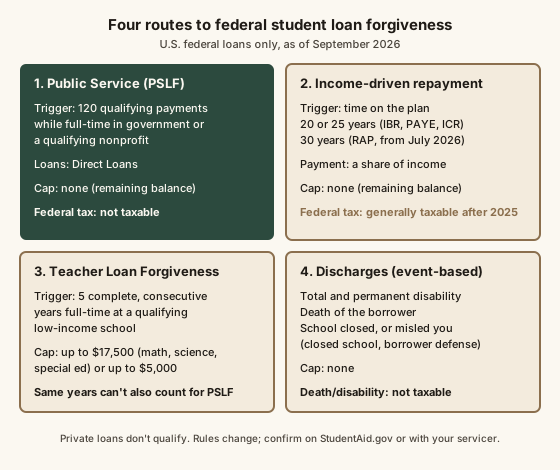
The four main routes to federal student loan forgiveness
The routes differ on three axes: what triggers forgiveness (a job, time, a teaching record or an event), whether there's a dollar cap, and whether the canceled amount is taxed. Most confusion comes from mixing them up, such as assuming IDR forgiveness is tax-free because PSLF is.
Common mistakes
Common Mistakes
✕
Assuming a public-service job alone qualifies you for PSLF.
→ Check all three conditions: Direct Loans, a qualifying plan, and certified full-time qualifying employment.
✕
Never certifying employment until year 10.
→ Certify each year or when you change jobs with the PSLF Help Tool, so problems surface early.
✕
Assuming all forgiveness is tax-free.
→ PSLF and death or disability discharges are federally tax-free; IDR forgiveness after 2025 generally isn't.
✕
Paying a company to 'enroll' you in forgiveness.
→ Applying is free on StudentAid.gov. Never share your FSA ID or pay upfront fees.
✕
Consolidating without checking the effect on your payment count or plan options.
→ Ask your servicer how consolidation affects your count and which plans you'll be eligible for before you do it.
Common misconception
“Student loan forgiveness was canceled, so none of it exists anymore.”
Broad one-time cancellation was struck down by the Supreme Court in 2023, and the SAVE plan has ended, but the programs written into law are still running as of September 2026: PSLF, income-driven forgiveness (now including RAP), Teacher Loan Forgiveness, and the disability, death, closed-school and borrower-defense discharges. What changed is the details, especially which repayment plans are available and how forgiveness is taxed.
What to do next
What to do next
Log in to StudentAid.gov and list each loan's type (Direct, FFEL, Perkins, or private).
Check which repayment plan you're on, and whether it counts for the program you're aiming at.
If you work in government or a nonprofit, run the PSLF Help Tool and certify your employment now.
If you teach at a low-income school, compare Teacher Loan Forgiveness with PSLF before applying for either.
If you're within a few years of IDR forgiveness, ask a tax professional about the likely tax bill and the insolvency exclusion.
Ignore anyone who charges a fee to apply or asks for your FSA ID.
FAQ
FAQ
Related terms
Related terms
Public Service Loan Forgiveness (PSLF)
A federal program that cancels the remaining balance on Direct Loans after 120 qualifying monthly payments made while working full-time for a government organization or qualifying nonprofit.
Qualifying payment
A full, on-time monthly payment made under a qualifying repayment plan while meeting a program's employment or plan rules. Only these count toward forgiveness.
Income-driven repayment (IDR)
Federal repayment plans that set the monthly payment as a share of income and forgive any balance left after a set number of years (20 to 30, depending on the plan).
Repayment Assistance Plan (RAP)
An income-driven plan created by a 2025 law and available from July 1, 2026, with payments of 1% to 10% of adjusted gross income and forgiveness of any remaining balance after 30 years.
Discharge
Cancellation of a federal student loan because of a specific event, such as total and permanent disability, death, a school closing or school misconduct, rather than years of payments.
Insolvency exclusion
An IRS rule that lets you exclude canceled debt from taxable income to the extent your total debts exceeded your total assets right before the cancellation (see IRS Publication 4681).
This entry was researched from public sources and drafted with AI-assisted tools, then edited — errors are still possible. Spot one, or want a topic covered? Read our disclaimer.
 KnowThis