A student loan is principal borrowed for education that accrues interest and gets repaid over a set term, with federal loans (originated and guaranteed by the U.S. Department of Education) offering mechanics private lenders generally don't, including a grace period before repayment starts, subsidized loans where the government pays interest while a borrower is in school, and income-driven repayment plans that tie the monthly payment to income rather than a fixed amortization schedule.
Reading time
— 4 min
Updated
— Aug 22, 2026
Fact-reviewed
— Aug 22, 2026
Key Takeaways
Key Takeaways
1A student loan follows the same basic mechanics as any installment loan — principal, an interest rate, and a repayment term — but federal loans add rules private loans generally don't have.
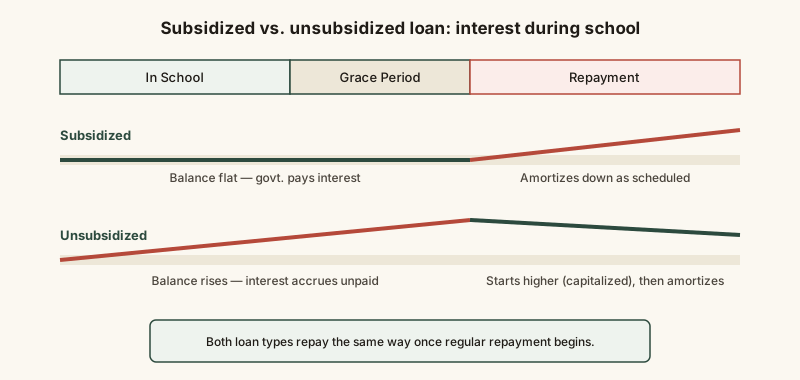
2On a subsidized federal loan, the government pays the accruing interest while the borrower is in school and during the grace period; on an unsubsidized loan, interest accrues the entire time, including while in school.
3Federal loans offer income-driven repayment plans that set the monthly payment as a percentage of income rather than a fixed schedule — a mechanic that doesn't exist on most private loans or other consumer debt.
The concept
A student loan is money borrowed to pay for education that has to be paid back with interest, same as any other loan. What makes federal student loans different from a typical personal loan is the extra structure built in: a grace period after leaving school before payments start, some loans where the government covers interest while you're in school (called subsidized loans), and repayment plans that can be based on income instead of a fixed monthly amount.
The subsidized-versus-unsubsidized distinction and the grace period are the two mechanics most specific to student loans, so it's worth walking through concrete numbers for each.
Quick check
A borrower has a subsidized federal loan while enrolled in school. What happens to the interest that accrues during that time?
Worked examples
Example 1: Estimating a standard repayment amount (baseline case)
A borrower has $25,000 in federal student loan debt at a 6% fixed rate on the standard 10-year repayment plan. Treating this as a standard amortizing installment loan — the same math used for a personal loan or a car loan — produces a fixed monthly payment for the full term. This is what the standard repayment plan looks like mechanically: same formula as any fixed-rate installment loan, just applied to a balance that (for a subsidized loan) never grew while the borrower was in school.
Estimate a fixed monthly student loan payment (standard repayment plan)
Estimated monthly payment$278
Example 2: Subsidized vs. unsubsidized, same amount borrowed (edge case / variation)
Two students each borrow $10,000 their freshman year and take four years to graduate. Student A's loan is subsidized: no interest accrues while in school, so at graduation their balance is still $10,000. Student B's loan is unsubsidized at the same rate: interest has been accruing the entire four years, and when repayment begins, that accrued interest is added to (capitalized into) the principal — so Student B starts repayment with a balance higher than $10,000, even though both students borrowed the identical amount. The subsidized/unsubsidized distinction, not the amount borrowed, is what produces the difference.
Quick check
Two students each borrow the same $10,000 at the same rate, one with a subsidized loan and one with an unsubsidized loan, both taking four years to graduate. Why does the unsubsidized borrower typically start repayment with a higher balance?
Example 3: When income-driven repayment changes the math entirely (real-world / applied case)
A borrower with $40,000 in federal loans and a modest income enrolls in an income-driven repayment plan instead of the standard 10-year plan. Their monthly payment is calculated as a percentage of discretionary income (income above a threshold tied to the federal poverty guidelines) rather than from the loan's amortization schedule — meaning two borrowers with identical loan balances and rates can have very different monthly payments if their incomes differ, and the same borrower's payment can change from year to year as income is recertified. This is a fundamentally different payment mechanic than the fixed-schedule installment-loan math used in the standard plan, which is why the studentaid.gov repayment estimator (not a generic loan calculator) is the accurate tool for income-driven amounts.
How it works (visual)
Timeline of a subsidized vs. unsubsidized federal student loan
The two loan types behave identically once repayment begins — the entire mechanical difference happens earlier, during the in-school and grace-period phases.
Common mistakes
Common Mistakes
✕
Assuming all student loans work the same way regardless of federal or private origin.
→ Federal loans have statutory features (grace periods, subsidized interest, income-driven repayment) that most private student loans simply don't offer — check studentaid.gov for federal loan terms and the private lender's own disclosures for private loans.
✕
Ignoring accrued interest on unsubsidized loans while still in school.
→ Unsubsidized loan interest accrues from disbursement, even while enrolled — paying it during school, if possible, avoids having it capitalized into a larger principal balance at graduation.
✕
Assuming an income-driven repayment estimate can be calculated the same way as a fixed-rate installment loan.
→ Income-driven plans set payments as a percentage of discretionary income, not from an amortization formula — use the official studentaid.gov Loan Simulator for an accurate income-driven estimate.
Common misconception
“A subsidized student loan is just a loan with a lower interest rate.”
Subsidized status doesn't necessarily change the interest rate itself — Direct Subsidized and Direct Unsubsidized loans for undergraduates are often issued at the same rate. What changes is who pays the interest that accrues during school and the grace period: the federal government pays it on a subsidized loan, while it accrues onto the unsubsidized loan the entire time.
What to do next
What to do next
Check studentaid.gov (or your loan servicer's account portal) to see whether each of your loans is subsidized or unsubsidized, and its current interest rate.
Use the official studentaid.gov Loan Simulator, not a generic loan calculator, to estimate income-driven repayment amounts — those plans don't follow standard amortization math.
Note your grace period end date so you know when payments are expected to begin after leaving school.
For decisions about which specific repayment plan fits your situation, or about loan forgiveness eligibility, consult your loan servicer directly or a nonprofit credit counselor (such as one affiliated with the NFCC) rather than treating this article as personalized advice.
FAQ
FAQ
Related terms
Related terms
Subsidized loan
A federal student loan on which the U.S. Department of Education pays the accruing interest while the borrower is enrolled in school at least half-time and during the grace period, so the balance doesn't grow during that time.
Grace period
A set window after a borrower leaves school or drops below half-time enrollment, typically six months for federal loans, before regular loan repayment is required to begin.
Income-driven repayment
A federal student loan repayment plan that sets the monthly payment as a percentage of discretionary income rather than a fixed amortization amount, and can change each year as income is recertified.
Someone earns a high salary and has significant savings, but has missed several credit card payments in the past year. Will their credit score likely be high?
This entry was researched from public sources and drafted with AI-assisted tools, then edited — errors are still possible. Spot one, or want a topic covered? Read our disclaimer.
 KnowThis