 KnowThis
Key Takeaways
Key Takeaways
- 1Both the debt snowball and debt avalanche methods work the same way mechanically — make minimum payments on every debt, then throw all extra money at one target debt — they differ only in which debt gets picked as the target.
- 2The debt avalanche (highest interest rate first) mathematically minimizes total interest paid across every combination of multiple debts.
- 3The debt snowball (smallest balance first) usually costs slightly more in total interest, but clears individual debts faster, which behavioral research on debt repayment associates with people being more likely to stick with the plan.
The concept
Seeing both methods run against the same set of debts side by side is the clearest way to see exactly where they diverge and by how much.
Someone has a $500 balance at 8% interest and a $3,000 balance at 22% interest. Which debt does the avalanche method target first, and which does the snowball target first?
Worked examples
Example 1: Three debts, ordered two different ways (baseline case)
Example 2: Why the avalanche saves money in a lopsided case (edge case / variation)
In the lopsided example above (a $200 debt at 6% next to an $8,000 debt at 27%), why does the snowball method end up costing more in total interest than the avalanche?
Example 3: Why some people still choose the snowball anyway (real-world / applied case)
How it works (visual)
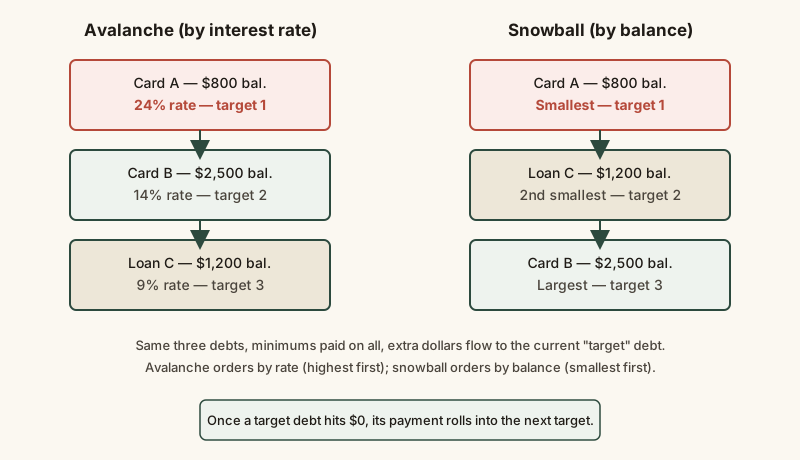
The two stacks contain the exact same four debts — only the ordering rule differs, which is the entire mechanical difference between the two strategies.
Common mistakes
Common Mistakes
Splitting extra payments evenly across all debts instead of concentrating them on one target debt.
→ Both methods work by concentrating every extra dollar on a single target debt while paying only minimums elsewhere — spreading extra payments thin doesn't clear any single debt meaningfully faster.
Assuming the snowball and avalanche will always produce a large cost difference.
→ Check the actual numbers — if the highest-rate debt and smallest-balance debt happen to be close in the ordering, the two methods can end up nearly identical in total interest paid.
Forgetting to keep making minimum payments on non-target debts.
→ Missing minimum payments on any debt (even a non-target one) can trigger late fees and credit score damage — both methods require paying at least the minimum on every debt throughout.
Common misconception
“The debt avalanche and debt snowball are fundamentally different strategies with different rules for how much to pay.”
Both methods use the exact same payment structure — minimums on every debt, all extra funds toward one target — and differ only in the single rule used to pick which debt is the current target (rate for avalanche, balance for snowball). Neither method changes how much total money is being put toward debt each month, only which specific debt that money attacks first.
What to do next
What to do next
- List every debt with its balance and interest rate side by side before choosing a method — you can't compare the two orderings without seeing both numbers for each debt.
- If minimizing total cost matters most to you, order debts by interest rate (avalanche); if staying motivated with early wins matters most, order by balance (snowball).
- Whichever method you pick, keep making at least the minimum payment on every other debt throughout — neither method allows skipping minimums on non-target debts.
- For a full personalized repayment plan, especially with multiple high-rate debts, consider a nonprofit credit counselor (such as one affiliated with the NFCC) rather than treating either method as one-size-fits-all advice.