 KnowThis
Key Takeaways
Key Takeaways
- 1A credit score is a statistical estimate of repayment likelihood, not a measure of income, savings, or overall wealth — someone with a high income can have a low score, and vice versa.
- 2Per FICO's own published methodology, payment history (35%) and credit utilization (30%) together account for nearly two-thirds of the score — length of credit history, credit mix, and new credit make up the rest.
- 3Scores are generated by private companies (FICO, VantageScore) from the data in your credit reports, not assigned directly by the government or a single central authority.
The concept
Understanding which factors carry the most weight is what turns "improve your credit score" from vague advice into something with an actual mechanism behind it.
Someone earns a high salary and has significant savings, but has missed several credit card payments in the past year. Will their credit score likely be high?
Worked examples
Example 1: Two borrowers with identical income, different scores (baseline case)
Example 2: Reducing utilization without paying off the full balance (edge case / variation)
Why can paying a credit card balance down (not fully off) still measurably improve a credit score within one or two billing cycles?
Example 3: A thin credit file limiting an otherwise strong score (real-world / applied case)
How it works (visual)
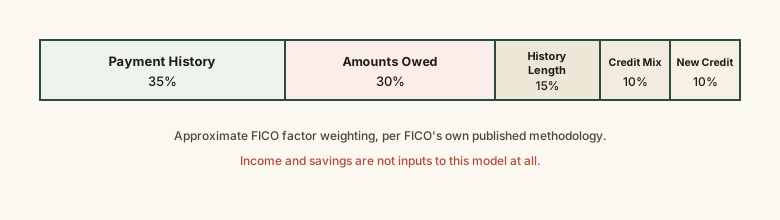
The two largest segments — payment history and utilization — together make up nearly two-thirds of the score, which is why those two behaviors (paying on time, keeping balances low relative to limits) produce the most noticeable movement in the number.
Common mistakes
Common Mistakes
Assuming income or savings directly raise a credit score.
→ Remember the score is calculated purely from credit report data (borrowing and repayment behavior) — building income or savings doesn't move the number unless it changes how you use and repay credit.
Closing an old, unused credit card to 'simplify,' without realizing it can shorten credit history and reduce total available credit.
→ Consider keeping old accounts open (especially with no annual fee) even if unused — closing them can raise utilization and reduce average account age, both of which can lower a score.
Treating 'FICO score' and 'credit score' as always identical.
→ Recognize FICO and VantageScore are separate models that can produce different numbers from the same credit report — check which model a lender is actually using before comparing scores from different sources.
Common misconception
“Checking your own credit score hurts it.”
Checking your own score or report is called a "soft inquiry" and has no effect on the score at all — this is different from a "hard inquiry," which happens when a lender checks your credit as part of a loan or credit card application, and can cause a small, temporary dip. Consumers are entitled to free access to their own credit reports and scores without penalty.
What to do next
What to do next
- Check your own credit report through a free, official channel (in the US, annualcreditreport.com) to see the raw data the score is built from — this is a soft inquiry and doesn't affect your score.
- If you carry credit card balances, note your utilization percentage — balance divided by limit — since that single ratio is one of the two biggest score factors.
- Avoid closing your oldest credit accounts if you're trying to build score, since account age and total available credit both factor in.
- For a real credit-building or debt strategy specific to your situation, talk to a nonprofit credit counselor (NFCC-affiliated organizations are a legitimate free/low-cost starting point) rather than relying on general guidance alone.