 KnowThis
Key Takeaways
Key Takeaways
- 1An overdraft happens when a bank chooses to pay a transaction that exceeds your available balance, rather than declining it — it's a discretionary courtesy, not a guaranteed account feature.
- 2Overdraft fees are typically a flat dollar amount charged per occurrence, not a percentage of the shortfall — a $2 shortfall and a $200 shortfall can trigger the exact same fee.
- 3An overdraft (bank pays, fee applies) and a nonsufficient funds decline (bank declines, a different fee may apply) are two separate outcomes for the same situation — which one happens depends on account settings and bank discretion.
The concept
Because the fee is flat rather than proportional, the actual cost of an overdraft has less to do with how much you were short and more to do with how many separate times it happened.
An account is overdrawn by $3 on one transaction and by $150 on another, both in the same account with the same bank. What's most likely true about the fees charged?
Worked examples
Example 1: A single overdraft (baseline case)
Example 2: Multiple overdrafts in one day (edge case / variation)
Example 3: A declined transaction instead of an overdraft (real-world / applied case)
Why might a customer with three separate overdrawn transactions on the same day owe more in fees than a customer with one large overdrawn transaction of similar total shortfall?
Try it yourself
Estimate the total cost of repeated overdrafts based on how many times an account has been overdrawn and the flat fee charged per occurrence.
How it works (visual)
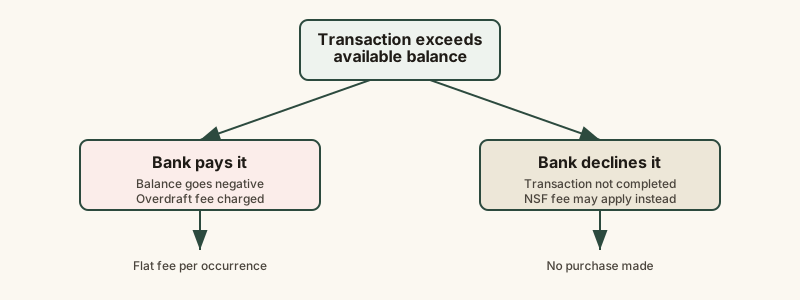
The same underlying situation — insufficient available balance — can end in two very different outcomes depending on the bank's decision and the account's specific settings.
Common mistakes
Common Mistakes
Assuming overdraft coverage means the bank will always pay every transaction that exceeds the available balance.
→ Remember it's a discretionary courtesy — banks can and do decline transactions even with overdraft coverage active, especially for accounts with a history of frequent overdrafts.
Confusing an overdraft fee with a nonsufficient funds (NSF) fee.
→ An overdraft fee applies when the bank pays the transaction; an NSF fee applies when the bank declines it instead — they're outcomes of two different bank decisions for the same shortfall.
Not realizing that multiple small transactions on the same day can each trigger a separate flat fee.
→ Check your bank's specific policy on daily overdraft fee caps, and monitor your available balance closely once it gets low to avoid a stack of same-day fees.
Common misconception
“Overdraft fees scale with how much you overdrew — spending $5 over your balance should cost less in fees than spending $200 over.”
Most banks charge a flat fee per overdraft occurrence, regardless of the shortfall size — a $5 overdraft and a $200 overdraft commonly trigger the identical fee. This is exactly why the total cost of overdrafting is driven far more by how many times it happens than by how large each individual shortfall is.
What to do next
What to do next
- Check your bank's specific overdraft opt-in status for one-time debit card and ATM transactions — you can typically view or change this in your account settings.
- Set up low-balance alerts through your bank's app so you're notified before a transaction risks going negative.
- Review your bank's fee schedule for any daily cap on the number of overdraft fees that can be charged in a single day.
- If you're overdrawn, deposit funds to bring the balance positive as soon as possible — banks often only charge extended overdraft fees after a balance stays negative beyond a set number of days.