 KnowThis
Key Takeaways
Key Takeaways
- 1A checking account is a demand deposit account — the defining feature is that you can withdraw the money at any time, with no advance notice required, unlike a certificate of deposit or other time deposit.
- 2Your balance is legally a liability the bank owes you, not cash sitting in a vault with your name on it — the bank lends most deposited funds out and keeps the system solvent through reserves and FDIC insurance.
- 3FDIC insurance automatically covers up to $250,000 per depositor, per insured bank, per ownership category — it isn't something you have to sign up for separately at an FDIC-member bank.
The concept
Understanding that a checking account balance is an insured claim on the bank, not a personal cash reserve, explains why the account behaves the way it does — instant-feeling debit swipes, slower ACH transfers, and complete safety even though the bank isn't literally holding your exact bills.
If a bank fails, what actually happens to money sitting in a checking account there?
Worked examples
Example 1: Tracing a paycheck from deposit to spendable balance (baseline case)
Example 2: Why a debit swipe and a check clear at different speeds (edge case / variation)
Example 3: How FDIC coverage scales with multiple accounts at the same bank (real-world / applied case)
A depositor has $200,000 in checking and $100,000 in savings, both single-owner accounts at the same bank. How much of the combined $300,000 is FDIC-insured?
How it works (visual)
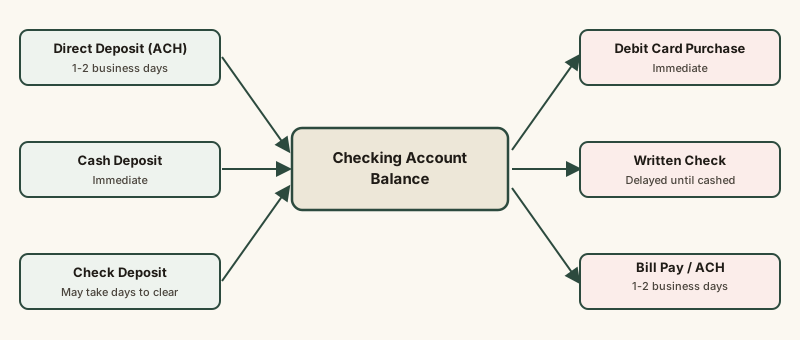
Every arrow into or out of the account moves at its own speed — cash and debit swipes are close to instant, while checks and ACH transfers can lag by a day or more, which is the real mechanism behind why a checking account's balance can be temporarily misleading if you don't account for pending transactions.
Common mistakes
Common Mistakes
Assuming the visible account balance already reflects every check written or payment scheduled.
→ Track outstanding checks and scheduled payments separately from the bank's displayed balance, since unclearedtransactions won't show up until they actually process.
Believing money is only protected if you specifically request FDIC insurance.
→ Remember FDIC coverage is automatic at any FDIC-member bank — check for the FDIC member sign or ask directly if you're unsure a bank carries it.
Assuming all deposit types (cash, check, direct deposit) become available at the same speed.
→ Expect cash and debit transactions to post near-instantly, while checks and ACH transfers can take one or more business days to fully clear.
Common misconception
“The bank is physically holding your exact deposited dollars in a vault somewhere with your name on them.”
Your checking account balance is a legal claim on the bank — a liability it owes you — not a set-aside pile of cash. The bank uses most deposited funds for loans and other activities under fractional-reserve banking, while FDIC insurance (not a physical cash reserve) is what actually guarantees you can get your money back, up to the coverage limit, even if the bank fails.
What to do next
What to do next
- Confirm your bank is FDIC-insured (look for the official FDIC sign or check the FDIC's BankFind tool) if you've never verified it directly.
- Track checks you've written and payments you've scheduled separately from the bank app's balance, since uncleared items won't show up yet.
- If your combined deposits at one bank exceed $250,000 under the same ownership category, consider spreading funds across banks or ownership categories to stay fully insured.
- Learn your specific bank's posting order and cutoff times for deposits and payments, since these vary by institution and affect when funds actually become available.