 KnowThis
Key Takeaways
Key Takeaways
- 1Inflation is a rise in the general price level across an economy — it doesn't change the number in a savings account, but it changes what that number can buy.
- 2Money sitting in an account earning a lower rate than the inflation rate is losing real, inflation-adjusted value every year, even while the account balance itself grows.
- 3The relevant comparison for savings is always the real return — the account's rate minus the inflation rate — not the nominal rate by itself.
The concept
The calculation below shows exactly how much of a fixed amount of money's buying power survives after a given number of years at a given inflation rate.
A savings account balance grows from $1,000 to $1,010 over a year (1% interest), while prices rise 3% over the same year. What actually happened to the money's purchasing power?
Worked examples
Example 1: What $10,000 today will be worth in real terms in 10 years at typical inflation (baseline case)
Example 2: Higher inflation accelerates the erosion sharply (edge case / variation)
Example 3: Why an emergency fund still belongs in cash despite inflation (real-world / applied case)
Since inflation erodes the real value of idle cash, does that mean an emergency fund should be moved into investments like stocks to avoid losing value?
How it works (visual)
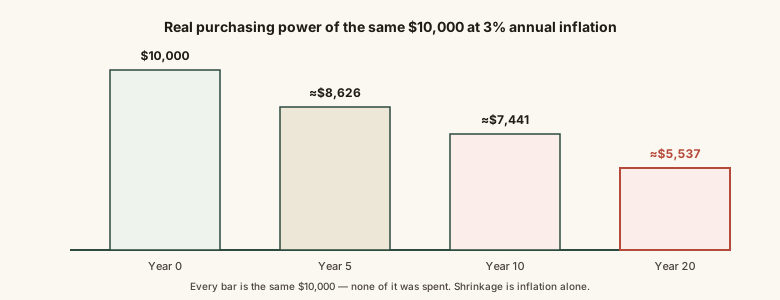
Every bar represents the exact same $10,000 — none of it was spent. The shrinkage shown is purely the effect of prices rising faster than that money grows.
Common mistakes
Common Mistakes
Judging savings progress purely by the account balance, without adjusting for inflation.
→ Compare the account's interest rate to the current inflation rate to estimate the real, inflation-adjusted return, not just the nominal dollar growth.
Assuming inflation is always around the same 2-3% level seen in typical years.
→ Check the current CPI figures from the Bureau of Labor Statistics — the inflation rate changes over time and has spiked well above typical levels during past periods.
Reacting to inflation by moving an emergency fund into higher-risk investments to 'keep up'.
→ Keep emergency savings in safe, liquid accounts (like high-yield savings) and accept a manageable amount of inflation erosion as the trade-off for guaranteed access without loss risk.
Common misconception
“If a savings account balance keeps growing every year, the money isn't losing value.”
An account balance can grow in nominal dollar terms while still losing real value if its interest rate is lower than the inflation rate. The number getting bigger and the money's actual buying power getting bigger are two different things — the second one is what determines whether the money is truly gaining or losing ground.
Try it yourself
What to do next
What to do next
- Check the current CPI inflation rate from the Bureau of Labor Statistics and compare it to your savings account's actual rate.
- Estimate the real return on idle cash (account rate minus inflation rate) rather than judging savings progress by the balance alone.
- Keep emergency funds in safe, liquid accounts like high-yield savings rather than moving them into investments to try to outrun inflation.
- Revisit long-term savings goals periodically, since a fixed dollar target set years ago may no longer reflect today's real cost of the same goal.