 KnowThis
Key Takeaways
Key Takeaways
- 1Automating savings means the transfer happens on a schedule without requiring a manual decision each time.
- 2Common mechanisms include a bank's recurring automatic transfer, a direct deposit split at the payroll level, and app-based round-up programs.
- 3The core mechanical benefit is that money moves to savings before it's available to spend, rather than depending on whatever is left over.
The concept
None of these mechanisms create money or interest by themselves — they're purely about the timing and consistency of moving money that already exists into a separate account.
What is the core mechanical difference an automatic savings transfer creates, compared to manually deciding to save each month?
Worked examples
Example 1: A simple recurring transfer (baseline case)
Example 2: A transfer that overdraws checking (edge case / risk)
Example 3: Combining a direct deposit split with a round-up program (real-world / applied case)
Can an automatic savings transfer contribute to overdrawing a checking account?
How it works (visual)
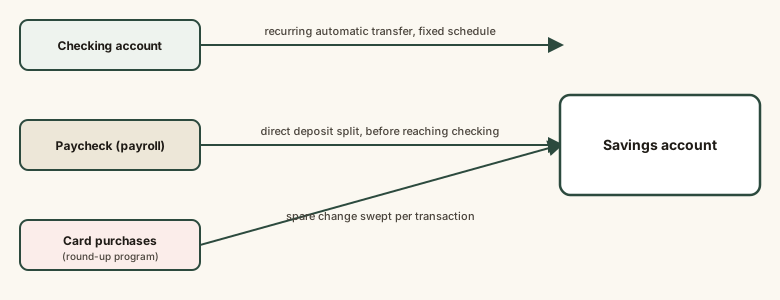
All three paths land in the same place — a savings account — but they intervene at different points in the money's path from being earned to being available to spend.
Common mistakes
Common Mistakes
Setting an automatic transfer amount based on an average month without checking the lowest expected checking balance.
→ Size and time the transfer around the leanest realistic month, not the average one, to avoid triggering an overdraft.
Assuming a direct deposit split and a bank's automatic transfer are the same mechanism.
→ Recognize a direct deposit split happens at the payroll/employer level before money reaches checking, while a bank transfer happens after, moving money that's already in checking.
Setting up automation once and never revisiting the amount as income or expenses change.
→ Periodically review the automatic transfer amount against current income and expenses rather than leaving a stale number in place indefinitely.
Common misconception
“Automating savings is a special financial product or service that costs money to set up.”
Automating savings isn't a product — it's a scheduling feature, typically free, built directly into most banks' online banking tools and most employers' payroll systems. The "automation" is just a standing instruction for money to move on a schedule; it doesn't require a paid app, a financial advisor, or a special account type to set up.
What to do next
What to do next
- Check whether your bank's online banking tools offer a recurring internal transfer feature, and what scheduling options it supports.
- Check with your employer's payroll system whether a direct deposit split into a separate account is available.
- Size any automatic transfer around your lowest expected checking balance for the month, not the average, to reduce overdraft risk.
- Revisit the automated amount periodically as income or expenses change, rather than leaving it untouched indefinitely.