 KnowThis
Key Takeaways
Key Takeaways
- 1A savings account pays interest because the bank lends deposited money out (as mortgages, auto loans, and other credit) and shares part of the return with depositors.
- 2In the US, deposits are FDIC-insured up to $250,000 per depositor, per bank, per ownership category — this is exactly why a savings account is considered safe even though the bank is actively using the money.
- 3APY (Annual Percentage Yield), not the stated interest rate alone, is the real number to compare between accounts, since it already accounts for how often interest compounds.
The concept
Turning the interest rate into an actual dollar figure over time is where simple interest math comes in — the calculation below uses simple interest as the clearest baseline case.
Why is a bank able to pay you interest on a savings account at all?
Worked examples
Example 1: Simple interest on a basic savings balance (baseline case)
Example 2: Why the FDIC $250,000 limit is per bank, not per account (edge case / variation)
Example 3: Comparing two accounts by APY instead of the headline rate (real-world / applied case)
Two savings accounts both advertise a 4.0% interest rate, but one compounds daily and the other compounds monthly. Will they pay out exactly the same amount over a year?
How it works (visual)
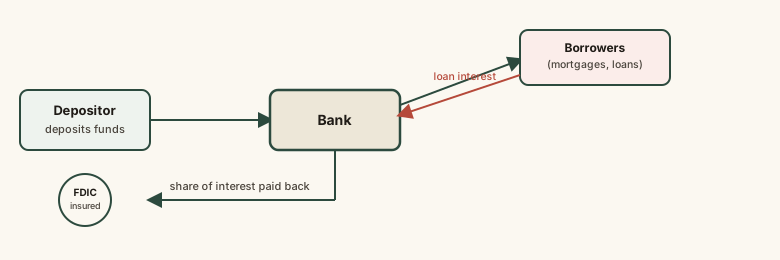
The depositor's interest is a direct share of the interest the bank earns from lending the money out elsewhere — FDIC insurance sits alongside this flow as the safety net if the bank itself fails.
Common mistakes
Common Mistakes
Comparing savings accounts using the stated interest rate instead of APY.
→ Always compare APY, which already reflects how often interest compounds — it's the number that actually predicts a year's earnings.
Assuming a single bank account can hold unlimited FDIC-insured funds.
→ Remember the $250,000 limit applies per depositor, per insured bank, per ownership category — larger balances may need to be spread across multiple banks for full coverage.
Treating a savings account balance as untouched, static cash rather than money the bank is actively lending out.
→ Understand that the interest paid is a direct consequence of the bank using deposited funds — this is also exactly why FDIC insurance exists as a backstop.
Common misconception
“Money in a savings account just sits there untouched, and interest is essentially free money the bank chooses to give out.”
The bank actively lends out most deposited funds as mortgages, auto loans, and other credit, earning interest on those loans — the interest paid to a depositor is a direct share of that earned return, not a discretionary bonus. This is also precisely why FDIC insurance matters: because the money is genuinely being used rather than held untouched, deposit insurance protects depositors if a bank's lending activity goes wrong.
Try it yourself
What to do next
What to do next
- Compare savings accounts by APY, not the advertised interest rate alone.
- Confirm any bank holding your savings is FDIC-insured (or NCUA-insured, for credit unions) before depositing.
- If total deposits at one bank approach $250,000, consider whether spreading funds across multiple insured banks makes sense for full coverage.
- Check whether a savings account has minimum balance requirements or monthly fees that could offset the interest earned.