 KnowThis
Key Takeaways
Key Takeaways
- 1A high-yield savings account is not a fundamentally different or riskier product — it's the same FDIC-insured deposit account structure as a traditional savings account, just paying a higher rate.
- 2The rate gap exists largely because online-only banks skip the overhead cost of physical branches and pass part of that savings on to depositors as a higher APY.
- 3Compounding applies the same way as any savings account — the difference in the actual formula between accounts is just the rate itself, not the mechanism.
The concept
The actual dollar impact of a higher rate compounds meaningfully over time — the calculation below uses compound growth to show that effect directly.
Why can online-only banks typically afford to offer higher savings rates than traditional branch-based banks?
Worked examples
Example 1: Comparing a traditional rate to a high-yield rate over one year (baseline case)
Example 2: How the gap compounds over multiple years (edge case / variation)
Example 3: Why a slightly lower rate with no fees can beat a slightly higher rate with fees (real-world / applied case)
An account advertises a higher APY than a competitor, but charges a monthly maintenance fee. Does the higher advertised rate guarantee a better real return?
How it works (visual)
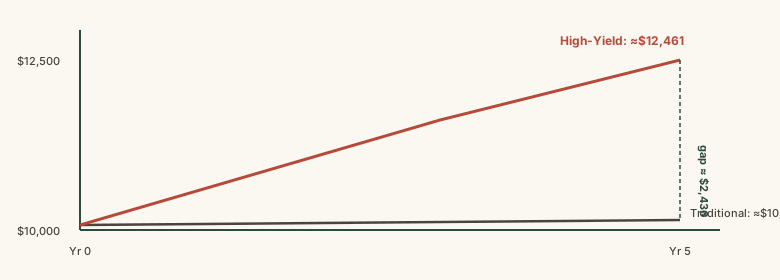
Both lines start at the identical $10,000 — the entire visible gap is produced by the rate difference compounding year over year, not by any difference in how much was deposited.
Common mistakes
Common Mistakes
Assuming a high-yield savings account is riskier than a traditional one because the rate is unusually high.
→ Confirm the account is FDIC-insured (or NCUA-insured at a credit union) — a legitimate high-yield account carries the same deposit protection as any standard savings account.
Comparing only the advertised APY between accounts without checking for monthly fees or minimum balance requirements.
→ Calculate the real net return after any fees, especially on smaller balances where a flat monthly fee has a larger proportional impact.
Assuming online-only banks are less legitimate or harder to trust than branch-based banks.
→ Check FDIC insurance status directly via the FDIC's BankFind tool rather than judging legitimacy by whether a bank has physical branches.
Common misconception
“A savings account paying an unusually high rate compared to competitors must be riskier or too good to be true.”
A legitimate high-yield savings account is not a different or riskier category of product — it's an ordinary FDIC-insured deposit account, typically offered by an online-only bank with lower overhead costs than a branch-based competitor. The rate gap is a real structural cost difference, not a sign of added risk, as long as the account is genuinely FDIC-insured (verifiable directly through the FDIC).
Try it yourself
What to do next
What to do next
- Verify FDIC (or NCUA) insurance status directly before opening any high-yield account, especially with a bank you haven't heard of.
- Compare accounts by real net return — APY minus the effect of any monthly fees or minimum balance requirements — not APY alone.
- Check whether the rate is variable (most are) and can change over time, rather than assuming today's advertised rate is permanent.
- Consider transfer speed and ATM access if the account is also meant to double as an emergency fund that needs to be reachable quickly.