Interest: Simple vs Compound (cross-link to Personal Finance topic)
Simple interest grows a balance by a fixed amount every period based only on the original principal, while compound interest grows it by a percentage of the current balance, which includes previously earned interest — a difference that widens dramatically over long time spans.
Reading time
— 5 min
Updated
— Aug 16, 2026
Fact-reviewed
— Aug 16, 2026
Key Takeaways
Key Takeaways
1Simple interest grows a balance by a fixed dollar amount every period, calculated only on the original principal — it's linear growth.
2Compound interest grows a balance based on the current total (principal plus previously earned interest), so the dollar amount it adds gets larger every period — it's exponential growth.
3The gap between simple and compound interest is small over short periods but becomes dramatic over long ones — this is why compounding is often called the most powerful force in long-term saving and the most costly one in long-term debt.
The concept
Simple interest pays you the same dollar amount every period, based only on your starting balance. Put $1,000 in an account earning 5% simple interest, and you get $50 every year, forever, no matter how large your balance has grown from past interest. Compound interest instead pays interest on your whole current balance, including interest you've already earned — so the $50 you earn in year one starts earning its own interest in year two, and the dollar amounts get larger every year instead of staying flat.
The formulas above look similar on paper, but the practical gap between them only becomes obvious once you run the same principal, rate, and time through both side by side.
Quick check
$1,000 is invested for 20 years at a 5% annual rate. Which grows to a larger amount: simple interest or compound interest (compounded annually)?
Worked examples
Example 1: Simple interest on a fixed deposit (baseline case)
$2,000 deposited at 4% simple annual interest for 5 years: A = 2,000 × (1 + 0.04 × 5) = 2,000 × 1.20 = $2,400. Each of the 5 years contributes exactly $80 in interest (2,000 × 0.04), for a total of $400 in interest over the 5 years — a flat, predictable, linear amount every year.
Example 2: The same numbers under compound interest, and how the gap grows with time (edge case / variation)
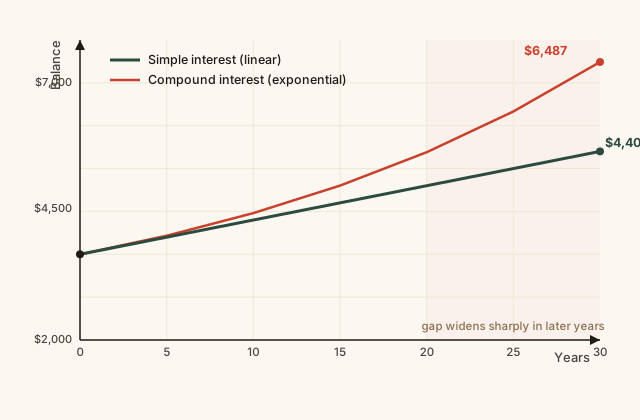
The same $2,000 at 4% compounded annually for 5 years: A = 2,000 × (1.04)^5 ≈ $2,433.31 — about $33 more than the simple interest result over 5 years, a modest difference. Extend the same comparison to 30 years: simple interest reaches 2,000 × (1 + 0.04 × 30) = 2,000 × 2.20 = $4,400, while compound interest reaches 2,000 × (1.04)^30 ≈ $6,486.80 — a gap of over $2,000, more than the entire original principal. The short-term gap looked negligible; the long-term gap does not. This is the core reason the two methods can seem "close enough to not matter" over a few years while diverging sharply over decades.
Quick check
Over a short time span (a few years), the difference between simple and compound interest on the same principal and rate is often small. Does this mean the choice between them 'doesn't matter much' in general?
Example 3: Using the Rule of 72 to estimate doubling time (real-world / applied case)
An investment grows at an average annual compound rate of 8%. Rather than solving 2 = (1.08)^t directly, the Rule of 72 estimates it instantly: 72 ÷ 8 = 9 years to roughly double. Checking against the exact exponential formula: (1.08)^9 ≈ 1.999 — essentially exactly double, confirming the shortcut's accuracy at this rate. The same shortcut applied to debt is a genuine warning sign: a credit card balance compounding at a 24% annual rate would double in about 72 ÷ 24 = 3 years if left completely unpaid — a fast, concrete illustration of why compounding works exactly as powerfully against a borrower carrying debt as it does for a saver building wealth.
How it works (visual)
Simple interest (straight line) vs. compound interest (curve) on $2,000 at 4% over 30 years
Notice the two lines sit almost on top of each other for the first several years — this is exactly why the difference feels unimportant early on. The compound curve's slope keeps increasing over time (it's earning interest on a constantly growing balance), while the simple interest line's slope never changes at all. The visual gap between the two, which looks trivial in year 5, becomes the chart's dominant feature by year 30.
Common mistakes
Common Mistakes
✕
Assuming simple and compound interest produce similar results regardless of the time span involved.
→ Check the actual time horizon — the gap between the two is small over a few years but can become larger than the principal itself over a few decades.
✕
Using the annual rate directly in the Rule of 72 as a decimal instead of a whole number.
→ Divide 72 by the rate as a whole number (e.g., use 6 for 6%, not 0.06) — using the decimal form produces a nonsensical result.
✕
Forgetting that compounding works identically against a borrower with unpaid debt as it does for a saver's growing balance.
→ Apply the same compound growth formula to a credit card or loan balance to see how quickly unpaid interest itself starts generating more interest.
Common misconception
“Since compound interest and simple interest end up close for short periods, it doesn't matter which one you're actually being offered.”
The closeness is temporary and specifically limited to short time horizons — it's a feature of how exponential and linear curves start out nearly overlapping near their common starting point, not a sign that the two methods are functionally equivalent. Over long time spans (retirement savings, long-term loans, multi-decade investments), compound interest's exponential curve diverges sharply from simple interest's straight line, and the method used can change the outcome by a substantial fraction of the total amount involved.
Quick check
A friend says, 'Simple and compound interest give basically the same result over a few years, so the difference is never a big deal.' What's the flaw in this reasoning?
Try it yourself
Compound growth calculator
Ending balance, compound interest ($)$6,487
Simple interest calculator
Ending balance, simple interest ($)$4,400
Rule of 72: estimate years to double
Approximate years to double9.0 years
What to do next
What to do next
Run the same principal, rate, and a long time horizon (20-30 years) through both calculators above to see the real gap between simple and compound growth.
Use the Rule of 72 calculator to quickly estimate the doubling time on any savings or debt balance you're tracking.
Check whether a specific savings account, bond, or loan you hold uses simple or compound interest — the terms should state this explicitly.
See the related Personal Finance category (once published) for how these same formulas apply directly to retirement accounts and credit card debt.
FAQ
FAQ
Related terms
Related terms
Principal
The original amount of money deposited or borrowed, before any interest is added.
Simple interest
Interest calculated only on the original principal each period, so it grows a balance by a fixed dollar amount every cycle.
Compound interest
Interest calculated on the current balance — original principal plus previously earned interest — so the dollar amount it adds grows larger each period.
Rule of 72
A quick estimation shortcut: dividing 72 by an annual interest rate (as a whole number, not a decimal) gives an approximate number of years for an amount to double under compound growth.
Compounding frequency
How often interest is calculated and added to a balance — annually, monthly, or daily — with more frequent compounding producing slightly faster growth at the same stated annual rate.
A friend says, 'Simple and compound interest give basically the same result over a few years, so the difference is never a big deal.' What's the flaw in this reasoning?
This entry was researched from public sources and drafted with AI-assisted tools, then edited — errors are still possible. Spot one, or want a topic covered? Read our disclaimer.
 KnowThis