 KnowThis
Key Takeaways
Key Takeaways
- 1Distance, speed, and time are related by one formula, distance = speed × time, which rearranges to solve for whichever of the three values is unknown.
- 2Average speed over a trip with two different speeds is total distance ÷ total time — not the simple average of the two speeds, which overstates the real average.
- 3Travel time estimates that ignore stops, traffic, or non-constant speed are a floor, not a realistic prediction — real trips rarely move at a single steady speed the whole way.
The concept
That average-speed distinction sounds like a technicality until you run the actual numbers on a simple there-and-back trip, where the gap between "simple average" and "true average" turns out to be surprisingly large.
You drive 120 miles at 40 mph, then drive back the same 120 miles at 60 mph. Is your average speed for the whole trip exactly 50 mph (the simple average of 40 and 60)?
Worked examples
Example 1: Solving for time when distance and speed are known (baseline case)
Example 2: The true average speed of a there-and-back trip at two different speeds (edge case / variation)
Why does the slower leg of a there-and-back trip pull the true average speed down below the simple average of the two speeds?
Example 3: Why a GPS's 'time remaining' estimate can jump when you hit slow traffic (real-world / applied case)
How it works (visual)
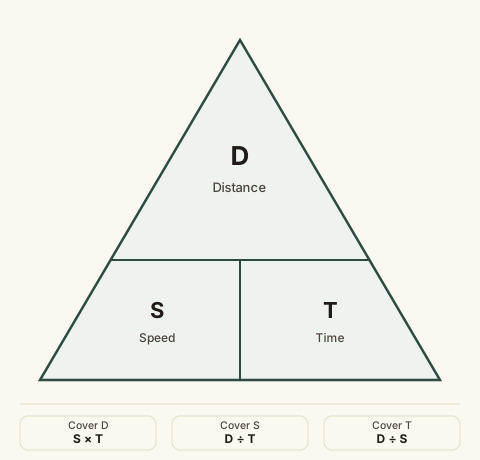
This is the classic "cover the unknown" memory device: covering Distance leaves Speed × Time side-by-side, meaning you multiply. Covering Speed leaves Distance over Time, meaning you divide distance by time. Covering Time leaves Distance over Speed, meaning you divide distance by speed. It's the exact same formula rearranged three ways, just organized so the correct operation (multiply or divide) is visually obvious for whichever value you're solving for.
Common mistakes
Common Mistakes
Averaging two different speeds by simple arithmetic mean instead of weighting by time.
→ Compute total distance ÷ total time instead — a simple average overstates the true average whenever the segments take unequal amounts of time.
Assuming a trip travels at a single constant speed the entire way when estimating time.
→ Treat a single-speed estimate as a best-case floor, not a prediction — real trips include stops, traffic, and speed variation that add time beyond the simple calculation.
Mixing units (e.g., dividing miles by a speed given in kilometers per hour) without converting first.
→ Convert distance and speed to matching units before applying distance = speed × time — mismatched units produce a numerically wrong answer, not just an imprecise one.
Common misconception
“If you drive one leg of a trip slower and the return leg faster by the same amount, your average speed for the whole trip is the midpoint of the two speeds.”
Average speed is always total distance divided by total time — and because the slower leg takes more time to cover the same distance, it counts for more of the trip's total duration than the faster leg does. A trip at 40 mph one way and 60 mph back isn't a 50 mph average; it works out to 48 mph, pulled toward the slower speed. The only case where a simple average of two speeds equals the true average is when the two legs take equal time, not equal distance.
A cyclist rides 30 miles at 15 mph, then rides back the same 30 miles at 10 mph. What is their true average speed for the round trip?
Try it yourself
What to do next
What to do next
- Next time you plan a drive, compute an estimated travel time from distance ÷ speed, then pad it for stops and traffic rather than trusting the raw number.
- For any trip with two different speeds over equal distances, calculate total distance ÷ total time instead of simply averaging the two speeds.
- Try the calculator above with your own commute or trip distance and typical speed to sanity-check a GPS estimate.
- Before comparing distance and speed values, double-check both are in matching units (miles with mph, or kilometers with km/h) to avoid a unit-mismatch error.