 KnowThis
Key Takeaways
Key Takeaways
- 1An exchange rate is a ratio — it tells you how many units of one currency equal one unit of another — and converting an amount is just multiplying by that ratio.
- 2Converting money back and forth between two currencies does not return your original amount, even with a 'fair' rate and zero fees, once rates move between the two conversions.
- 3Currency exchangers rarely charge a labeled 'fee' — instead they often use a spread, quoting a worse rate than the real market rate, which functions as a hidden cost.
The concept
The reciprocal-rate idea seems like it should make round-trip conversions a wash, but the math only balances at a single frozen moment — the moment rates move even slightly, that symmetry breaks.
If 1 euro = 1.10 US dollars, how many euros do you get for $220?
Worked examples
Example 1: Converting a fixed amount at a given rate (baseline case)
Example 2: Why converting money there and back doesn't return your original amount (edge case / variation)
You convert dollars to euros, then convert the resulting euros back to dollars a week later. The exchange rate moved slightly in between. Assuming no fees were charged either time, will you get back exactly your original dollar amount?
Example 3: How a currency exchange spread quietly costs you money (real-world / applied case)
How it works (visual)
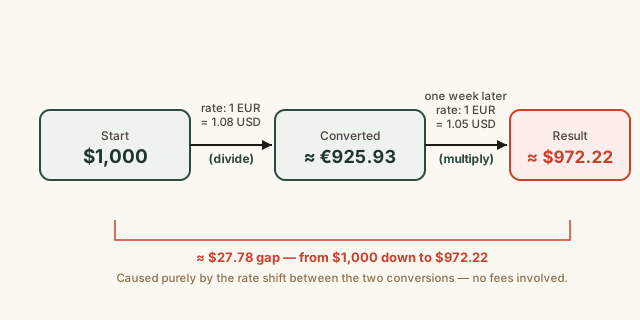
The diagram's two arrows use two different numeric rates, even though both are labeled with the same currency pair — that's the entire source of the gap on the right. If both arrows used the identical rate (no time gap, or a rate that happened not to move), the round trip would land exactly back on $1,000. The gap only appears because real exchange rates are a moving target, not a fixed constant.
Common mistakes
Common Mistakes
Multiplying by the exchange rate in both directions instead of using the reciprocal for the return conversion.
→ Multiply going from base currency to target currency, and divide (or multiply by 1 ÷ rate) going the other direction — mixing these up produces a wildly wrong result, not just a slightly wrong one.
Assuming a 'no fee' currency exchange has no real cost.
→ Compare the quoted rate against the real-time market mid-rate — a worse rate built into the spread is still a real cost, even without a separate itemized fee.
Expecting a round-trip currency conversion to return the exact original amount.
→ Remember the reciprocal relationship only holds at a single frozen rate — any time gap between the two conversions introduces a real rate change and a real difference in the result.
Common misconception
“A currency exchange advertised as having no fee is genuinely free to use.”
Very few currency exchangers actually operate at zero cost. Most build their profit into the spread — quoting you a rate that's worse than the true market mid-rate — rather than charging a separately itemized fee. A "no fee" exchange offering meaningfully less favorable pounds-per-dollar (or any currency pair) than the live market rate is still charging you a real cost; it's just built into the exchange rate itself instead of listed as a line item.
An airport kiosk advertises 'zero fees' on currency exchange, but its quoted rate is noticeably worse than the real-time market rate you can check on your phone. Is this exchange actually free?
Try it yourself
What to do next
What to do next
- Before your next trip, check the real-time market exchange rate on your phone and compare it against whatever rate a bank, kiosk, or app quotes you.
- Use the calculator above with a realistic fee percentage to see how much a 'small' 2-3% spread actually costs on a larger conversion.
- Practice converting in both directions (multiply one way, use the reciprocal the other way) until it feels automatic.
- If you're converting money for a future trip, remember the rate you lock in today may differ from the rate on your travel date — check again closer to departure if timing allows.