 KnowThis
Key Takeaways
Key Takeaways
- 1Converting currency is mechanically identical to any other unit conversion: multiply the amount by a fixed conversion factor — here, the exchange rate.
- 2The one real difference from converting length or weight is that the 'factor' itself isn't fixed at all — it floats continuously based on global currency markets, unlike 1 mile always equaling 1.60934 kilometers.
- 3Real-world currency exchange almost never gives you the quoted mid-market rate directly — a fee, a spread (a worse buy/sell rate than the true market rate), or both are layered on top, meaning the amount you actually receive is smaller than a naive rate-times-amount calculation suggests.
The concept
Because the rate itself moves, the goal in practice isn't memorizing a number the way you might memorize "1 kg ≈ 2.2 lbs" — it's understanding the conversion mechanics well enough to sanity-check whatever rate you're quoted at the moment of a transaction.
A currency converter website shows 'GBP/USD 1.27.' What does this tell you?
Worked examples
Example 1: A straightforward conversion at the quoted rate (baseline case)
Example 2: The same conversion with a real-world fee applied (edge case / variation)
Two currency exchange kiosks both advertise 'no fees.' Kiosk A quotes 0.90 EUR per USD; Kiosk B quotes 0.92 EUR per USD (the true mid-market rate). Which one is actually a better deal, and why?
Example 3: Comparing card payment vs cash exchange while traveling (real-world / applied case)
How it works (visual)
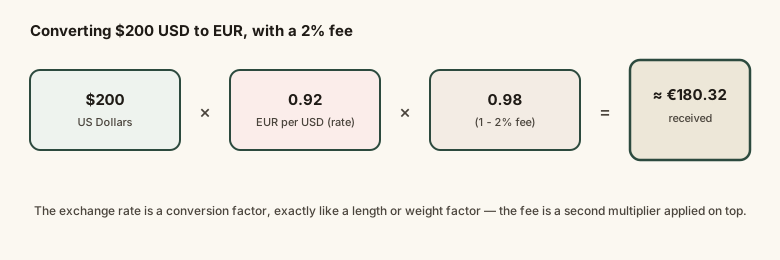
The exchange rate and the fee are two separate multipliers chained together — exactly the same chaining logic used for any multi-step unit conversion, just applied to money instead of length or weight.
Common mistakes
Common Mistakes
Reading a currency pair backwards (assuming 'EUR/USD 1.09' means a dollar buys 1.09 euros, when it means a euro buys 1.09 dollars).
→ Remember the first-listed currency is the base — the number tells you how much of the second currency one unit of the base is worth.
Assuming a 'no fee' currency exchange service has no cost, when the cost may simply be built into a worse-than-market exchange rate (the spread).
→ Compare the quoted rate against the actual mid-market rate (available from financial news sources) to see the real cost, not just whether a separate fee line exists.
Treating the mid-market exchange rate as fixed, the way a physical unit conversion factor is fixed.
→ Check the current rate at the time of the actual transaction — unlike miles to kilometers, currency 'conversion factors' genuinely change day to day and even hour to hour.
Common misconception
“The exchange rate you see quoted online is the rate you'll actually receive when exchanging money in person or through a bank.”
The rate shown on financial news sites and currency converter apps is typically the mid-market rate — the rate at which large institutions trade currency directly with each other. Consumer-facing services (banks, airport kiosks, some payment apps) almost always apply a spread, an explicit fee, or both, meaning the effective rate you actually receive is worse than the quoted mid-market figure. Treating the two as identical overstates how much currency a given amount of money will actually convert into.
Why does the exchange rate itself change continuously, unlike a physical conversion factor such as miles-to-kilometers?
Try it yourself
What to do next
What to do next
- Before traveling, check the current mid-market rate from a neutral source so you have a baseline to compare any quoted rate against.
- Ask explicitly whether a fee is charged separately, and compare the quoted rate itself against the mid-market rate to check for a hidden spread.
- Remember which currency is the 'base' in any quoted pair before doing the multiplication.
- Use the calculator above to see how a rate and a fee combine, rather than estimating the fee's impact by eye.