 KnowThis
Key Takeaways
Key Takeaways
- 1The overwhelming majority of real-world unit conversion mistakes fall into a small set of recurring patterns, not an unlimited variety of unique errors — which means learning to recognize the pattern is more valuable than memorizing any single conversion.
- 2The five biggest patterns are: inverting a conversion factor (multiplying instead of dividing), rounding a factor too early, treating an offset-based conversion (like temperature) as pure multiplication, confusing similarly-named units across regions, and mixing up bits with bytes in digital units.
- 3Every one of these has a simple, repeatable habit that catches it — mostly some version of 'run a rough sanity-check estimate before trusting the precise calculation.'
The concept
The five patterns below aren't ranked by severity so much as by how often each one actually shows up across the length, weight, temperature, currency, and data conversions covered elsewhere in this topic.
What's the single most broadly useful habit for catching unit conversion mistakes before they cause real problems?
Worked examples
Example 1: Catching an inverted conversion factor with a sanity check (baseline case)
Example 2: Forgetting the offset in a temperature conversion (edge case / variation)
Someone rounds the pound-to-kilogram conversion factor from 0.453592 down to 0.45 'to make the math easier,' then applies it to convert a 20,000-pound shipment. Roughly how much error does this introduce?
Example 3: Confusing similarly-named units across regions (real-world / applied case)
How it works (visual)
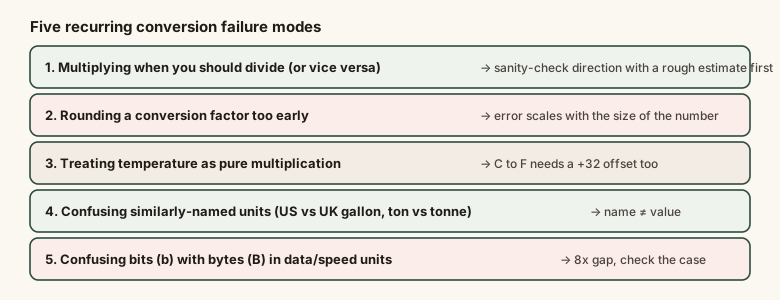
Nearly every mistake covered across this topic's 49 other entries traces back to one of these five rows — which is exactly why recognizing the pattern matters more than memorizing any individual conversion factor.
Common mistakes
Common Mistakes
Multiplying by a conversion factor when the situation calls for dividing (or vice versa).
→ Run a rough sanity check first: converting to a smaller unit should give a bigger number, and converting to a bigger unit should give a smaller number.
Using an overly rounded conversion factor for a large-scale or high-precision conversion.
→ Use the full-precision factor whenever the quantity being converted is large — rounding error scales up with the size of the number.
Treating every conversion as a pure multiplication, including the handful (like temperature) that require an added or subtracted offset.
→ Check whether the two units share the same zero point — if not (like Celsius and Fahrenheit), the conversion needs an offset, not just a multiplication.
Common misconception
“Unit conversion mistakes are rare, careless slips that could happen to anyone at any time, with no real pattern to them.”
Across the length, weight, volume, temperature, currency, and data conversions covered in this topic, real-world errors overwhelmingly cluster into a handful of recognizable, recurring patterns — inverted factors, premature rounding, skipped offsets, similarly-named-unit mix-ups, and bit/byte confusion. Because the failure modes repeat, they're also predictably preventable with the same small set of habits, rather than requiring constant fresh vigilance against an unlimited variety of possible mistakes.
A shopper reads '500 Mbps' internet speed and assumes it means 500 MB/s of download capacity. Which of this entry's five failure-mode patterns does this match?
Try it yourself
What to do next
What to do next
- Before trusting any conversion result, run a rough sanity check on whether the number's general size makes sense.
- Use full-precision conversion factors for large-scale or high-stakes conversions rather than convenient rounded numbers.
- Double-check whether a conversion needs an added or subtracted offset (like temperature) before assuming pure multiplication.
- When a unit name sounds familiar across two regions (pint, ton, fluid ounce), verify which regional definition actually applies rather than assuming they match.
- Read the case of unit abbreviations carefully — lowercase 'b' (bits) and capital 'B' (bytes) differ by a factor of 8.