 KnowThis
Key Takeaways
Key Takeaways
- 1One kilogram equals exactly 2.20462262... pounds — a metric-to-customary factor fixed by international agreement since 1959, not a rounded approximation.
- 2One avoirdupois pound splits into exactly 16 ounces — a conversion entirely inside the US/UK customary system, with no metric step involved.
- 3Converting kilograms to ounces (or vice versa) means chaining both factors together — kilograms to pounds, then pounds to ounces — not applying a single shortcut factor.
The concept
Why does converting kilograms directly to ounces require a factor like 35.274 rather than a clean round number?
Worked examples
Example 1: Converting body weight from kilograms to pounds (baseline case)
Example 2: Converting a small kitchen quantity straight to ounces (edge case / variation)
A recipe gives 0.25 kg of butter and you want the answer in ounces. Which approach is mathematically valid?
Example 3: A shipping label rounding error compounding at scale (real-world / applied case)
How it works (visual)
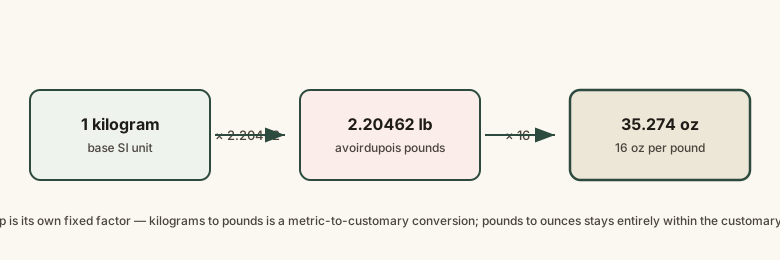
The first arrow (× 2.20462) is the only step that crosses between the metric and customary systems. The second arrow (× 16) never touches the metric system at all — it's a purely internal customary subdivision, which is why pounds-to-ounces is always a clean whole-number multiplication while kilograms-to-pounds never is.
Common mistakes
Common Mistakes
Using an overly rounded factor like '2.2' for high-stakes or large-scale conversions.
→ Use the full-precision factor (2.20462, or more decimal places) whenever precision matters — the rounding error scales with the size of the number being converted.
Confusing a fluid ounce (a volume unit) with a weight ounce (1/16 of a pound) — they are not interchangeable even for water, and definitely not for other substances.
→ Check whether a recipe or label means a weight ounce (mass) or a fluid ounce (volume) — for water they're approximately equal, but for anything else (flour, oil, syrup) they diverge significantly.
Assuming the troy ounce (used for gold and silver) is the same size as the everyday avoirdupois ounce.
→ A troy ounce (≈31.1 g) is heavier than an avoirdupois ounce (≈28.35 g) — never assume they're interchangeable when precious metals are involved.
Common misconception
“An 'ounce' always means the same thing, whether you're weighing gold, measuring flour, or pouring milk.”
There are at least three different things commonly called an "ounce": the avoirdupois ounce (1/16 pound, ≈28.35 g, used for food and everyday goods), the troy ounce (used for precious metals, ≈31.1 g), and the fluid ounce (a volume measurement, not a weight at all). Reading "ounce" without checking which one is meant is a genuine source of real-world measurement error, particularly in cooking and precious-metal trading.
Why can't a fluid ounce and a weight ounce simply be treated as the same unit?
Try it yourself
What to do next
What to do next
- Memorize the two core factors: 1 kg ≈ 2.20462 lb, and 1 lb = 16 oz exactly.
- For any large or high-stakes conversion (shipping, medical, engineering), use the full-precision 2.20462 rather than a rounded 2.2.
- Before using an 'ounce' figure, confirm whether it's a weight ounce, a troy ounce, or a fluid ounce — they are not interchangeable.
- Use the calculator above with either the direct kg-to-oz factor (35.274) or the two-step chain, whichever matches how your source data is structured.