 KnowThis
Key Takeaways
Key Takeaways
- 11 ounce (weight) equals approximately 28.3495 grams — the conversion factor recipes use when a US measurement needs to become metric, or vice versa.
- 2Weighing ingredients in grams or ounces is more accurate than measuring by volume (cups) because weight is unaffected by how tightly an ingredient is packed — a genuinely different physical measurement, not just a different unit.
- 3A 'cup of flour' can weigh anywhere from about 120 to 150 grams depending on whether it was scooped and packed or spooned and leveled — a variation large enough to change a baking recipe's outcome.
The concept
Two bakers each measure '1 cup of flour' using a measuring cup, but one scoops the cup directly into the flour bag while the other spoons flour in gently and levels it. Will their measurements weigh the same?
Worked examples
Example 1: Converting a butter measurement (baseline case)
Example 2: Why "1 cup" of flour and "1 cup" of sugar aren't comparable weights (edge case / variation)
Why can't a single 'cups to grams' conversion factor work for every dry ingredient?
Example 3: A baking recipe that fails when converted by volume instead of weight (real-world / applied case)
How it works (visual)
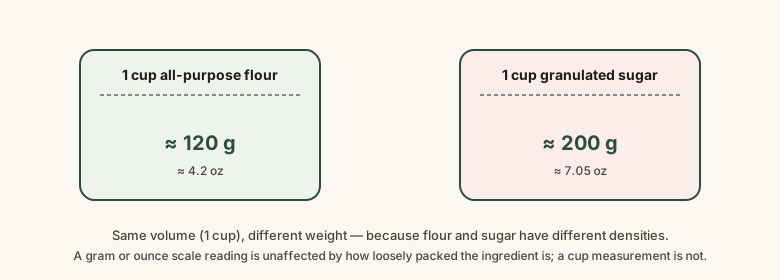
Both cups show exactly 1 cup on the volume markings — the difference in grams comes entirely from how densely each ingredient's particles pack together, not from any error in measuring.
Common mistakes
Common Mistakes
Using one 'cups to grams' conversion figure for every dry ingredient in a recipe.
→ Look up the specific grams-per-cup figure for each ingredient (flour, sugar, cocoa, etc.) rather than assuming they're interchangeable — or better, weigh the ingredient directly on a scale.
Confusing a weight ounce (used for solids like flour or butter) with a fluid ounce (used for liquids).
→ Check whether the recipe means weight or volume — for water they're close, but for anything else (oil, honey, flour) they diverge, sometimes significantly.
Assuming a kitchen scale's gram reading will vary if the ingredient is packed more or less tightly, the same way a cup measurement would.
→ A scale measures actual mass directly — packing technique doesn't affect a weight reading at all, which is the entire point of preferring weight over volume for precision baking.
Common misconception
“Measuring by cups is just as accurate as measuring by weight, as long as you're careful and consistent.”
Even careful, consistent measuring by volume can't fully eliminate the density variability of dry ingredients — humidity, brand, sifting, and settling during storage all change how much a given ingredient packs into a fixed cup, independent of technique. Weight sidesteps all of these variables at once, which is why professional bakeries and serious recipe developers weigh ingredients rather than relying on cup measurements, even when using their own well-practiced scooping method.
Why do professional bakeries generally weigh ingredients in grams rather than measuring by cups?
Try it yourself
What to do next
What to do next
- Memorize the core factor: 1 oz (weight) ≈ 28.3495 grams.
- For baking specifically, weigh dry ingredients on a kitchen scale where possible instead of relying on a cup measurement.
- If a recipe only gives cups, look up (or weigh your own) the specific grams-per-cup figure for that exact ingredient rather than using a generic conversion.
- Always double-check whether a recipe's 'ounce' figure is a weight ounce or a fluid ounce before converting — they are not the same unit.