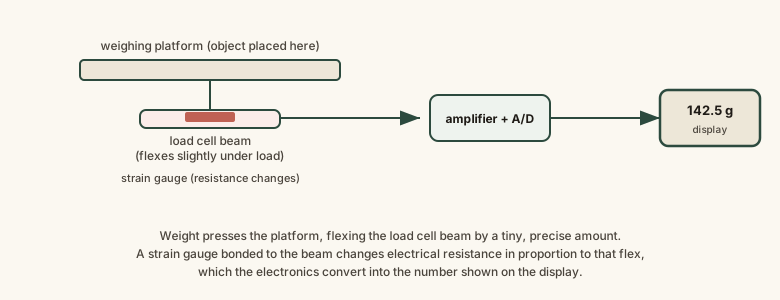
Most modern digital scales measure weight using a load cell — a metal beam that flexes slightly under load — fitted with a strain gauge whose electrical resistance changes proportionally to that flex, which the scale's electronics amplify, digitize, and convert into the number shown on the display.
Reading time
— 4 min
Updated
— Aug 21, 2026
Fact-reviewed
— Aug 21, 2026
Key Takeaways
Key Takeaways
1Most kitchen and postal scales use a load cell — a metal beam that flexes by a microscopic, precise amount under weight — fitted with a strain gauge that turns that flex into an electrical signal.
2The scale's electronics amplify the tiny voltage change from the strain gauge, convert it to a digital number, and apply a calibration factor to display the result in grams, ounces, or pounds.
3Postal scales work on the exact same underlying principle as kitchen scales — the meaningful difference is calibration range and legal certification for commercial use, not the sensing mechanism itself.
The concept
A digital scale has a small metal component called a load cell underneath the platform. When you set something on the scale, the load cell bends very slightly — far too little to see — and an electronic sensor measures exactly how much it bent. The scale's internal computer converts that measurement into the weight shown on the display.
Quick check
What physically changes inside a digital kitchen scale when you place an item on it?
Worked examples
Example 1: Reading a straightforward kitchen scale measurement (baseline case)
A baker places a bowl of flour on a digital kitchen scale, which reads 142.5 g. Internally, the flour's weight flexed the load cell, the strain gauge's resistance shifted proportionally, the amplifier and analog-to-digital converter processed that shift, and the pre-calibrated conversion factor turned the digital signal into the 142.5 g figure shown — all in a fraction of a second.
Example 2: Why taring works, and what it actually zeroes out (edge case / variation)
A baker places an empty 200 g mixing bowl on the scale, then presses "tare," which resets the display to 0 g even though the load cell is still physically flexed by the bowl's weight. The scale has simply stored that flexed baseline internally and now subtracts it from every future reading. Adding 300 g of flour then displays 300 g, not 500 g — the scale is still measuring the full 500 g of physical force on the load cell, but reporting only the difference from the stored baseline.
Quick check
After taring a scale with an empty bowl on it, why does the display show 0 g even though the load cell is still under load from the bowl's weight?
Example 3: Why postal scales require certification but kitchen scales don't (real-world / applied case)
A small business owner uses an uncertified digital scale to weigh outgoing packages and calculate postage themselves, then compares it against the post office's own certified scale — the two readings differ by a few grams, enough to occasionally misjudge which postage tier a package falls into. Postal scales used commercially for calculating charges are subject to formal metrological certification (in the US, under NIST Handbook 44) precisely because their reading determines a financial transaction — a systematic bias, even a small one, becomes a real business cost over thousands of packages. A kitchen scale used only to follow a recipe carries no such certification requirement, since a few grams of drift affects nothing beyond that one dish.
How it works (visual)
Inside a digital scale: from physical flex to a displayed number
Every stage in this chain — the beam's flex, the strain gauge's resistance change, the amplified signal, the digitized value — happens automatically and near-instantly. The only step a user directly interacts with is the calibration factor baked in at manufacturing (or occasionally reset with a certified reference weight).
Common mistakes
Common Mistakes
✕
Assuming a kitchen scale reading is exact to the last decimal place regardless of what's being weighed.
→ Most consumer kitchen scales have a stated accuracy tolerance (often ±1-2 g) — treat readings as precise, not infinitely exact, especially for very small quantities.
✕
Not taring before adding ingredients to a bowl already on the scale, then subtracting the bowl's weight manually (and sometimes incorrectly).
→ Use the scale's built-in tare function instead of manual subtraction — it's designed exactly for this and eliminates a step where arithmetic errors can creep in.
✕
Using an uncertified consumer scale to calculate exact postage for commercial shipping.
→ For business shipping where postage cost depends on precise weight, use a scale that's calibrated and certified for commercial use, or verify against the carrier's own scale.
Common misconception
“Digital scales measure weight by directly sensing how much an object 'weighs' the same way our intuition imagines a scale working — as if it just 'knows' the number.”
A digital scale has no direct sense of "weight" as a concept — it only measures a tiny mechanical flex in its internal load cell, converts that flex into an electrical signal via a strain gauge, and then applies a pre-calibrated conversion factor to translate that signal into a number. The entire process is an indirect chain of physical and electronic conversions, not a direct measurement of mass or force.
Quick check
Why might a postal scale and an uncertified consumer kitchen scale give slightly different readings for the same package?
Try it yourself
Convert a scale reading using a fixed conversion factor
Converted value5.03
What to do next
What to do next
Use your scale's tare function instead of manually subtracting a container's weight — it's exactly what the feature exists for.
If precision matters (baking, dosing, shipping cost), check your scale's stated accuracy tolerance rather than assuming perfect precision.
For business or postage use, prefer a certified commercial scale over an uncertified consumer one, since certification directly addresses calibration drift.
Periodically check a scale's accuracy against a known reference weight (even a labeled grocery item) if it's used for anything precision-sensitive.
FAQ
FAQ
Related terms
Related terms
Load cell
A metal structural component in a digital scale that flexes by a tiny, precise, repeatable amount under an applied weight — the physical sensor at the core of most modern scales.
Strain gauge
A thin resistive element bonded to a load cell that changes its electrical resistance in proportion to how much the load cell flexes, converting a mechanical deformation into a measurable electrical signal.
Tare (taring)
Zeroing out a scale's reading with a container already on the platform, so the displayed weight reflects only the contents added afterward, not the container itself.
This entry was researched from public sources and drafted with AI-assisted tools, then edited — errors are still possible. Spot one, or want a topic covered? Read our disclaimer.
 KnowThis