 KnowThis
Key Takeaways
Key Takeaways
- 1Carat (used for gemstones) is a unit of weight, standardized as exactly 0.2 grams — a 2-carat diamond has a mass of 0.4 grams.
- 2Karat (used for gold) is a purity scale out of 24 parts, not a weight at all — 18K gold is 18 parts gold and 6 parts other metal by mass, or 75% pure.
- 3Precious metals are commonly weighed in troy ounces (≈31.1 g), a different and heavier unit than the everyday avoirdupois ounce (≈28.35 g) used for food and general goods — mixing the two up misstates a metal's price or weight by about 10%.
The concept
A jeweler describes a ring as '2 carats, 18 karat gold.' What do these two numbers actually describe?
Worked examples
Example 1: Converting a diamond's carat weight to grams (baseline case)
Example 2: Calculating the actual gold content of an 18K item by weight (edge case / variation)
A 20 gram bracelet is marked 18K gold. How much of that 20 grams is actually pure gold?
Example 3: Why gold prices are always quoted per troy ounce, not per avoirdupois ounce (real-world / applied case)
How it works (visual)
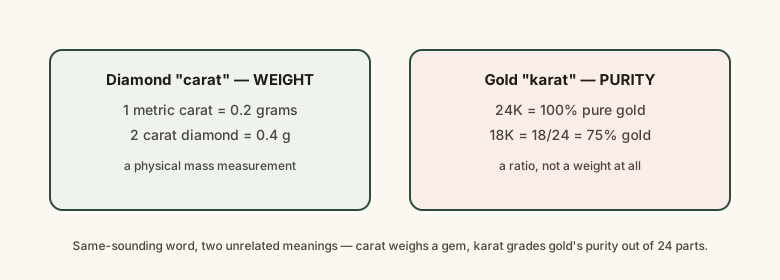
Carat is always a weight (grams), regardless of what gemstone is being described. Karat is always a purity ratio (out of 24), regardless of the item's total weight. Neither figure can be derived from the other — they answer completely different questions.
Common mistakes
Common Mistakes
Treating 'carat' and 'karat' as spelling variants of the same concept.
→ Carat is always a weight (0.2 g), used for gemstones. Karat is always a purity ratio (out of 24), used for gold. They apply to different materials and measure different physical properties.
Reading a karat figure as a direct percentage without dividing by 24 first.
→ Convert karat to a percentage by dividing by 24 (e.g., 18K = 18/24 = 75%), then apply that percentage to the item's actual weight to find the pure-metal content.
Using the everyday avoirdupois ounce (≈28.35 g) when calculating precious-metal prices quoted 'per ounce.'
→ Precious-metal prices almost always use the troy ounce (≈31.1035 g) — check which ounce is meant before doing any price-per-gram math.
Common misconception
“A larger karat number on a piece of gold jewelry means it's a bigger, heavier piece.”
Karat has nothing to do with size or weight — a tiny 24K gold stud earring is purer (but not larger) than a much bigger 14K gold necklace. Karat measures only what fraction of the metal's mass is actually gold, completely independent of how much the item weighs overall.
Why does gold priced 'per ounce' in the news use a different gram figure than an everyday 'ounce' of food?
Try it yourself
What to do next
What to do next
- Remember carat = weight (0.2 g each), karat = purity (out of 24) — they never describe the same thing, even on the same piece of jewelry.
- To find actual gold content, divide the karat number by 24 and multiply by the item's total weight.
- When comparing precious-metal prices, confirm whether the figure is per troy ounce (≈31.1 g) or per avoirdupois ounce (≈28.35 g) before doing any math.
- Use the calculator above with 0.2 for carat-to-gram conversions, or 31.1035 for troy-ounce-to-gram conversions.