 KnowThis
Key Takeaways
Key Takeaways
- 1The metric tonne (1,000 kg, ≈2,204.62 lb), the US short ton (2,000 lb, ≈907.18 kg), and the UK long ton (2,240 lb, ≈1,016.05 kg) are three genuinely different units, all commonly just called 'a ton.'
- 2The metric tonne is the heaviest-sounding name but sits in the middle by actual weight — the UK long ton is the heaviest of the three, and the US short ton is the lightest.
- 3The gap between the lightest (short ton) and heaviest (long ton) is about 12%, large enough to matter significantly in bulk freight, commodities, and industrial contexts.
The concept
Which of the three 'ton' units is the heaviest, and which is the lightest?
Worked examples
Example 1: Converting a metric tonne to kilograms and pounds (baseline case)
Example 2: The same nominal '10 tons' meaning two different weights (edge case / variation)
A US shipment and a UK historical record both list '10 tons.' Why might these represent different actual weights?
Example 3: Why bulk commodity contracts specify the ton type explicitly (real-world / applied case)
How it works (visual)
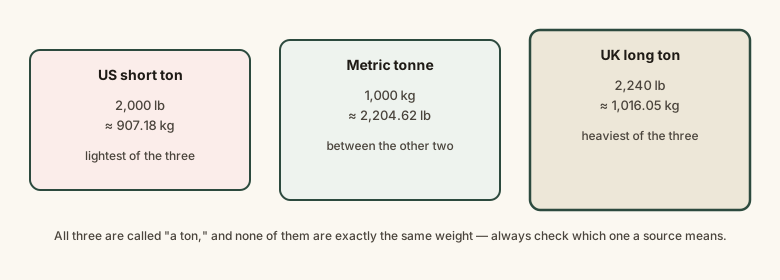
None of the three boxes are the same size, despite all three being commonly called "a ton" in casual speech — which is exactly why serious commercial and scientific writing specifies which one is meant.
Common mistakes
Common Mistakes
Treating a bare 'ton' figure from an unspecified source as automatically meaning the metric tonne (or automatically meaning the US short ton).
→ Check the source's country of origin and industry convention — US sources typically default to the short ton, while most of the rest of the world defaults to the metric tonne.
Assuming 'ton' and 'tonne' are just alternate spellings of the identical unit.
→ Treat the -ne spelling ('tonne') as a signal for the metric tonne specifically, and 'ton' (no -ne) as likely referring to a short or long ton — though always verify rather than assuming from spelling alone.
Averaging or blending figures from sources using different ton definitions without converting them to a common unit first.
→ Convert every figure to a single common unit (kilograms is usually safest) before combining, comparing, or totaling ton-denominated figures from multiple sources.
Common misconception
“Since a 'ton' is roughly 2,000-2,200 pounds no matter which version you mean, the differences are too small to matter in practice.”
A roughly 12% gap between the lightest (US short ton, 2,000 lb) and heaviest (UK long ton, 2,240 lb) definitions is large at commercial and industrial scale — on a single 50,000-ton bulk shipment, that gap represents millions of kilograms of discrepancy. The differences are small only in the sense that the three units sound similar; the actual weight gap is entirely large enough to cause real financial and logistical errors if left unspecified.
Why do serious international shipping and commodity contracts specify 'metric tonnes' or 'short tons' explicitly rather than just writing 'tons'?
Try it yourself
What to do next
What to do next
- Never treat a bare 'ton' figure as unambiguous — check whether it's a metric tonne, US short ton, or UK long ton before using it in a calculation.
- When writing or reading contracts involving bulk weight, use (or look for) explicit unit names: 'metric tonnes,' 'short tons,' or 'long tons.'
- Convert every ton figure to a common base unit (kilograms is usually safest) before combining or comparing values from different sources.
- Remember the ranking: UK long ton (2,240 lb) > metric tonne (≈2,204.62 lb) > US short ton (2,000 lb).