 KnowThis
Key Takeaways
Key Takeaways
- 1A liter converts to gallons the same way as any unit conversion — multiply by a fixed factor — but "gallon" secretly refers to two different sizes depending on country.
- 21 US gallon = 3.78541 liters, but 1 UK imperial gallon = 4.54609 liters — about 20% larger, because the two countries defined the unit differently and never reconciled it.
- 3The UK sells fuel in liters but still often reports fuel economy in "miles per gallon" using the larger imperial gallon, which makes UK mpg figures not directly comparable to US mpg figures for the same real efficiency.
The concept
Because the size difference is real and not just a rounding quirk, the practical skill here isn't just doing the multiplication — it's knowing which gallon you're actually being asked to convert.
A UK recipe blog and a US recipe blog both list an ingredient as '1 gallon.' Do they mean the same volume?
Worked examples
Example 1: Converting a US gallon water jug to liters (baseline case)
Example 2: Comparing UK "mpg" to US "mpg" for the same real fuel efficiency (edge case / variation)
Why can a car advertised as '35 mpg' in the UK and a car advertised as '29 mpg' in the US potentially be equally fuel-efficient?
Example 3: Sizing a home water heater tank listed only in liters for a US buyer (real-world / applied case)
How it works (visual)
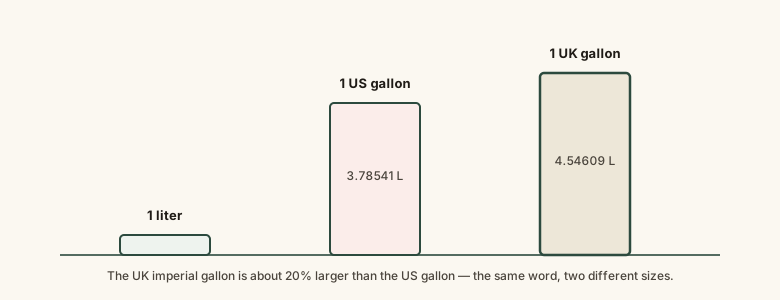
The visual gap between the US and UK bars is the entire lesson: both are called "gallon," both are real legal units, and neither can be substituted for the other without a real, roughly 20% error.
Common mistakes
Common Mistakes
Assuming 'gallon' always means the US gallon, especially when reading a UK or older Commonwealth source.
→ Check the source's country before converting — if it's UK-published and pre-metric-era or automotive, it may mean the imperial gallon.
Comparing US mpg and UK mpg figures directly without converting to a common unit first.
→ Convert both to liters per 100 km (or km per liter) before comparing fuel efficiency across countries.
Rounding 3.78541 down to 'about 3.8' or even '4' for large-volume conversions.
→ Use the full-precision factor when the total volume is large — a small per-gallon rounding error compounds across many gallons.
Common misconception
“A gallon is a gallon — it's a standard unit like a meter, so it means the same thing everywhere.”
Unlike the meter (defined once, internationally, via the speed of light), the gallon was never unified between the US and UK. The US gallon (3.78541 L) and the UK imperial gallon (4.54609 L) are both real, legally defined units that happen to share an English word — they are not interchangeable, and converting with the wrong one produces a wrong answer that looks perfectly reasonable.
You're converting a European car's 55-liter fuel tank to gallons for a US audience. Which factor should you use?
Try it yourself
What to do next
What to do next
- Before converting any 'gallon' figure, confirm whether the source is US or UK/Commonwealth in origin.
- Memorize the two anchor numbers: 1 US gallon = 3.78541 L, 1 UK gallon = 4.54609 L.
- When comparing fuel efficiency across countries, convert both to liters per 100 km rather than trusting raw 'mpg' numbers.
- Use the calculator above with the correct factor for your target gallon definition, not a rounded approximation.