 KnowThis
Key Takeaways
Key Takeaways
- 1Engine displacement and fuel tank size are both volume measurements — converting between liters, cubic centimeters, and cubic inches is ordinary unit conversion, not a difference in the underlying quantity.
- 21 liter = 1,000 cubic centimeters (cc) exactly, since both are metric; 1 cubic inch = 16.387 cc, a fixed non-metric conversion factor.
- 3A classic American 'small block 350' engine (350 cubic inches) and a modern '5.7-liter' engine spec describe the same displacement — 350 × 16.387 ≈ 5,735 cc ≈ 5.7 liters — just using two different unit-era conventions.
The concept
The one place this trips people up in practice is when comparing specs pulled from sources of different eras or regions without first converting them to a common unit.
A car enthusiast forum debates whether a '454' engine (454 cubic inches) or a '7.4-liter' engine is bigger. What's the actual answer?
Worked examples
Example 1: Converting a 2.0-liter engine to cubic inches (baseline case)
Example 2: A motorcycle spec sheet mixing cc and liters within the same market (edge case / variation)
Why might a shopper underestimate the displacement gap between a '600cc' motorcycle and a '1.0-liter' motorcycle?
Example 3: Sizing a fuel tank for a cross-border road trip (real-world / applied case)
How it works (visual)
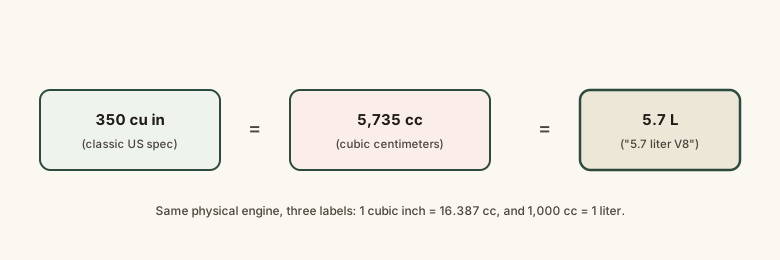
All three boxes describe the identical physical engine — the diagram exists specifically to make the point that changing the unit label doesn't change what's inside the block.
Common mistakes
Common Mistakes
Comparing a cc figure and a liter figure without converting them to the same unit first.
→ Convert to a common unit before comparing — remember 1,000 cc = 1 liter.
Assuming a cubic-inch spec from an older source can't be compared to a modern liter spec.
→ Use the fixed factor 1 cubic inch = 16.387 cc (then divide by 1,000 for liters) — it converts cleanly regardless of era.
Assuming bigger displacement numbers always mean a bigger real-world engine when units differ.
→ Check the unit before comparing numbers — '600' (cc) is smaller than '1.0' (liters), not bigger, despite looking like the larger digit sequence.
Common misconception
“Engines measured in cubic inches, cc, and liters are fundamentally different kinds of specifications that can't be directly compared.”
All three are simply volume measurements of the same physical quantity — displacement — expressed in different unit systems. A cubic-inch spec from a 1970s American muscle car and a liter spec from a modern engine both describe swept cylinder volume, and convert cleanly into each other with fixed factors (1 cubic inch = 16.387 cc, 1,000 cc = 1 liter). There is no separate "cubic-inch kind of displacement" distinct from a "liter kind."
Someone claims a '5.0-liter' modern engine and a '302 cubic inch' classic engine 'measure completely different things' and can't be compared. Is this correct?
Try it yourself
What to do next
What to do next
- Remember 1,000 cc = 1 liter exactly, and 1 cubic inch = 16.387 cc.
- Always convert engine specs to the same unit before comparing displacement across eras or markets.
- When renting or researching a foreign-market vehicle, convert its liter-based fuel tank size to gallons for an intuitive sense of range.
- Use the calculator above with the correct factor for the two units you're actually comparing.