 KnowThis
Key Takeaways
Key Takeaways
- 1A US fluid ounce (29.5735 mL) is larger than a UK fluid ounce (28.4131 mL) — about a 4.1% difference.
- 2This is the reverse of the gallon relationship: the UK gallon is bigger than the US gallon, but the UK fluid ounce is smaller than the US fluid ounce.
- 3The reversal happens because the US gallon splits into 128 fluid ounces while the UK gallon splits into 160 — dividing a smaller gallon into fewer pieces (US) can still yield a bigger piece than dividing a bigger gallon into more pieces (UK).
The concept
The practical risk shows up whenever a US-labeled beverage or recipe amount (in fl oz) gets read by someone assuming the UK definition, or vice versa — a small per-unit gap that compounds across a larger total.
Given that the UK gallon (4.54609 L) is larger than the US gallon (3.78541 L), why is the UK fluid ounce smaller than the US fluid ounce?
Worked examples
Example 1: Converting a US 12 fl oz soda can to milliliters (baseline case)
Example 2: Comparing a US 16 fl oz bottle to a UK 16 fl oz (pint) bottle (edge case / variation)
A US product and a UK product are both labeled '8 fl oz.' Which one contains more liquid?
Example 3: A bartender following a US cocktail recipe with UK-labeled jiggers (real-world / applied case)
How it works (visual)
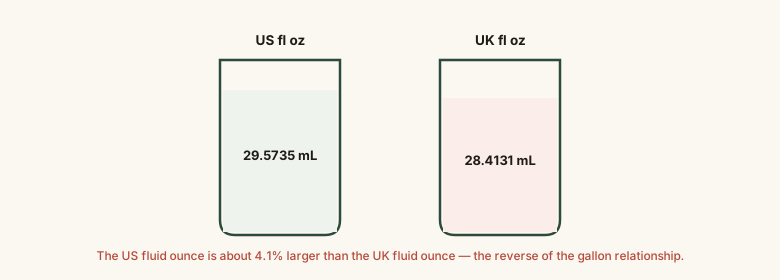
Unlike the gallon comparison, where the UK bar was visibly taller, here the US beaker is the fuller one — a useful visual reminder that the direction of the size difference flips depending on which unit in the chain you're comparing.
Common mistakes
Common Mistakes
Assuming that because the UK gallon is bigger, every UK volume unit derived from it is also bigger.
→ Check each unit individually — the UK fluid ounce is actually smaller than the US fluid ounce, even though the UK gallon is larger.
Treating a '16 fl oz' or '2 fl oz' label as unambiguous without checking the country of origin.
→ Look for context clues (brand origin, other metric labeling) to determine whether a fl oz figure is US or UK, especially for recipes or bartending measures.
Confusing the fluid ounce (a volume unit) with the ordinary ounce (a weight unit).
→ Remember 'fluid ounce' measures volume; a plain 'ounce' on a food label measures weight — they're related by design for water but not interchangeable in general.
Common misconception
“Since the UK gallon is bigger than the US gallon, every UK unit built from the gallon must also be bigger than its US counterpart.”
Whether a UK derived unit ends up bigger or smaller than its US counterpart depends on how many pieces each country splits its own gallon into, not just which gallon is bigger. The UK gallon is split into more fluid ounces (160) than the US gallon (128), which is enough to flip the comparison — the US fluid ounce (29.5735 mL) ends up larger than the UK fluid ounce (28.4131 mL), even though the US gallon itself is smaller.
Why can't you assume a UK-derived unit is always bigger than its US equivalent just because the UK gallon is bigger than the US gallon?
Try it yourself
What to do next
What to do next
- Memorize both anchor figures: US fl oz = 29.5735 mL, UK fl oz = 28.4131 mL.
- Don't assume a UK-derived unit is bigger just because the UK gallon is bigger — check each unit's actual figure.
- When following a recipe or cocktail spec with 'fl oz,' confirm the country of origin before measuring.
- Use the calculator above with the correct fl oz factor rather than treating '29.5' as a universal rounding.