 KnowThis
Key Takeaways
Key Takeaways
- 1The US customary system defines two separate volume-unit families — dry measure and liquid measure — that share names like pint and quart but are not the same size.
- 2A dry quart (1.101 L) is about 16.4% larger than a liquid quart (0.946 L); the same gap scales up through pints, gallons-equivalents, and the dry-only peck and bushel.
- 3In an ordinary kitchen, the 'cup' used for flour and the 'cup' used for water are actually the same volume unit (236.588 mL) — the real dry/liquid split shows up at the pint-and-larger scale, in agricultural and produce measurement, not at the cup level.
The concept
The part that surprises most home cooks is that the dry/liquid split barely matters at the scale they actually cook at — the confusion is really about technique, not the unit itself.
A recipe calls for '1 cup of flour' and '1 cup of milk.' Are these two different-sized cups, given that flour is a dry good and milk is a liquid?
Worked examples
Example 1: Converting a dry quart of berries to liters (baseline case)
Example 2: Why a 'bushel of corn' and a 'bushel of wheat' aren't the same weight (edge case / variation)
Why can 100 bushels of wheat and 100 bushels of corn weigh different total amounts if a bushel is a fixed volume?
Example 3: A grocery store berry display mixing dry-quart and liquid-quart language (real-world / applied case)
How it works (visual)
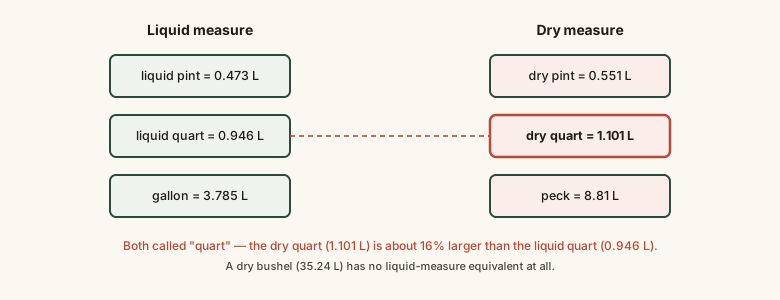
The dry column also extends further than the liquid column — the peck and bushel have no liquid-measure counterpart at all, since they exist specifically for large-volume dry goods trade.
Common mistakes
Common Mistakes
Assuming a produce 'quart' (berries, tomatoes) is the same size as a liquid quart (milk).
→ Produce quarts are dry quarts (1.101 L) by trade convention — about 16% larger than the liquid quart (0.946 L) used for beverages.
Thinking home kitchen cooking uses a separate 'dry cup' and 'liquid cup' of different sizes.
→ Both use the same 236.588 mL US cup — the real difference at cup scale is measuring technique, not unit size.
Assuming a bushel of any crop weighs the same amount.
→ A bushel is a fixed volume, but its standardized weight is crop-specific — 56 lbs for corn, 60 lbs for wheat, and so on.
Common misconception
“Dry measuring cups and liquid measuring cups hold different amounts, which is why recipes tell you to use the 'right one.'”
A US dry measuring cup and a US liquid measuring cup hold the identical 236.588 mL — the difference is shape and reading method, not volume. A dry measuring cup has a flat rim so you can level off the excess with a straight edge; a liquid measuring cup has a spout and extra headroom so you can read the fill line at eye level without spilling. The true dry/liquid unit-size split (pint, quart, peck, bushel) exists at a larger, mostly agricultural scale, not in the home kitchen.
What's the actual difference between a 'dry measuring cup' and a 'liquid measuring cup' sold at a kitchen store?
Try it yourself
What to do next
What to do next
- Remember produce sold by the 'quart' or 'pint' at a market is almost always the dry measure, not the liquid measure.
- Don't worry about a dry/liquid split at kitchen-cup scale — the US cup is one size (236.588 mL) regardless of ingredient.
- If converting a large agricultural quantity (bushels, pecks), check whether you need the volume or the crop-specific standardized weight.
- Use the calculator above with 1.101 for dry quarts or 0.946 for liquid quarts, not a single generic 'quart' factor.