 KnowThis
Key Takeaways
Key Takeaways
- 1US cooking measures nest in clean whole-number ratios: 1 cup = 16 tablespoons = 48 teaspoons, all built from a single base unit multiplied by small integers.
- 2The tablespoon is not a single global size — the US and UK use 15 mL (technically 14.7868 mL in the US, 15 mL exactly in the UK/metric world), while Australia defines its tablespoon as 20 mL, equal to 4 teaspoons instead of 3.
- 3Because the Australian tablespoon breaks the clean ×3 ratio other countries share, an Australian recipe read as if it used a US tablespoon will over-measure any ingredient given in tablespoons by about a third.
The concept
The whole-number nesting inside one country's system is genuinely reliable — the risk is entirely in assuming that nesting holds true across country lines.
An Australian recipe calls for 2 tablespoons of oil. If you measure it with a US tablespoon (15 mL) instead of the intended Australian tablespoon (20 mL), what happens?
Worked examples
Example 1: Converting cups to tablespoons within the US system (baseline case)
Example 2: Converting an Australian tablespoon amount into US teaspoons (edge case / variation)
Why is converting through milliliters safer than converting directly between an Australian tablespoon amount and US teaspoons?
Example 3: Scaling a US recipe that also lists a metric cup conversion (real-world / applied case)
How it works (visual)
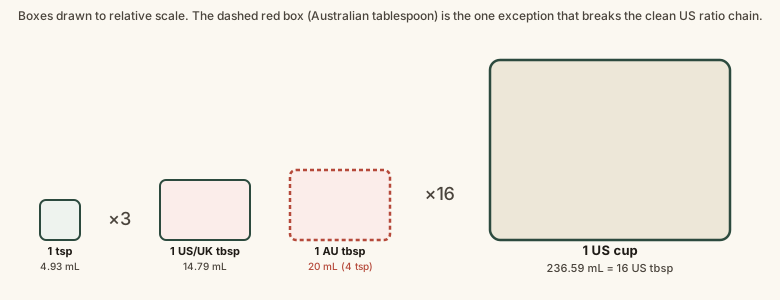
The dashed box in the diagram is deliberately drawn slightly larger and off to the side — it's the one unit in the chain that doesn't fit the otherwise clean ×3, ×16 nesting pattern.
Common mistakes
Common Mistakes
Treating every country's tablespoon as the same 15 mL size.
→ Check the recipe's country of origin — Australian recipes use a 20 mL tablespoon, about a third larger than the US/UK version.
Assuming a US cup and a metric/Commonwealth cup are interchangeable.
→ Remember the US cup is 236.588 mL while the common metric cup is 250 mL — about a 5.6% difference that adds up when scaling a recipe.
Skipping the milliliter conversion step when comparing measures across countries.
→ Convert both measures to milliliters first, then compare — it's the one unit that means the same thing everywhere.
Common misconception
“A tablespoon is a tablespoon — cooking measurement words describe fixed, universal amounts.”
Cooking-spoon units are standardized only within a country's own system, not internationally. The US and UK tablespoon (about 15 mL) and the Australian tablespoon (20 mL) are both real, standard, everyday units — just different sizes wearing the same name. The same is true for the "cup": 236.588 mL in the US versus 250 mL in most of the rest of the metric-using world.
A US recipe and its metric conversion both say '2 cups (473 mL) flour.' A cook uses a 250 mL metric measuring cup and pours exactly 2 of them. What happens?
Try it yourself
What to do next
What to do next
- Memorize the US chain: 1 cup = 16 tablespoons = 48 teaspoons.
- Check a recipe's country of origin before trusting 'tablespoon' — Australian recipes mean 20 mL, not 15 mL.
- When scaling or converting across countries, go through milliliters as the unambiguous common unit.
- Remember the US cup (236.588 mL) and the common metric cup (250 mL) aren't the same size either.