Converting a recipe between countries means handling two separate problems at once: converting the units themselves (cups to milliliters, ounces to grams) and converting between measuring by volume (the US convention) and measuring by weight (the convention almost everywhere else), which is the more consequential difference for baking accuracy.
Reading time
— 4 min
Updated
— Aug 21, 2026
Fact-reviewed
— Aug 21, 2026
Key Takeaways
Key Takeaways
1Converting a recipe between countries involves two separate problems: converting the units themselves, and converting between volume-based measuring (US convention) and weight-based measuring (used almost everywhere else).
2A US 'cup' of flour has no single fixed weight — it commonly ranges from about 120 to 150 grams depending on how tightly the flour is packed, which is why weight-based recipes are inherently more repeatable.
3Scaling a recipe up or down (doubling it, halving it) is simple multiplication of every ingredient by the same ratio — the country-conversion problem and the scaling problem are independent and can be handled in either order.
The concept
A recipe from another country needs two kinds of conversion: unit conversion (cups to milliliters, ounces to grams — ordinary multiplication by a fixed factor) and a bigger structural difference — most of the world weighs dry ingredients like flour and sugar on a kitchen scale, while US recipes traditionally scoop them by volume using volume-based measuring. The volume method is the less precise one, because how tightly an ingredient is packed into the cup changes its actual weight.
Once you separate the two problems — units, and volume-vs-weight — converting any recipe becomes a matter of doing each conversion carefully rather than guessing at a single blended adjustment.
Quick check
Why is a European recipe listing '120g flour' generally more reliable to follow exactly than a US recipe listing '1 cup flour'?
Worked examples
Example 1: Scaling a recipe from 4 servings to 6 (baseline case)
A recipe uses 2 cups of flour for 4 servings. Scaling to 6 servings: 2 × (6 ÷ 4) = 3 cups. Every ingredient in the recipe gets multiplied by the same 1.5 ratio — this scaling step is entirely independent of whether the recipe is in cups, grams, or any other unit.
Example 2: Converting a UK recipe's 250g flour into US cups (edge case / variation)
A UK recipe calls for 250 grams of flour. Using a standard reference density of about 120 grams per US cup for spooned-and-leveled all-purpose flour: 250 ÷ 120 ≈ 2.08 cups — an inconvenient, non-round number, which is normal and expected, since grams-to-cups conversion for a compressible ingredient is always an approximation, not an exact factor like liters-to-gallons. If the same flour were packed rather than spooned (closer to 150 g/cup), the same 250 g would appear to be only about 1.67 cups — a real discrepancy that shows why professional sources always specify (or assume) the spoon-and-level method for their gram-per-cup references.
Quick check
Why doesn't converting grams of flour to cups have one single, universally exact conversion factor, unlike converting liters to gallons?
Example 3: A US baker following a French pastry recipe exactly (real-world / applied case)
A French recipe specifies 500 grams of flour, 300 grams of butter, and 10 grams of salt — all by weight. A US baker without a kitchen scale estimating by cups introduces packing-variance error on every dry ingredient simultaneously; a baker using a scale and the recipe's original gram figures reproduces the exact same ratios the recipe author used, regardless of which country either of them is in. This is the practical case for buying an inexpensive kitchen scale rather than relying on cup-to-gram conversion tables at all for weight-original recipes.
How it works (visual)
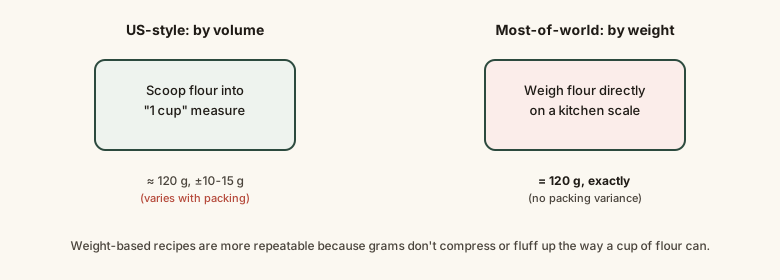
Volume-based vs weight-based measuring for the same cup of flour
Both paths can produce the same 120 grams — the diagram's point is that only the weight-based path guarantees it every time, regardless of who's doing the scooping.
Common mistakes
Common Mistakes
✕
Treating a 'cup of flour' as a fixed, precise weight when converting a recipe.
→ Use a gram figure and a kitchen scale whenever a recipe's original measurements were by weight, rather than converting to cups and back.
✕
Scaling a recipe's ingredients by different ratios instead of one consistent multiplier.
→ Apply the exact same scaling ratio (new servings ÷ original servings) to every single ingredient.
✕
Assuming there's one universal 'grams per cup' figure for every dry ingredient.
→ Look up (or weigh) the specific ingredient — flour, sugar, and cocoa powder all have different densities per cup.
Common misconception
“Converting a recipe between countries is just a matter of applying the right cups-to-grams conversion factor, like converting miles to kilometers.”
Unlike miles to kilometers, which have one fixed, exact conversion factor, converting cups of a dry ingredient to grams depends on the ingredient's density as packed into the cup — which isn't fixed. There's no single "correct" number, only reasonable reference approximations (like ~120g per cup of spooned-and-leveled flour). The more reliable fix isn't a better conversion factor — it's using a kitchen scale and the recipe's original weight figures whenever they're available.
Quick check
What's the most reliable way to follow a recipe originally written in grams if you're used to cooking by volume (cups)?
Try it yourself
Scale a recipe ingredient to a new number of servings
Scaled quantity3
What to do next
What to do next
For any recipe originally written in grams, use a kitchen scale rather than converting to cups.
When you must convert cups to grams, use a reputable per-ingredient reference (flour, sugar, and butter all differ) rather than a single blanket figure.
Scale ingredients by multiplying every single one by the same ratio (new servings ÷ original servings).
Use the calculator above to scale any single ingredient consistently before shopping or prepping.
FAQ
FAQ
Related terms
Related terms
Volume-based measuring
Measuring an ingredient by how much space it occupies (cups, tablespoons), the dominant home-cooking convention in the United States.
Weight-based measuring
Measuring an ingredient by mass (grams, ounces) using a kitchen scale, the dominant convention outside the United States, generally more precise for dry ingredients like flour.
This entry was researched from public sources and drafted with AI-assisted tools, then edited — errors are still possible. Spot one, or want a topic covered? Read our disclaimer.
 KnowThis