Medicine Dosing Units Explained (mL, mg — General Literacy)
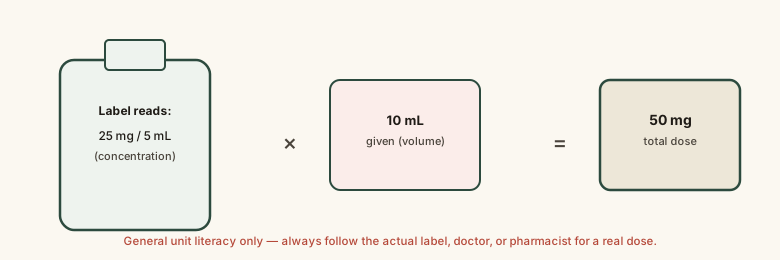
Liquid medicine labels carry two different kinds of unit: milligrams (mg), which describe the amount of active drug, and milliliters (mL), which describe the volume of liquid carrying it — reading a dose correctly means multiplying a concentration (mg per mL) by a volume (mL given) to get a total dose (mg), not treating the two units as interchangeable.
Reading time
— 5 min
Updated
— Aug 21, 2026
Fact-reviewed
— Aug 21, 2026
This entry explains how dosing units and math work — it is general measurement literacy, not medical advice. Never use figures on this page to determine a real dose for yourself, a child, or anyone else. Always follow the exact instructions on the product label, or ask a doctor or pharmacist.
Key Takeaways
Key Takeaways
1Liquid medicine labels mix two different kinds of unit: milligrams (mg), the amount of actual drug, and milliliters (mL), the volume of liquid you measure out — they are not interchangeable.
2The relationship is: dose in mg = concentration (mg per mL) × volume given (mL). Reading a label means finding both numbers and multiplying them, not assuming the mL figure alone is 'the dose.'
3A dosing spoon, oral syringe, or dosing cup marked in mL is the accurate tool — a kitchen teaspoon can vary in real volume by 20% or more and should never be used for medicine.
The concept
A liquid medicine label typically shows a concentration like "25 mg / 5 mL," meaning every 5 milliliters of the liquid contains 25 milligrams of the actual medicine. The dose you actually receive depends on how many milliliters you measure out — pouring 10 mL of that same liquid delivers 50 mg, not 25 mg, because you doubled the volume. Reading these two numbers correctly, and knowing which one the product label or instructions are actually specifying, is the entire skill.
None of this is about doing harder math — it's about correctly identifying which printed number is the concentration and which is the volume, since a label with two numbers on it is easy to misread under time pressure.
Quick check
A label reads '25 mg / 5 mL.' If someone measures out and gives 5 mL, how much active medicine (in mg) have they given?
Worked examples
Example 1: Reading a concentration and volume to find total dose (baseline case, illustrative numbers only)
A label reads "25 mg / 5 mL." That means the concentration is 25 ÷ 5 = 5 mg per mL. If a product's instructions (not this page) specify giving 10 mL, the total dose is 5 mg/mL × 10 mL = 50 mg. This is a straightforward multiplication once the concentration and the volume are correctly identified as two separate numbers.
Example 2: Two products with the same total mg dose but different concentrations (edge case / variation, illustrative only)
Product A is 25 mg/5 mL; Product B (a different, more concentrated formulation of the same medicine) is 25 mg/1 mL. Giving 5 mL of Product A delivers 25 mg — but giving 5 mL of Product B would deliver 125 mg, five times as much, because its concentration is five times higher. This is exactly why product-specific instructions must always be followed exactly, and why a volume that was safe for one product's concentration can be unsafe for a differently concentrated version of what looks like "the same medicine."
Quick check
Why is it dangerous to assume that 'the same volume' (say, 5 mL) always delivers 'the same dose' across different liquid medicine products?
Example 3: Why a kitchen teaspoon is not an acceptable substitute for a dosing device (real-world / applied case)
A liquid medicine's instructions specify a dose in mL, assuming use of the calibrated dosing device provided with the product. Measurement studies cited by health agencies have found ordinary household teaspoons can hold anywhere from about 4 to 9 mL depending on the specific spoon — meaning the identical instruction, followed with an untrustworthy tool, can deliver a dose that's roughly half or nearly double what was intended. This is precisely why health agencies emphasize using the marked oral syringe, dosing cup, or dosing spoon that ships with the product rather than any kitchen utensil.
How it works (visual)
Concentration × volume given = total dose
The diagram's arithmetic (concentration × volume = dose) is the same relationship covered in the calculator below, just expressed the other way around — as a per-kilogram dosing rate rather than a per-mL concentration, which is how many real dosing instructions are actually written for illustrative unit-literacy purposes.
Common mistakes
Common Mistakes
✕
Reading the mg number on a label as if it were the number of mL to give.
→ Identify both numbers separately — the mg figure is the drug amount inside a stated mL volume, not the volume itself.
✕
Using an ordinary kitchen teaspoon to measure a liquid dose.
→ Always use the calibrated dosing device (oral syringe, dosing cup, or dosing spoon) provided with the product.
✕
Assuming the same mL volume gives the same dose across different products or strengths.
→ Check the specific product's concentration every time — never reuse a volume figure from a different product or strength.
Common misconception
“The numbers on a liquid medicine label are basically the same thing — mg and mL are just two ways of writing the dose.”
Milligrams and milliliters measure two different physical properties: mg measures the mass of active drug, mL measures the volume of liquid carrying it. A label pairs them as a concentration (mg per mL) precisely because neither number alone tells you the dose — you need the concentration and the actual volume given, multiplied together, to know the true amount of medicine delivered.
Quick check
What is the single most important practical takeaway from how mg and mL relate on a liquid medicine label?
Try it yourself
This calculator illustrates the arithmetic behind a weight-based dosing rate (a common way dosing instructions are structured) — it is for understanding the math only, not for determining any real dose.
Illustrative: dosing-rate math (mg per kg × body weight)
Illustrative total (mg) — not a real dose100
What to do next
What to do next
Never determine or adjust a real medicine dose using this page — always follow the product label or a doctor/pharmacist's instructions exactly.
Learn to separate the two numbers on a liquid medicine label: concentration (mg per mL) and volume given (mL).
Always use the dosing device that comes with a liquid medicine, never a kitchen teaspoon.
If a label or instruction is unclear, ask a pharmacist to walk through the exact numbers before giving any dose.
FAQ
FAQ
Related terms
Related terms
Concentration (mg/mL)
The amount of active ingredient (in milligrams) dissolved in each milliliter of a liquid medicine — the number that has to be multiplied by the volume given to find the total dose.
Dose
The total amount of active ingredient actually administered, expressed in milligrams (or micrograms), equal to concentration multiplied by volume given.
This entry was researched from public sources and drafted with AI-assisted tools, then edited — errors are still possible. Spot one, or want a topic covered? Read our disclaimer.
 KnowThis